

Publications
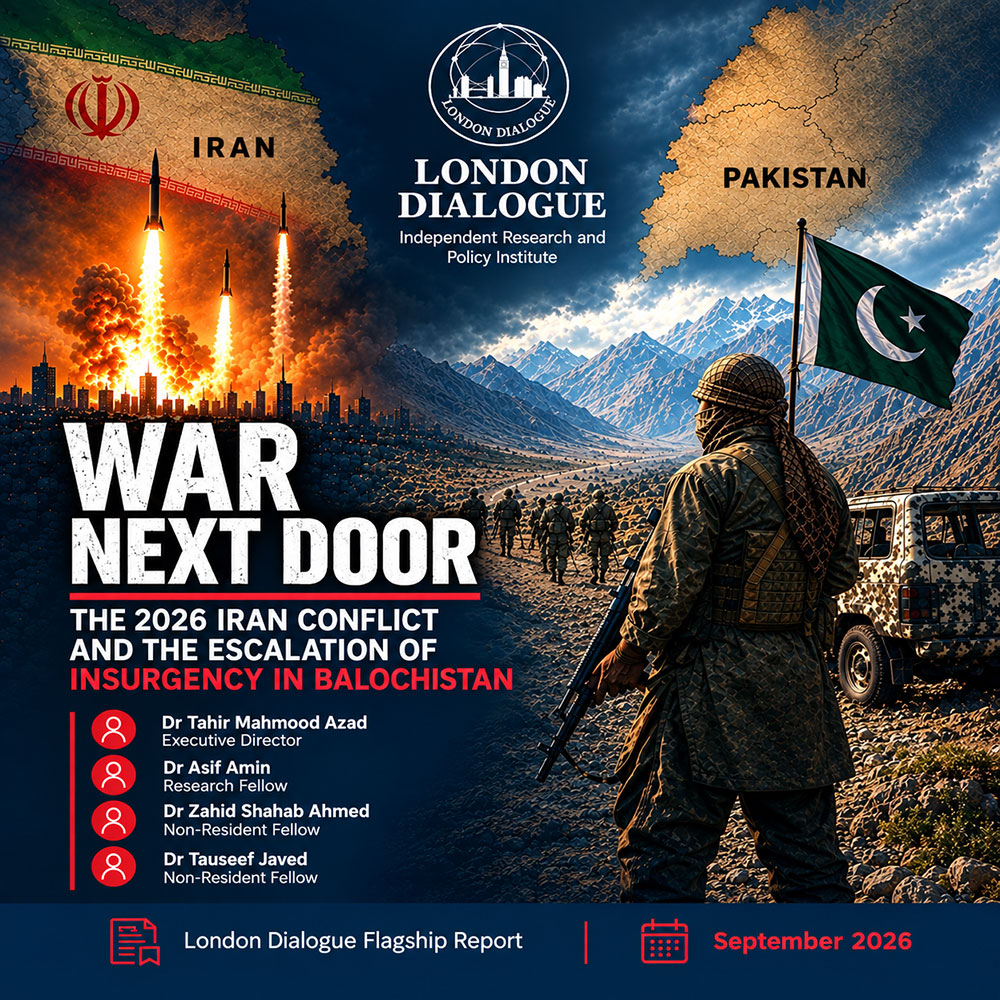
Research Report
Research Report/03/August/2026/London-Dialogue. 17 August 2026
Authors: Dr Tahir Mahmood Azad, Dr Asif Amin, Dr Zahid Shahab Ahmed and Dr Tauseef Javed.
Executive Summary
The central argument of this report is that the resurgence of armed violence in Baluchistan is domestic in origin and that its escalation across 2026 has been driven principally by the internal development of the insurgency rather than by the war across the frontier in Iran. The current wave of Baloch insurgency did not begin in 2026. It revived in the mid-2000s, gathered momentum after the launch of the China–Pakistan Economic Corridor (CPEC) in 2015, and accelerated most sharply during 2024 and 2025, well before the decisive phase of the Iran war. The organisational changes that account for the surge of 2026, the consolidation of the Baloch Raaji Aajoi Sangar alliance, the maturation of the BLA’s Majeed Brigade, the Baluchistan Liberation Front’s turn to coordinated multi-target assaults, and the spread of armed commercial drones and Afghan-sourced weapons – each followed a timeline of its own, and each was already in motion before hostilities opened in Iran. The insurgency, in short, is escalating for reasons of its own, and the clearest confirmation came after the war had ended, when militant attacks across Pakistan rose from 144 in July to 199 in August 2026, the tempo of violence climbing through the summer even as the ceasefire held.
Against that backdrop, the war next door is best understood not as a cause of the escalation, nor even as its principal external accelerant, but as a marginal, bounded factor that reaches the province through a single well-evidenced channel: the borderland fuel economy. The closure of the Strait of Hormuz and the dislocation of Iran’s exports raised the price of the smuggled Iranian fuel on which tens of thousands of frontier households depend, pushed the informal trade from five days a week to seven, and drove the borderland economy deeper into the illicit sector that armed groups tax and protect, sharpening both the material hardship and the political grievance on which recruitment feeds. A second and more modest effect followed from the weakening of Iranian control along the frontier, which eased cross-border movement at the margins without creating the sanctuary that already existed on both sides. Beyond these two channels the evidence does not reach, and this report declines the wider claims that are sometimes made, that the mediation effort distracted the state from Baluchistan, or that cross-border displacement fed the insurgency, because neither is supported by the record.
The report presents the evidence that disciplines its own argument. The largest coordinated insurgent operation on record in the province, the BLA’s twelve-district offensive of late January 2026, took place before the war’s second phase opened; the two deadliest months of the year, May and July, fell after the conditional ceasefire of 8 April and the June memorandum of understanding rather than during the fighting; and independent researchers found that armed groups inside Iran remained reluctant to engage directly. The war widened, at its margins, the space within which existing organisations operate; it did not create them, and it did not supply their motive.
That motive is domestic and documented. Baluchistan remains Pakistan’s poorest province, with an income poverty rate approaching half f its population against a national average well below thirty per cent, and a multidimensional deprivation headcount above seventy per cent, even as the province holds close to forty-four per cent of the national landmass together with much of the country’s mineral and hydrocarbon wealth. Decades of contested accession, resource grievance, political marginalisation, enforced disappearance and the conflation of peaceful dissent with terrorism have produced a reservoir of alienation that force alone cannot drain. The paradox of the security ledger makes the point plainly: the state killed militants in record numbers during 2025, and the insurgency intensified regardless, becoming through 2026 the deadliest in the country and carrying Baluchistan past Khyber Pakhtunkhwa as Pakistan’s most violent province.
The report treats seriously the Pakistani state’s contention that India seeks to exploit this instability, while noting that India denies it, that the International Court of Justice made no finding on the espionage question, and that independent assessments attribute the insurgency’s capabilities to indigenous development. External sponsorship, where it exists, works upon domestic fault lines; it does not create them, and it cannot substitute for the political failures that give it purchase.
The policy implication, developed in a sequenced framework in Section 10, is that a political crisis cannot be resolved by military means alone, and that neither the war next door nor the foreign hand should be permitted to become an alibi that displaces responsibility from where it properly lies. The province must be treated as a political question first and a security question second by restoring the primacy of elected representatives, ensuring fiscal transfers reach citizens rather than intermediaries, ending practices that manufacture grievance, and opening a credible channel of negotiation under a national compact.
Read The Report here
Tahir Azad
Related posts
Rivers as Leverage: India’s Suspension of the Indus Waters Treaty and the Logic of Hydro-Coercion in South Asia
Iraq After Operation Inherent Resolve: Testing Security and State Control
The Electrostate Thesis: Geopolitics, Clean Energy Dominance, and China’s New Global Leverage
A Last Open Letter to President Mr D. J. Trump
Iran’s Reliance on “Self-Defence” in the Shadow of “Strategic Loneliness”
From Chokepoint Diversification to Coupling: Hormuz, Bab al-Mandab and the New Fragility of Gulf Energy Security
Imran Khan’s Solitary Confinement and the Mandela Rules
The South Atlantic Flashpoint: Argentina Tests Britain, Chile, and the US
Religious Rhetoric Around the Mecca Defence Agreement and Its Long-Term Impacts for Pakistan
Operationalising The Maritime Dimension Of The Makkah Joint Defence Agreement
The Arithmetic of Saturation: What the Iran War Taught About the Limits of Layered Air Defence
Beyond the Mecca Accord: Why Pakistan Must Choose Deterrence over Entanglement in Yemen
London Dialogue — Founding Statement
Publication Categories
- Analysis (102)
- Book Review (1)
- Commentary (6)
- Essay (9)
- Journal (0)
- Journal Article (0)
- Policy Brief (6)
- Policy Paper (1)
- Research Article (2)
- Research Report (5)
- Young Writers Corner (0)