


Publications
Understanding Asim Munir’s Doctrine: Regime Security in Place of a National Goal
Tahir Azad
Analysis Series
Analysis/0079/September/2026/London-Dialogue. 07 September 2026
Abstract
This analysis assesses what may be termed the “Munir’s Doctrine” not as a formally declared doctrine, but as a pattern of political, constitutional, strategic and security behaviour associated with the leadership of General Asim Munir. It evaluates Munir’s doctrine across the international, regional, and domestic domains and reaches a single conclusion: the doctrine advances no national direction and sets no discernible goal for Pakistan beyond the accumulation and protection of the power of one office. Its most tangible product is not a policy but a sequence of constitutional and statutory changes, the 26th and 27th Amendments, the restructuring of the National Command Authority, and the amendment of the Defence Forces Act, which together transfer decisive authority to the Army Chief personally while delivering no measurable benefit to the state, a judgement now conceded from within the government itself. Measured against performance, the record is one of comprehensive underachievement: prestige abroad without advantage, the suspension of the Indus Waters Treaty and the loss of Afghanistan, an economy stabilised at the summit while poverty rises, and insurgencies that have widened under coercion. The paper argues that this is regime security displacing national interest, sustained by an undeclared martial law the population has not accepted.
What is the Doctrine, and What is the Goal?
The Constitution of Pakistan defines the armed forces’ function with economy: the defence of the state and, upon lawful requisition, assistance to the civil power, both under the direction of an elected federal executive. Nothing in that settlement authorises a service chief to select prime ministers, reconstitute the judiciary, superintend elections, or direct economic policy. Yet each has become, across four years, the substantive content of the office General Asim Munir holds, and this divergence between mandate and practice is the necessary point of departure.
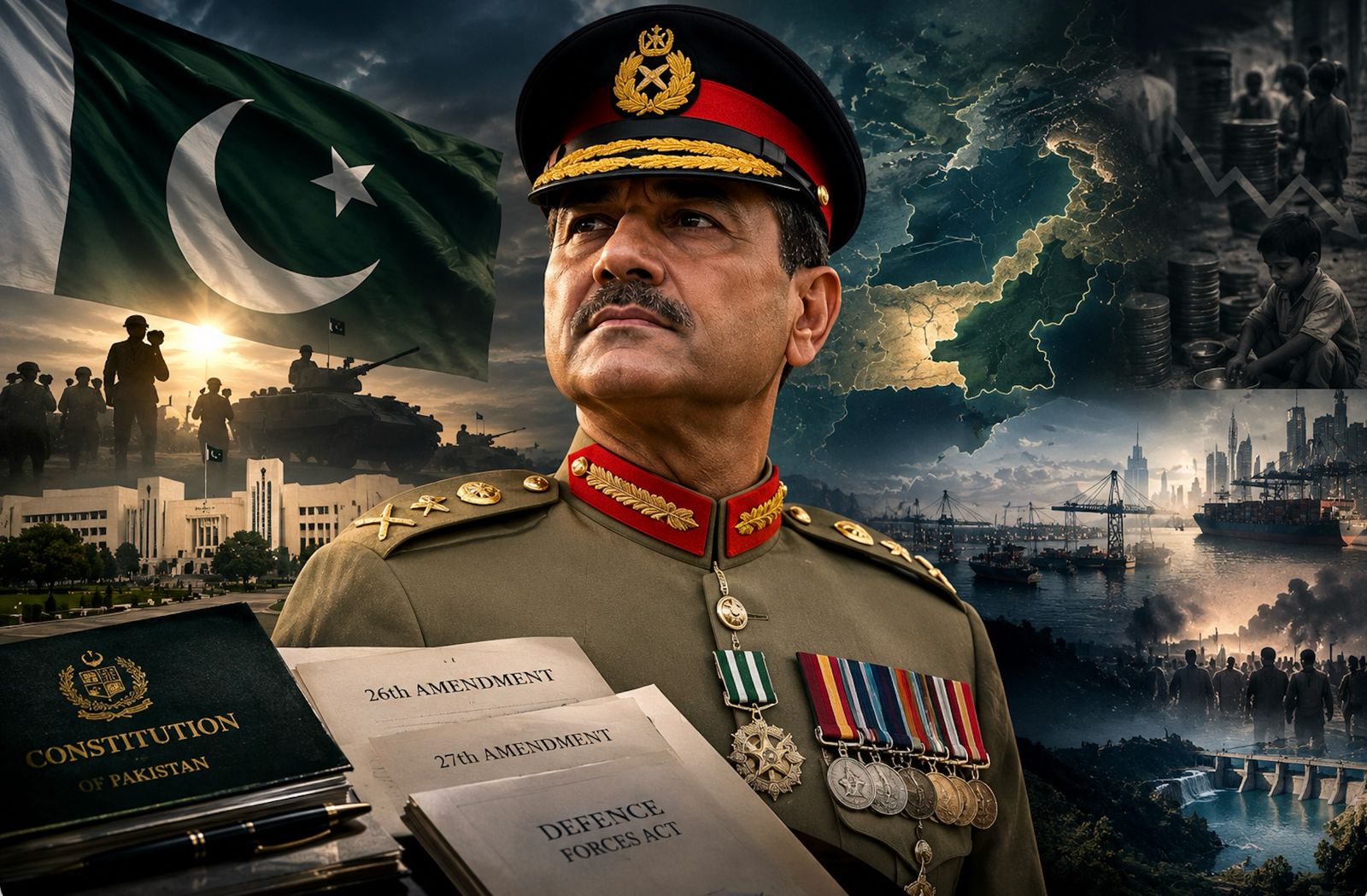
The question, “What doctrine does this express, and what goal does it set for Pakistan?” admits of an uncomfortable answer: there is no goal for Pakistan. No articulated theory relates means to ends, no ordered set of national objectives is offered, and no account exists of what a successful Pakistan would look like at the conclusion of the process. What presents itself as doctrine is a single invariant motion, the accumulation and protection of personal power, and the goal that has in fact been set is the security of the regime rather than the advancement of the state. The resulting form is an undeclared martial law: no proclamation issued and no constitution abrogated, the outward architecture of parliamentary government preserved, yet effective sovereignty exercised by the Army Chief in person rather than through any reformed institutional office. It is a controlled democracy administered by an individual, and the sections that follow test that proposition across each domain of performance.
Constitutional Engineering and Its Sole Beneficiary
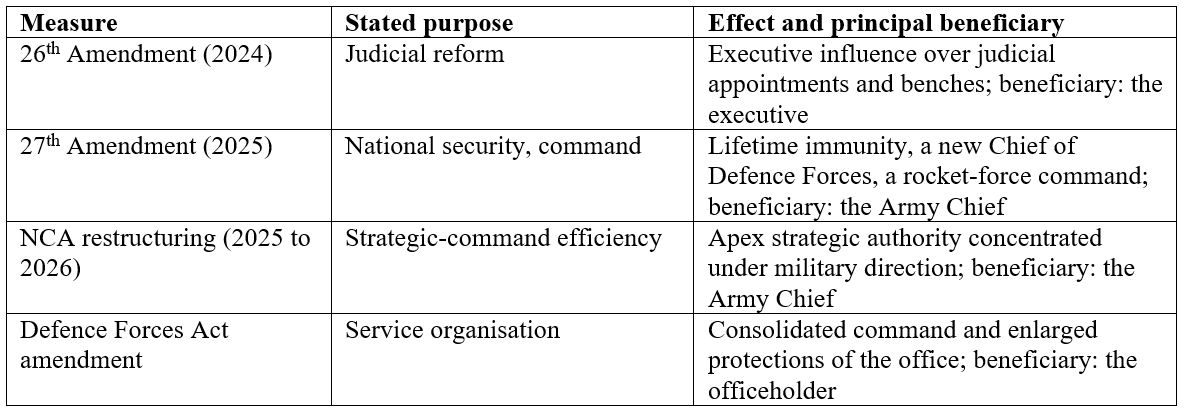
Over four years the doctrine’s most concrete legacy is a series of constitutional and statutory changes, and the appropriate test of each is the classical one: who benefits. The record is set out below, and its striking feature is the absence of any column that could be headed benefit to the state.
Table 1: Constitutional and statutory changes, 2022 to 2026
If read together, these changes describe a single trajectory. The 26th Amendment delivered the judiciary; the Twenty-seventh delivered personal immunity, a five-star command, and a new strike force; the restructuring of the National Command Authority delivered the apex of strategic decision-making; and the Defence Forces Act consolidated the whole. Not one produced a measurable improvement in governance, growth, security, or welfare, and the clearest confirmation is internal rather than external: the Interior Minister has publicly conceded that the system has collapsed, an extraordinary admission about a system its own architects designed. These are, in the plainest sense, person-centric measures, and they answer the question of what goal has been set for Pakistan by revealing that the goal was never for Pakistan.
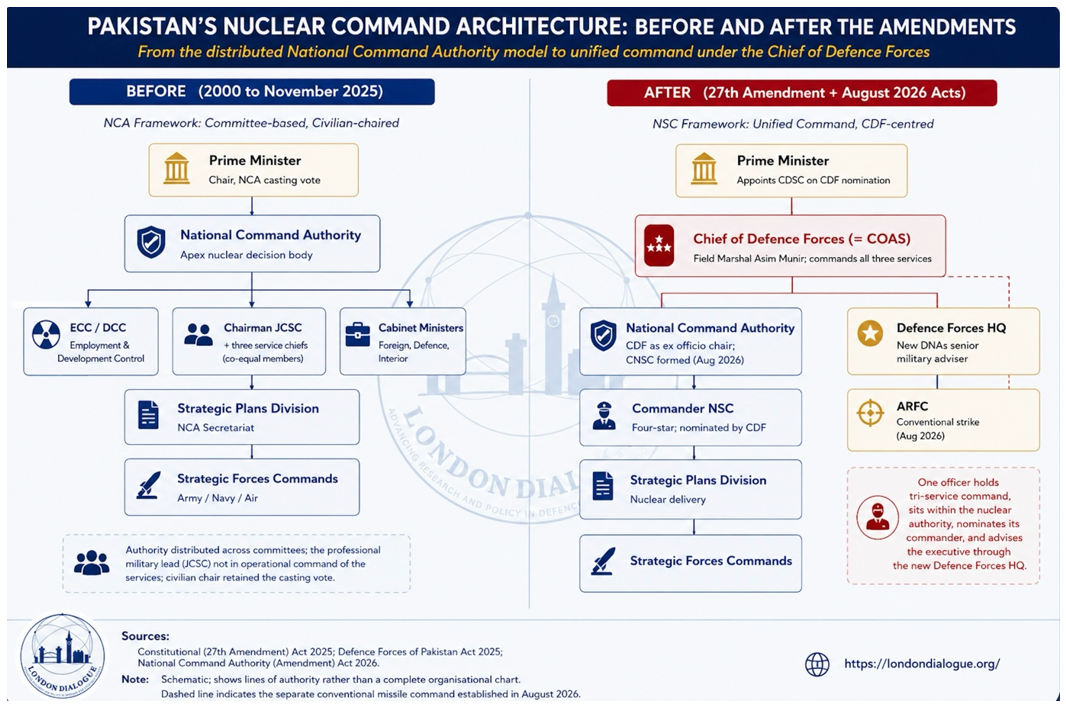
The amendment to the National Command Authority is the gravest of the four and warrants separate treatment, because the arrangements governing a nuclear-armed state’s apex command rank among the most consequential provisions of its constitutional order, and their subjection to genuine civilian oversight is a first-order safeguard. The National Command Authority Act of 2010 vested that authority in a body chaired by the elected Prime Minister, as the comparison below records; the reported restructuring shifts its centre of gravity toward the military leadership.
Figure 1: The National Command Authority, Before and After
The process is itself part of the argument. A decision that alters civilian oversight of the country’s strategic command is of the first constitutional magnitude, and the norm, reflected in the deliberation that attended the 2010 Act, is that such decisions are debated at length and settled by broad consent. That a change of this order should reportedly have been affected quickly, by cabinet approval and expedited amendment rather than by sustained parliamentary debate, is not an incidental procedural detail but the substance of the matter, for a measure of this weight taken without deliberation is not statecraft but consolidation, and the haste is the tell.
International Performance
The most conspicuous achievement claimed for the period is the transformation of relations with Washington, and it is instructive because the claim is not wholly false. The reception of the Army Chief at the White House in June 2025, an honour without precedent for a serving commander not holding executive office, followed his elevation to Field Marshal and established a direct channel to President Trump, cultivated to the point of nominating the President for a Nobel Peace Prize. The rapport is genuine, and he has become, in the vocabulary of the moment, Washington’s “Favourite Field Marshal”. However, Pakistan has obtained from it no assistance package of consequence, no structural partnership, and no mitigation of the transactional character of the relationship. What was transacted was access, each element serving an American interest and none addressing a Pakistani weakness, and the favour operates domestically as a legitimating resource: the prestige accrues to the officeholder while the position of the state is unchanged.
The Defence Pact as Regime Architecture
The mutual defence agreement concluded with Saudi Arabia in September 2025 belongs to the same register. Presented as a strategic breakthrough and as evidence of a vision for the security of the Muslim world, it is on examination selective, addressing the preoccupations of the Gulf rather than the threats confronting Pakistan, with operative commitments in the contingencies that matter most to Islamabad left unspecified. Pakistan extends a guarantee and receives liquidity, which is a transaction rather than an alliance, and its principal function is architectural: to constitute the Field Marshal as a figure of consequence in the Muslim world and thereby manufacture an external legitimacy that domestic performance has failed to supply.
The contradiction is diagnostic. A leadership presenting itself abroad as a custodian of Muslim security has simultaneously denied its own citizens the right to assemble in solidarity with Gaza, dispersing such demonstrations with the apparatus used against political opposition, as the Human Rights Commission of Pakistan has documented. Solidarity is serviceable when performed abroad and generative of prestige; it becomes intolerable at home, because autonomous mobilisation of any kind challenges the monopoly of expression on which the arrangement depends.
Regional Performance
The regional ledger records the erosion of Pakistan’s position on every frontier that matters. Following the Pahalgam attack, India placed the Indus Waters Treaty in abeyance in April 2025, suspending the instrument on which Pakistan’s agriculture and habitability depend, and the official response has consisted principally in celebrating a contested engagement of May 2025 under the designation Marka-e-Haq, which illustrates the substitution of spectacle for strategy. To the west, the doctrine of strategic depth has collapsed: the Tehreek-e-Taliban Pakistan consolidated its sanctuaries under a Taliban government, and Islamabad responded with cross-border airstrikes and closures at Torkham and Chaman and with the expulsion of Afghan nationals so that Afghanistan has slipped from Pakistan’s orbit and the frontier is more volatile than at any point in recent memory.
The relationship with Beijing is the most instructive case, because it is where the strategic and the internal converge. China’s stake is concentrated in the China-Pakistan Economic Corridor and above all in Gwadar, situated in Baluchistan, precisely where the writ of the state is weakest. Repeated attacks on Chinese nationals have converted a strategic investment into a security liability, Chinese pressure has intensified to the point of proposals for a direct security presence, and disbursement has slowed. A leadership that directs coercion efficiently against unarmed domestic opponents has proved unable to secure the territory on which its principal ally’s investment depends, and the resulting Chinese anxiety now constrains the very capital the economic agenda was designed to attract.
Economic Performance
The economic programme has been prosecuted through announcements: the Special Investment Facilitation Council, projected to draw tens of billions in Gulf capital; the Reko Diq project, valued in the trillions; and a national crypto council with a proposed strategic bitcoin reserve. Underwriting it was the anticipation of Gulf capital, but a central-bank deposit augments reserves while augmenting liabilities, whereas investment augments the productive base, and what arrived was overwhelmingly the former. The aggregate position corresponds neither to catastrophe nor to recovery, but to a crisis arrested at the summit without amelioration below.
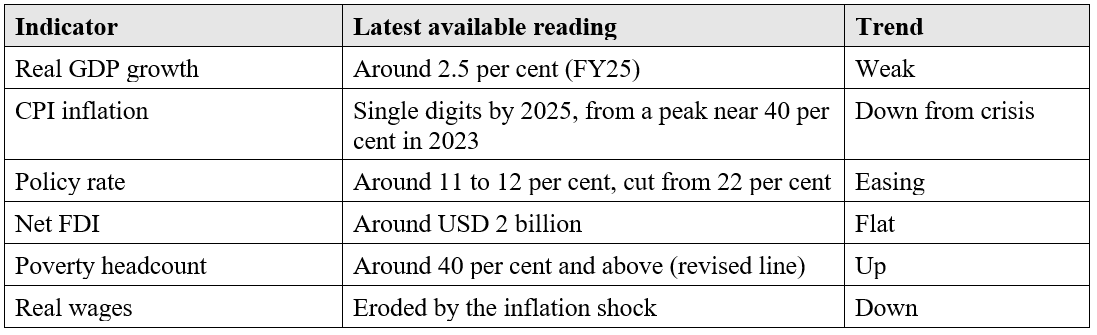
Table 2: Macroeconomic, Fiscal, and Welfare Indicators
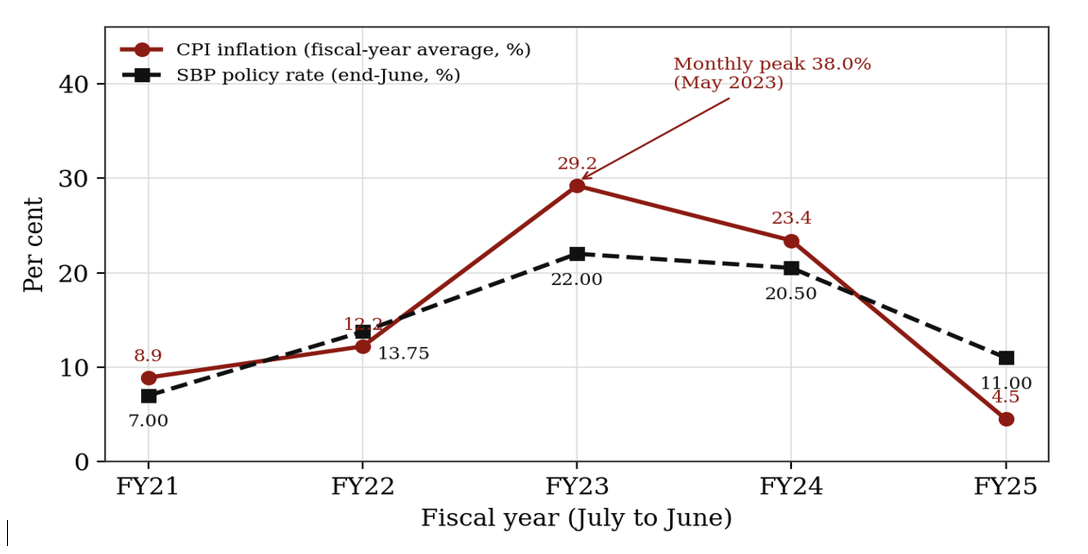
The table’s internal contradiction is the argument in miniature: the upper rows record relief the government may claim, and the lower rows record a population it cannot. The single genuine achievement, disinflation and a halved policy rate made feasible by the Fund programme, is real, but the curve conceals as much as it shows.
Figure 2. Disinflation and the policy-rate cycle (illustrative; replace with verified SBP and IMF series).
Figure 2. Inflation and the policy-rate cycle, FY21 to FY25. CPI is the Pakistan Bureau of Statistics national series, fiscal-year average; the policy rate is the State Bank of Pakistan rate at the end of June. Author’s compilation.
Disinflation achieved by demand compression is experienced by the citizen as scarcity rather than relief, and it is unaccompanied by any recovery in production or employment. Nor did the promised capital arrive: realised net foreign direct investment remained near two billion dollars a year throughout the period, an order of magnitude below the sums repeatedly announced, so that the agenda’s measurable output was announcement rather than accumulation.
Security Performance and the Permanent Crisis
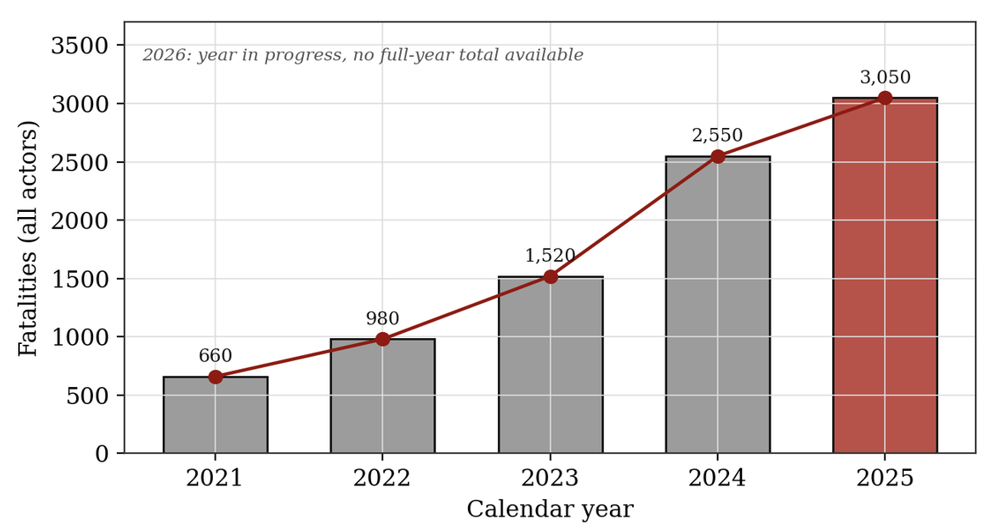
The doctrine has failed most conspicuously in the domain proximate to the army’s vocation, for violence has risen steeply and Pakistan now numbers among the states most severely affected. In Baluchistan, the insurgency attained a capability earlier campaigns did not approach, demonstrated in the seizure of a passenger train in March 2025, and the response has been overwhelmingly kinetic, treating a political grievance rooted in contested resources, in documented denial of due process and allegations of enforced disappearance, and in marginalisation, as a purely military problem, so that intensified coercion has produced intensified insurgency.
Figure 3. Violence-related Fatalities in Pakistan, 2021 to 2025 (civilians, security personnel and militants).
Author’s compilation from published annual tallies (CRSS, PIPS and the South Asia Terrorism Portal); totals differ between trackers according to coverage and definitions, and each value should be confirmed against the source release before publication. No full-year figure for 2026 is yet available.
This curve is the most damaging single datum in the paper, because it falls in the one domain in which the institution claims unrivalled competence and takes the largest share of resources. Its strategic significance exceeds the province, since Baluchistan is simultaneously where Chinese investment is concentrated and where the mineral wealth that was to underwrite recovery is buried. There is a further dimension statistics capture poorly: the country now confronts a new crisis or tragedy almost daily, met as an isolated event to be managed rather than as a systemic failure to be corrected, while the leadership’s energies are absorbed by amendments, receptions, and the containment of opposition. The state secures its rulers while the security of citizens is left to attrition.
Domestic Performance
Domestically the same logic operates with less restraint. The general election of 8 February 2024 was conducted amid an internet suspension, an unexplained delay in results, and systematic irregularities in the compilation of Form 47; candidates aligned with Imran Khan, forced to contest as independents, secured the largest bloc yet were denied government, and the pattern reappeared in the Gilgit-Baltistan and Azad Jammu and Kashmir contests. The apprehension of Imran Khan from within the Islamabad High Court asserted that no institutional space lay beyond executive reach, and the dispersal by force of the protest convoy at the capital in November 2024 exemplified a pattern in which peaceful assembly meets disproportionate coercion, reflected in the assessments of press-freedom monitors.
Beneath the management of elections lies a broader deterioration in the quality of governance, registered across the Worldwide Governance Indicators in declining scores for government effectiveness, the rule of law, voice and accountability, and the control of corruption. Against this backdrop the establishment is reported to be reviving proposals to redraw the provincial map, carving new administrative units out of the existing provinces. Presented as administrative rationalisation and a response to long-standing regional grievances, the initiative carries a transparent political logic, for new provinces would fracture the territorial strongholds on which the mainstream parties depend, diluting the dominance of the Pakistan Muslim League (Nawaz) in Punjab and the Pakistan Peoples Party in Sindh, and it is for precisely this reason that the parties in government, whatever their public postures, have quietly resisted it. That the redrawing of the federation should be contemplated as an instrument for weakening the only organised forces still capable of independent electoral weight, rather than as a considered constitutional reform pursued by consensus, places it within the same person-centric logic that governs every other change of the period: the object is not better government but a political map more amenable to control.
The solitary confinement of Imran Khan should be read in this light. It is explicable neither as a security measure, since he is already under close custody, nor as a judicial requirement, since no sentence prescribes isolation, but only as a function of insecurity: a leadership holding immunity, unified command, the highest rank, and the acquiescence of every mainstream party nonetheless finds the political existence of a single detained man intolerable, so that the severity of the measures is an index of the arrangement’s fragility rather than of his dangerousness. The cost is borne, finally, by the institution itself, for each intervention is purchased by expending the accumulated prestige of the armed forces, and the resentment attaches not to a policy but to the uniform. It is the professional core of the army, not the office that directed these measures, that will bear that cost.
Pakistan now faces a choice that it cannot indefinitely postpone, because a nuclear-armed state cannot govern in perpetuity by suppressing the political preferences of its own majority. The energy required to contain a popular movement, to manage a compromised judiciary, to police the press, and to hold restive provinces by force is energy that is not being spent on the country’s staggering development needs, and the present arrangement is therefore not stability at all but rather the deferral of instability at compounding interest.
The way out is neither mysterious nor radical, for it runs through the release of political prisoners, with Khan foremost among them, through a genuine national dialogue that includes rather than excludes the country’s most popular party, through the restoration of judicial and electoral independence, and, above all, through a free and fair election whose result is honoured. This is not a call for upheaval but a call for the ordinary, unglamorous machinery of constitutional democracy, the very machinery that Pakistan’s rulers have spent years dismantling.
Nowhere would the dividend of legitimacy be felt sooner than in the economy, since, set against the backdrop of a steepening decline, a credible and elected government under Khan could begin to reverse the slide, not through slogans but through the patient restoration of trust, by mobilising the immense goodwill and resources of the overseas Pakistani community that he has rallied to national causes before, by drawing in the investment that always flees uncertainty, and by pursuing structural reform with a mandate strong enough to make it hold. Economic recovery in Pakistan has always been, at bottom, a question of confidence, and confidence is something that only a legitimate government can ever truly command.
Imran Khan is not the last hope of a nation because he is a saviour, for no individual ever is. Khan is the last hope because, at this precise moment, he is the one figure around whom a genuine national consensus can plausibly form, across provinces, across ethnicities, and across the generational divide that will shape the country’s future, and he has become the test case for whether the popular will means anything in Pakistan at all. A country that can find its way back to governing by consent will have many hopes before it, while a country that cannot may yet discover that it has run out of them, and the choice, for now, still belongs to Pakistan, though it will assuredly not remain open forever.
Conclusion: Power on Notice
The Munir Doctrine, understood as a pattern rather than a formally published doctrine, is best characterised by the convergence of military centralisation, political management, external legitimisation and coercive security policy. Its most consequential feature is the apparent movement from military influence as an institutional phenomenon towards the personalisation of authority around the office of the Army Chief. Internationally, policy yielded personal standing without national advantage and a defence pact designed to furnish external legitimacy rather than to answer Pakistan’s threats. Regionally, it presided over the suspension of the Indus Waters Treaty, the loss of Afghanistan, and the alarm of the ally whose investment was to transform the economy. Economically, it stabilised a crisis at the summit while the citizen grew poorer. In security, it widened the insurgencies it was meant to suppress. What succeeded, comprehensively, was the concentration and protection of power in a single office, entrenched through amendments that benefited that office and no one else.
This is regime security displacing national interest, sustained under an undeclared martial law in which the forms of democracy are maintained because their maintenance is cheaper than their abolition. Such an arrangement is an unstable equilibrium, claiming neither the legitimacy of a mandate nor the frank authority of an avowed military government, and it must therefore expend continuously the coercive and symbolic resources it cannot replenish. The constraint it cannot legislate away is acceptance. Immunity may be inscribed in a constitution, command unified, rank conferred, and every institution arranged to a single design, and none of it constitutes authority if the people of Pakistan withhold their consent. Its absence explains both the confinement of a detained politician and the haste of each amendment. Power that must continually defend itself against its own population is not consolidated power; it is power on notice, and the institution in whose name it is maintained will continue to pay the price.
Tahir Azad
Related posts
Rivers as Leverage: India’s Suspension of the Indus Waters Treaty and the Logic of Hydro-Coercion in South Asia
Iraq After Operation Inherent Resolve: Testing Security and State Control
The Electrostate Thesis: Geopolitics, Clean Energy Dominance, and China’s New Global Leverage
A Last Open Letter to President Mr D. J. Trump
Iran’s Reliance on “Self-Defence” in the Shadow of “Strategic Loneliness”
From Chokepoint Diversification to Coupling: Hormuz, Bab al-Mandab and the New Fragility of Gulf Energy Security
Imran Khan’s Solitary Confinement and the Mandela Rules
The South Atlantic Flashpoint: Argentina Tests Britain, Chile, and the US
Religious Rhetoric Around the Mecca Defence Agreement and Its Long-Term Impacts for Pakistan
Operationalising The Maritime Dimension Of The Makkah Joint Defence Agreement
The Arithmetic of Saturation: What the Iran War Taught About the Limits of Layered Air Defence
Beyond the Mecca Accord: Why Pakistan Must Choose Deterrence over Entanglement in Yemen
London Dialogue — Founding Statement
Publication Categories
- Analysis (102)
- Book Review (1)
- Commentary (6)
- Essay (9)
- Journal (0)
- Journal Article (0)
- Policy Brief (6)
- Policy Paper (1)
- Research Article (2)
- Research Report (5)
- Young Writers Corner (0)