

Publications

Trojan APCs: Ukraine’s Kamikaze BTR-60s in Operation Vivaldi

Picture of Viktor Trumbetas

Viktor Trumbetas

Analysis Series

Analysis/0106/October/2026/London-Dialogue. 29 October 2026

By Viktor Trumbetas

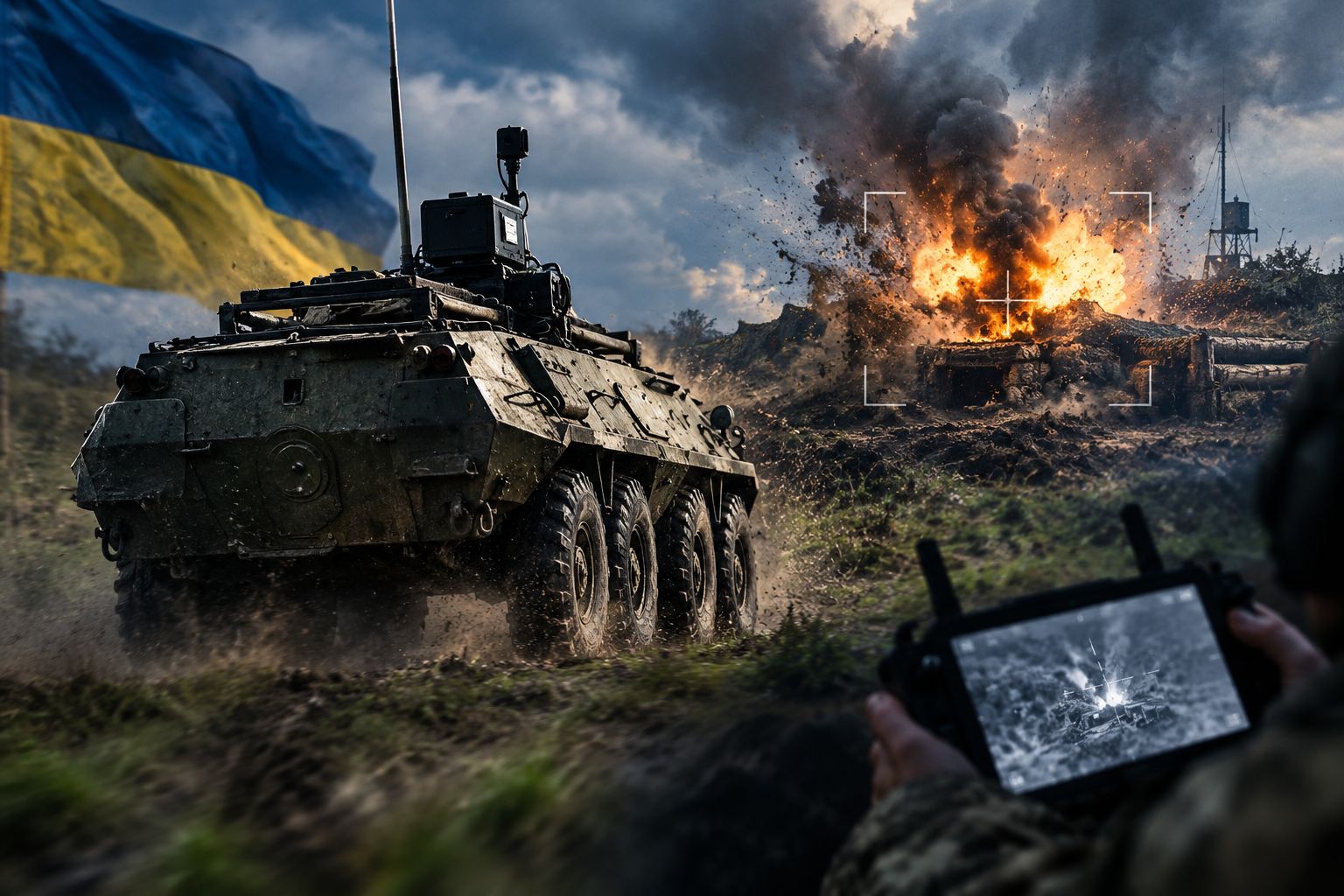
During the third phase of Operation Vivaldi on the Lyman axis, Ukraine’s Third Army Corps sent two uncrewed, explosive-laden Soviet BTR-60 armoured personnel carriers into Russian positions around Nove and Katerynivka. The defenders, by the corps’ account, took them for reinforcements. When the vehicles detonated, they destroyed command-and-observation posts and communications nodes and struck launch positions of Russia’s Rubikon drone unit, with a blast the corps compared to a KAB guided glide bomb. Corps commander Brigadier General Andrii Biletskyi described the vehicles as the corps’ “own invention”, used “to blow up the enemy’s strongest fortifications”. The corps also released footage of the strikes.

Operation Vivaldi in Brief

The Third Army Corps launched Vivaldi in September 2026 in the north of Donetsk Oblast. In its first official statement, the corps said it had cleared Novoselivka, Oleksandrivka, Yarova and the outskirts of Korovy Yar of Russian infiltration groups, liberated Serednie, cleared 75 km² and recaptured a further 10 km². It claimed around 1,500 Russian casualties, a “devastating blow” to Russia’s 20th and 25th Combined Arms Armies, and said drone strikes had forced Russia to move its fuel supply back into Voronezh Oblast. Biletskyi framed the operation in four “seasons”, referring to the composer’s name, and warned against reading its aim as simply reaching the Chornyi Zherebets river. The corps summed up the first phase as “drones, robots and motivated infantry”. The BTR-60 strikes came in the third phase, which rested on deception. According to Biletskyi, Russian commanders expected the main blow along the Shandryholove–Zelena Dolyna axis and spent their reserves on counterattacks there. The real effort went to Nove, which the corps described as the key hub of the Russian bridgehead. The corps reported that the phase liberated Nove, Ridkodub and Katerynivka, restored control over Karpivka and Novomykhailivka, and cost Russia about 2,000 personnel, with more than 250 taken prisoner. It put the total area regained at 176 km².

The BTR-60 APC and the Remote Bomb Conversion

The BTR-60 is an eight-wheeled Soviet APC introduced in service in 1959 to replace the BTR-152. It was built at the Gorky Automobile Plant from 1960 to 1976 and at Kurgan until 1987, with estimates of total output ranging from 10,000 to 25,000. The BTR-60PB variant, still in Ukrainian service, dates from 1967. Ukraine has drawn these vehicles from its own storage bases and from foreign aid, including Bulgarian deliveries. The 3rd Assault Brigade has already fielded the modernised BTR-60D, with BTR-80-style side doors, spaced armour and new engines. The corps has not disclosed how the vehicles were controlled. One plausible explanation could be the  Starlink-based remote control, the method used in earlier Ukrainian conversions of BRDM-2 scout cars and pickup trucks into unmanned ground vehicles (UGVs). The size of the charge is also undisclosed, but if the KAB comparison is accurate, it points to a payload in the hundreds of kilograms. The idea behind using these kamikaze transporters is that they could be used as a surprise attack vehicle, remotely controlled, without the need of risking the lives of soldiers trying to assault the first defence line of the enemy and, above all, the cheapness of this mass-produced old Soviet-era armoured personnel carrier. BTR-60 is now quite old and thinly armoured to carry infantry under drone observation, can still move across rough ground and carry a heavy load. A full-size hull also carries far more explosive than purpose-built strike UGVs, which range from small platforms with anti-tank-mine warheads to carriers of captured FAB-250 bombs. Remote control means no crew is put at risk on the run-in.

Precedents: from the Islamic State to Russia

The armoured vehicle bomb as a breaching weapon was a weapon of choice perfected by Islamic State in Syria and Iraq. From 2013–14, as the group moved from insurgency to holding territory, it welded improvised armour onto its suicide vehicle-borne improvised explosive devices (SVBIEDs) and converted captured military vehicles, most often BMP-1s, M113s and Humvees. These offered thick armour, cross-country mobility and large payload space. IS used them as a substitute for the heavy artillery it lacked, punching holes in static defences ahead of ground assaults. At Ramadi in May 2015, it committed some 30 armoured SVBIEDs, led by armoured bulldozers and front-end loaders that cleared blast walls, and routed the Iraqi garrison. Two IS innovations anticipate Vivaldi directly. The first was deception; in Mosul and Raqqa in 2016–17, workshops disguised armoured SVBIEDs as ordinary civilian vehicles, with painted fake windscreens and grilles, to delay recognition by Iraqi troops and coalition aircraft. The second was remote guidance, with which quadcopter operators steered drivers around roadblocks in real time, and IS was already experimenting with driverless, remote-controlled vehicle bombs by 2016. The Ukrainian BTR-60 removes the suicide driver altogether, making it a remotely controlled armoured VBIED rather than an SVBIED, but the operational logic is the same.

In this war, the Russian army first resorted to the use of explosive-packed armour. In February 2023, footage showed Russian troops loading an MT-LB tractor with an OFAB-100-120 high-explosive fragmentation bomb (123 kg, of which 46 kg TNT) and UZP-77 line charges from a UR-77 mine-clearing vehicle. Such vehicles were left un-crewed on Ukrainian movement routes and detonated remotely as booby traps disguised as abandoned equipment. Later in 2023, Russian forces sent MT-LBs and T-54/55 tanks packed with explosives towards Ukrainian lines. A crew drove each vehicle towards its launch point and jumped out on the move, so it could not manoeuvre or correct course afterwards. Near Marinka in June 2023, a T-54/55 reportedly carrying about six tonnes of TNT hit a mine some 100 metres short of the Ukrainian line and was then struck by an RPG, detonating well short of its target. The closest current foreign parallel is Israel’s use of uncrewed M113 APCs in Gaza, reportedly loaded with one to three tonnes of explosives to demolish buildings. The Ukrainian innovation is not the vehicle bomb itself but its use as a remotely steered, deep-penetration weapon against command nodes.

Why it the Remote VBIED Tactic Worked

Three factors explain the effect of these Ukrainian improvised VBIED’s, as far as open sources allow. The first is deception at two levels, by which, at the operational level, the BTR-60s struck while Russian reserves were tied down on the wrong axis. At the tactical level, they exploited the problem of identification. On a front where both armies field Soviet-pattern wheeled APCs, a drone feed or a sentry may struggle to tell a friendly BTR from an enemy one, especially when it arrives from an expected direction. Hence the label “Trojan APCs”. The second factor is the reach and mass of this VBIED. A wheeled APC such as the sturdy BTR-60 covers ground faster than small, tracked robots and can carry far more explosives than an FPV drone. Remote steering let it drive past forward positions to rear targets – the command posts, signals nodes and drone launch sites, which are usually dug in deeply enough to resist smaller munitions. The third factor is a supporting robotic ecosystem. The BTR-60s were one element in a corps that has made ground robots routine. The NC-13 strike UGV unit air-dropped armed robots from heavy drones up to 10 km behind Russian lines, a method it calls “Griffin”. Its commander said UGVs carried 80 per cent of logistics and 90 per cent of casualty evacuations during Vivaldi. Robots also cleared 30 km of routes in two nights and attacked positions with grenade launchers in place of infantry. The combined effect of this type of attack was to target the very important assets, especially the Rubikon drone crews, that have recently strengthened Russian defences. In one case reported by NC-13’s commander, a single air-dropped robot behind the lines led Russian troops to cancel a mechanised assault, fearing that a Ukrainian sabotage team was waiting in ambush.

Conclusion and Lessons for the Future

This episode of Operation Vivaldi is small in scale, but it shows how Ukraine is experimenting with turning obsolete armour into precision-guided demolition charges and folding them into a wider robotic offensive. This attack, in its essence, had not been a novelty, as it is said this concept was already tested and tried ten years ago in Syria and Iraq and by the Russian army quite recently. Only two BTR-60 vehicles have been confirmed up so far, so this is proof of an isolated concept rather than a new standard tactic. Almost everything known about the action comes from the Ukraine’s Third Army Corps and media relaying its statements; the blast comparison, the targets hit and the casualty figures are unverified. Reported totals also diverge: about 2,000 Russian losses in the third phase, but about 5,000 across all three phases. This special action might also be a trick that works only for a short time. Once Russian units know that a lone friendly-looking APC may be a bomb, they will engage it early with fire from anti-tank weapons, machine guns and FPV drones, as Ukraine did to the Russian T-54/55 at Marinka. Remote control also depends on links that electronic warfare can contest, and the control method remains undisclosed. Disguise raises a legal question too: misleading an enemy is a permitted ruse of war, but using enemy markings during an attack is not. Nothing reported so far suggests the BTR-60s carried Russian insignia. For European armies, three lessons stand out, the first of them being that legacy armour stocks are still a resource. Central and Eastern European states still hold Soviet-era armour, and Bulgaria has already supplied BTR-60s to Ukraine. Cheap remote-control kits can turn vehicles slated for scrap into heavy, expendable strike systems. Counter-UGV defence also needs doctrine. Forward and rear positions must assume that any approaching vehicle may be uncrewed and hostile, which requires layered barriers, mines, positive identification procedures and readily available anti-armour fires in depth. Operation Vivaldi ultimately demonstrated that meaningful results emerge when strike, logistics, evacuation, and demining robots are integrated with deception measures and drone‑based reconnaissance. The operation underscored that robots are most effective as a coordinated system rather than as isolated single platforms.

Picture of Viktor Trumbetas

Viktor Trumbetas