


Publications
The South Atlantic Flashpoint: Argentina Tests Britain, Chile, and the US
Dr Daniel Amicci Mussati
Policy Brief Series
Policy Brief/006/September/2026/London-Dialogue. 29 September 2026
By Daniel Amicci
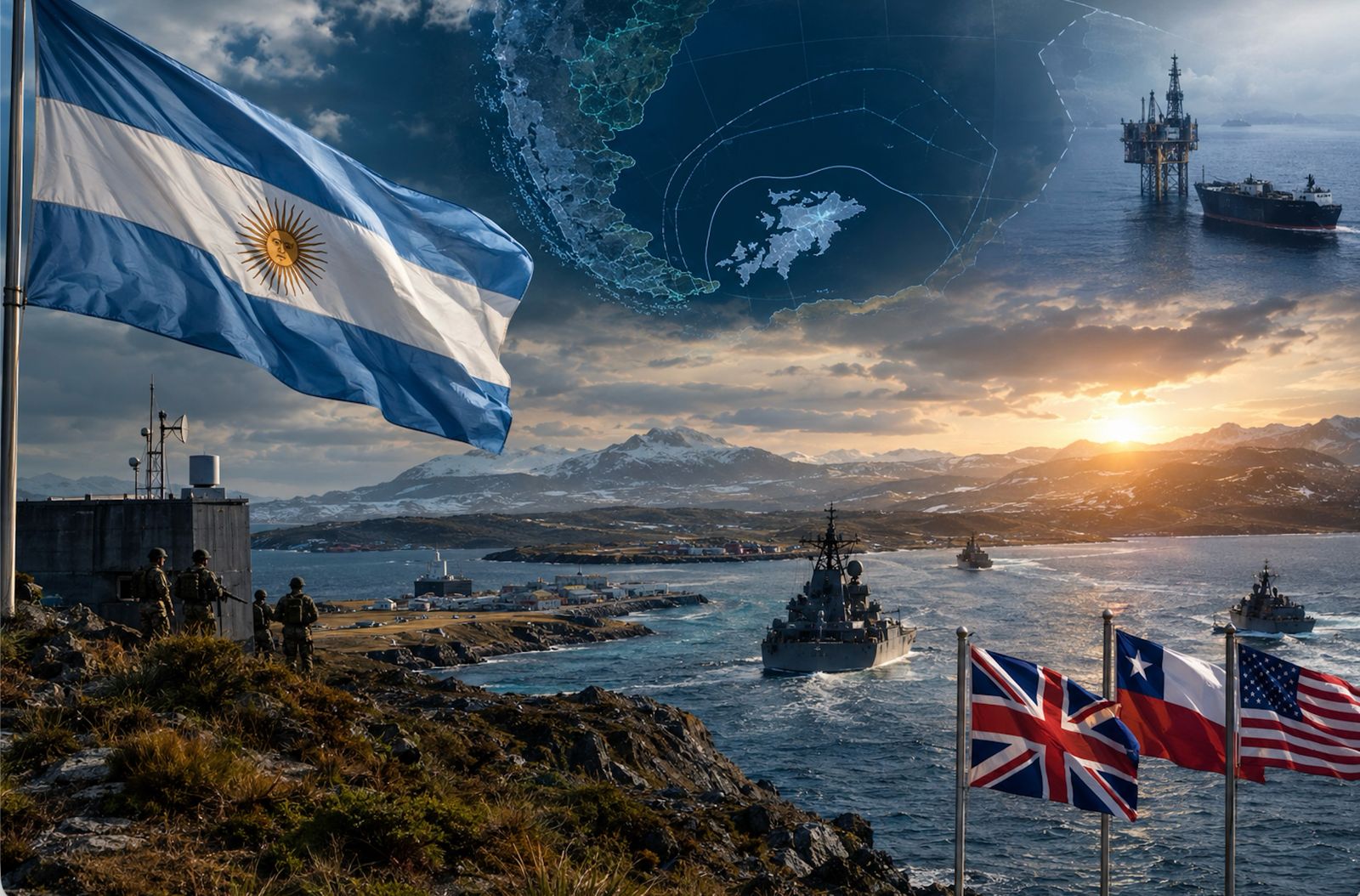
In mid-September 2026, an offhand remark by a visiting American president reopened a dispute most observers had assumed was dormant. Within a fortnight, Argentina had revived a stalled naval base, escalated a legal campaign against Falklands oil operators, reignited a sovereignty dispute with Chile, drawn an explicit statement of support from Beijing, and provoked a formal rebuttal from London. Read individually, each episode is a manageable bilateral irritant. Read together, they describe a government testing the limits of symbolic sovereignty projection against three different interlocutors simultaneously, a traditional adversary (the United Kingdom), a notionally aligned neighbour (Chile), and, implicitly, Washington, while operating with financing and institutional capacity considerably narrower than the rhetoric suggests.
The Trigger: An American President's Ambiguity
The sequence did not originate in Buenos Aires. During a visit to Ireland, Donald Trump told GB News that he did not rule out revisiting the United States’ historically neutral position on Falklands sovereignty and suggested Washington might not necessarily back London in a hypothetical conflict with Argentina, adding that he was disappointed by the UK’s limited support for the US during the Iran war. He also offered to mediate what he called a “potential disaster” between the two countries. In direct response, Milei’s government held a televised national address announcing sanctions, the revival of the Ushuaia base, and a bill to toughen Law 26,659. Everything that follows traces to that address.
Ushuaia: Revival, Not Creation — And Not Without Teeth
The Integrated Naval Base project is frequently reported as new; it is not. The Antarctic Logistics Pole was formally incorporated into state planning as early as 2014 (Decree 2645), and construction began in 2022 under then-defence minister Jorge Taiana, financed through FONDEF resources, before stalling for lack of funds. A government report submitted to Congress in mid-2025 put physical progress at roughly 9% of the planned site, a concrete slab on a 38-hectare peninsula near the Beagle Channel. What changed in September 2026 was political priority, not physical fact.
Decree 867/2026 reallocated roughly ARS 217,954 million, about 3.86% of the annual defence budget, across the Defence Ministry, Army, Air Force, Navy and Joint Staff. Of this, approximately $142–145 million was earmarked specifically for the naval base and the Antarctic Petrel base, by the government’s own estimate, close to 30% of the $400–500 million total the project is expected to require. The balance is contingent on the 2027 budget, currently before a Congress that has recently handed the ruling coalition several legislative defeats.
Officials have been emphatic that financing is “100 percent Argentine,” explicitly disavowing any US contribution, a retreat from Milei’s 2024 characterisation of the project as a prospective joint base with Washington. Nor is the base being framed as purely logistical in practice: presidential spokesman Adrián Ravier has said it will provide naval and air protection via a P-3 Orion maritime patrol aircraft, and the incoming F-16 fleet, 12 of 24 aircraft purchased from Denmark, have already arrived, sitting uneasily alongside official claims that the base carries no “warlike character”. The naval build-up extends well beyond Ushuaia: the 2027 budget authorises up to $2.3 billion in credit for three Scorpène-class submarines from France’s Naval Group, for the Mar del Plata base, plus $1.2 billion for two multi-mission frigates for Puerto Belgrano, a combined $3.5 billion in potential naval borrowing. Tellingly, the submarine negotiations were dismissed as “fake news” by the government’s own Response Office in February 2026, despite Milei having already confirmed the talks in a recorded interview; the budget text now confirms what it officially denied seven months earlier.
Sea Lion: Escalation Meets a Hardened British Response
The Falklands’ Sea Lion oilfield, operated by Britain’s Rockhopper Exploration and Israel’s Navitas Petroleum, reached a final investment decision in late 2025 and targets first oil for March 2028, with an initial phase of 11 subsea wells and projected output ramping to between 55,000 and 180,000 barrels per day within two years of start-up. Buenos Aires responded with sanctioning proceedings against 45 individuals and entities under Law 26,659, new criminal complaints against Navitas, Rockhopper and their executives, and on 17 September an interim injunction from a Tierra del Fuego federal judge ordering the companies to halt drilling and infrastructure work pending environmental review.
The injunction’s practical weight is limited: the presiding judge acknowledged enforcement depends on international cooperation that is not forthcoming, and both companies maintain their licences are valid. London’s response has been more than procedural. On 15 September the British government published an official guidance document, Doing Business with the Falkland Islands, stating that it supports all legitimate economic activity in the Islands and welcomes continued private-sector investment issued within days of Trump’s remarks and read in Buenos Aires as a hardening of the British position. The guidance denies Argentina any jurisdiction over companies operating in the Islands, reaffirms UK sovereignty as not up for discussion absent islanders’ own wishes, and advises firms receiving Argentine warnings to seek independent legal counsel via the FCDO.
A smaller, illustrative episode followed in mid-September around a proposed telecommunications cable. Uruguayan President Yamandú Orsi denied plans for a fibre-optic cable linking the Falklands to Montevideo (roughly 2,100 km) after images circulated of a survey vessel operated by Dutch firm Fugro, a YPF contractor in Vaca Muerta — working in Uruguayan waters. Orsi dismissed the reports while reaffirming Uruguay’s historical position on Argentine sovereignty over the islands; Fugro confirmed seabed survey work but denied any connection to Sea Lion. The episode is minor in itself but indicative of how readily any maritime activity near the islands is now read through the sovereignty dispute.
Magallanes: The Neighbour Who Will Not Be Moved
The third front involves a government (Kast’s Chile) broadly aligned ideologically with Milei’s, which makes its resistance more structurally significant than the Falklands dispute. The friction traces to Decree 457/2021, signed under Alberto Fernández, describing the Strait of Magellan and the Drake Passage as spaces for “joint exploration, study and control”. Chile has contested since publication, under both the 1881 Boundary Treaty and the 1984 Treaty of Peace and Friendship.
The decree resurfaced in August 2026 after Argentine Air Force chief Gustavo Valverde described Magallanes and the southern approaches broadly as Argentine sovereign territory, prompting a formal Chilean protest and a rare rebuttal from Argentina’s own navy chief, Admiral Juan Carlos Romay, who publicly affirmed Chilean sovereignty over the strait. At a Navy Day ceremony in Punta Arenas, Kast said Argentina “does not have and will never have sovereignty or control” over the strait, while declining to make repealing Decree 457 a precondition for dialogue.
The two presidents met at La Moneda on 3 September for a brief, 35–40-minute session that ended without a joint declaration. Argentina formally reaffirmed Chilean sovereignty, and Milei reportedly committed to replacing Decree 457; hours later, Foreign Minister Pablo Quirino described Argentina as “a bicontinental, bi-oceanic country” while discussing the Ushuaia base’s strategic rationale — reopening precisely the ambiguity the summit was meant to close. Six former Chilean navy commanders subsequently urged the government to combine cooperation with continued firmness, and as of late September the replacement decree remains unsigned.
The Great-Power Dimension: Washington's Opening and Beijing's Response
China moved quickly to occupy the vacuum Trump’s ambiguity created. At a 16 September reception marking the 77th anniversary of the People’s Republic, Beijing’s ambassador in Buenos Aires, Wang Wei, stated that China backs “the legitimate Argentine claim to sovereignty over the Falkland Islands” the most explicit Chinese statement on the dispute in recent memory, delivered in the presence of Foreign Minister Pablo Quirino and Central Bank president Santiago Bausili. Wang paired the sovereignty statement with a reaffirmation of China’s economic weight — second-largest trading partner, top destination for agro-industrial exports, a major source of investment — a juxtaposition unlikely to be accidental. A first face-to-face meeting between Trump and UK Prime Minister Andy Burnham was reportedly being arranged for UN General Assembly week in New York, though neither government has confirmed it at the time of writing.
The sequencing matters more than any single statement: an American president’s off-the-cuff ambiguity created a diplomatic vacuum that Beijing filled within days, while Buenos Aires used the same opening to justify a bundle of sovereignty measures that had been dormant for years a textbook case of a secondary claimant leveraging a primary patron’s momentary ambiguity to extract goodwill from a third party at negligible cost.
Capacity Versus Rhetoric: A Structural Caveat
Specialist defence commentary has been notably more circumspect than the government’s own framing. Writing for Pucará Defensa, analyst Nicolás Sierra distinguishes the Integrated Naval Base itself as a military asset from the broader Antarctic Logistics Pole, which would require coordination across the Foreign Ministry, the National Antarctic Directorate, the Joint Antarctic Command, provincial authorities, universities and private operators, an interinstitutional undertaking considerably larger than a single infrastructure announcement. More pointedly, Sierra cites research by Ferrari and Auza showing Argentina’s Antarctic Plan executed only around 60% of its allocated budget between 2007 and 2013, with investment-project underexecution reaching at least 60% between 2008 and 2011, a documented historical pattern of announced funding not converting into delivered capability. He also cites the 2007 fire aboard the icebreaker ARA Almirante Irízar, which left Argentina dependent on foreign-chartered vessels for years, as evidence of the risks of concentrating Antarctic logistics in single platforms.
Synthesis: Tactical Micro-Sovereignty
Taken together, these episodes exhibit a recognisable pattern within the Southern Frontier analytical framework: tactical micro-sovereignty, the accumulation of discrete, symbolically loaded assertions of control that individually carry limited operational weight but cumulatively signal intent to redraw the practical boundaries of Argentine authority in the South Atlantic and Antarctic approaches. The pattern’s clearest illustration is not rhetorical but administrative: a submarine acquisition officially denied as “fake news” in February 2026 reappearing, fully budgeted, in September the same asymmetry between assertive public messaging and underlying institutional follow-through that a decade of Antarctic programme underexecution data would predict.
For institutional observers, three indicators merit monitoring through early 2027: whether Congress approves the 2027 defence allocations needed to move Ushuaia and the naval procurement programme beyond symbolic groundwork; whether Rockhopper and Navitas encounter any operational disruption beyond the largely declaratory judicial order, now set against an explicitly hardened British guidance document; and whether Argentina formally signs the promised replacement to Decree 457 or allows the ambiguity to persist with a government otherwise disposed to cooperate with Chile on mining, energy and Antarctic logistics. Each represents a distinct test of whether symbolic assertion in the South Atlantic will convert into durable institutional or operational change or remain, for now, primarily a signalling exercise conducted against a backdrop of Beijing’s opportunistic diplomatic entry and London’s calibrated resolve.
Dr Daniel Amicci Mussati
Related posts
Rivers as Leverage: India’s Suspension of the Indus Waters Treaty and the Logic of Hydro-Coercion in South Asia
Iraq After Operation Inherent Resolve: Testing Security and State Control
The Electrostate Thesis: Geopolitics, Clean Energy Dominance, and China’s New Global Leverage
A Last Open Letter to President Mr D. J. Trump
Iran’s Reliance on “Self-Defence” in the Shadow of “Strategic Loneliness”
From Chokepoint Diversification to Coupling: Hormuz, Bab al-Mandab and the New Fragility of Gulf Energy Security
Imran Khan’s Solitary Confinement and the Mandela Rules
Religious Rhetoric Around the Mecca Defence Agreement and Its Long-Term Impacts for Pakistan
Operationalising The Maritime Dimension Of The Makkah Joint Defence Agreement
The Arithmetic of Saturation: What the Iran War Taught About the Limits of Layered Air Defence
Beyond the Mecca Accord: Why Pakistan Must Choose Deterrence over Entanglement in Yemen
From Security Dependence to Strategic Autonomy: The Gulf Amid the 2026 Iran War
London Dialogue — Founding Statement
Publication Categories
- Analysis (102)
- Book Review (1)
- Commentary (6)
- Essay (9)
- Journal (0)
- Journal Article (0)
- Policy Brief (6)
- Policy Paper (1)
- Research Article (2)
- Research Report (5)
- Young Writers Corner (0)