
Publications
The NPT After the Iran Wars: A Crisis of Non-Proliferation and Nuclear Order
Tahir Azad
Analysis Series
Analysis/0088/September/2026/London-Dialogue. 25 September 2026
Introduction
The Treaty on the Non-Proliferation of nuclear weapons (NPT) rests on three interlocking pillars: the prevention of proliferation, the right to peaceful nuclear technology, and the pursuit of disarmament. In the space of nine months, all three have been placed under a strain the regime was never built to absorb. In June 2025 Israel and then the United States struck Iran’s principal nuclear installations. On 28 February 2026 they returned with a far larger campaign, this time directed at the Iranian state itself. Between them, these two wars did something the non-proliferation regime had never previously confronted at this scale: they subjected the safeguarded nuclear facilities of a treaty member to sustained military attack and then destroyed the international community’s ability to know what had become of the material inside them.
This analysis argues that the Iran wars have exposed a structural contradiction at the heart of the NPT. Non-nuclear states are asked to renounce weapons and to accept intrusive verification, yet the regime can neither shield their nuclear facilities from attack nor guarantee that restraint will be rewarded with security. The gravest long-term consequence may therefore not be Iranian weaponisation, nor even Iranian withdrawal, but something quieter and more corrosive: that other states conclude non-nuclear status no longer makes them safer and begin to hedge accordingly.
The paper develops this claim across four questions. Do safeguards and verification still command confidence after being bombed into blindness? Does remaining non-nuclear still purchase security? Is the disarmament half of the bargain, contained in Article VI, still credible? And has the withdrawal provision of Article X become strategically more consequential than at any time since North Korea’s departure? A short concluding section asks what, if anything, can repair the damage.
What the NPT Was Designed to Do
The treaty is best understood not as a prohibition but as a bargain. Under Articles I and II, the nuclear-weapon states undertake not to transfer weapons, and the non-nuclear states undertake not to acquire them. Under Article III, the non-nuclear states accept International Atomic Energy Agency (IAEA) safeguards on their nuclear material so that compliance can be independently verified. Article IV preserves the right to peaceful nuclear technology. Article VI commits all parties, and in practice the nuclear armed in particular, to pursue disarmament in good faith. Article X permits withdrawal on three months’ notice where a state judges that extraordinary events have jeopardised its supreme interests.
The logic that binds these provisions together is reciprocal and conditional. Non-nuclear states accept constraint and inspection; nuclear states accept a disarmament obligation; peaceful cooperation remains available to those who comply; and safeguards supply the confidence that allows every party to believe the others are keeping their side. Remove any one element and the structure weakens. The remainder of this analysis asks a single question of the post-war landscape: does that bargain still hold, and if not, which part has given way first?
Iran Before the Wars: The Verification Problem
It is important to establish the pre-war position without rewriting the article as a history of Iran’s programme. Iran is a party to the NPT with a Comprehensive Safeguards Agreement. By 2025 it was enriching uranium to 60 per cent U-235, a level far above any civilian requirement and a short technical step from weapons-grade, and it had accumulated a stockpile the Agency could no longer fully reconcile with its declarations. On 12 June 2025 the IAEA Board of Governors found Iran in non-compliance with its safeguards agreement, citing undeclared material and unresolved questions consistent with past weaponisation research.
This finding did not arrive without warning. Access had been eroding since 2018, when the United States withdrew from the Joint Comprehensive Plan of Action (JCPOA); Iran progressively curtailed cooperation, ceased implementing the Additional Protocol that had granted the Agency enhanced access, and by 2025 the IAEA reported it could no longer maintain continuity of knowledge over parts of the programme. In late September 2025 the European parties triggered the “snapback” of United Nations sanctions. Iran rejected the measures as lacking any legal basis and declared them null and void.
Iran’s own position deserves to be stated fairly, both because balance strengthens the analysis and because the position itself matters. Tehran maintains that its programme is peaceful, that it remains committed to the NPT, and that military attacks on safeguarded facilities are precisely what undermine the treaty and international law. Whatever one makes of the first two claims, the third cannot be waved away, because it points directly at the contradiction this paper examines.
When Nuclear Facilities Become Military Targets
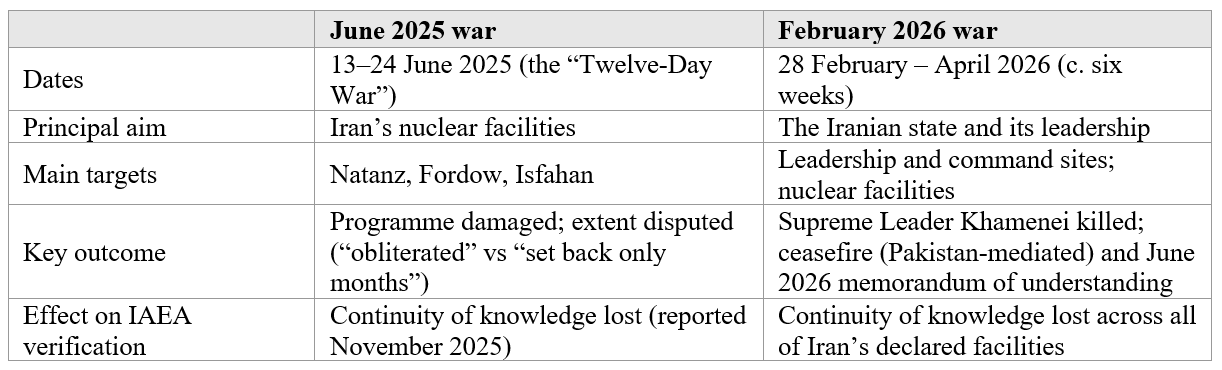
The defining feature of this crisis is not enrichment. It is that a safeguarded programme was bombed and then bombed again.
Table 1. The Two Wars Against Iran, 2025–2026
Sources: IISS; Council on Foreign Relations; IAEA; Al Jazeera Centre for Studies.
The first war came in June 2025. A day after the non-compliance finding, Israel struck Natanz and other sites; nine days later the United States joined, striking the deeply buried enrichment plant at Fordow along with Natanz and Isfahan. Assessments of the damage diverged immediately and have never fully converged. The United States President described the sites as having been obliterated, while an early Defense Intelligence Agency assessment concluded that the core of the programme had survived and that the strikes had set it back only by months. The gap between those two claims is itself an analytical finding: if the attacking power cannot agree with itself on what the attack achieved, the confidence that verification exists to supply has already been lost.
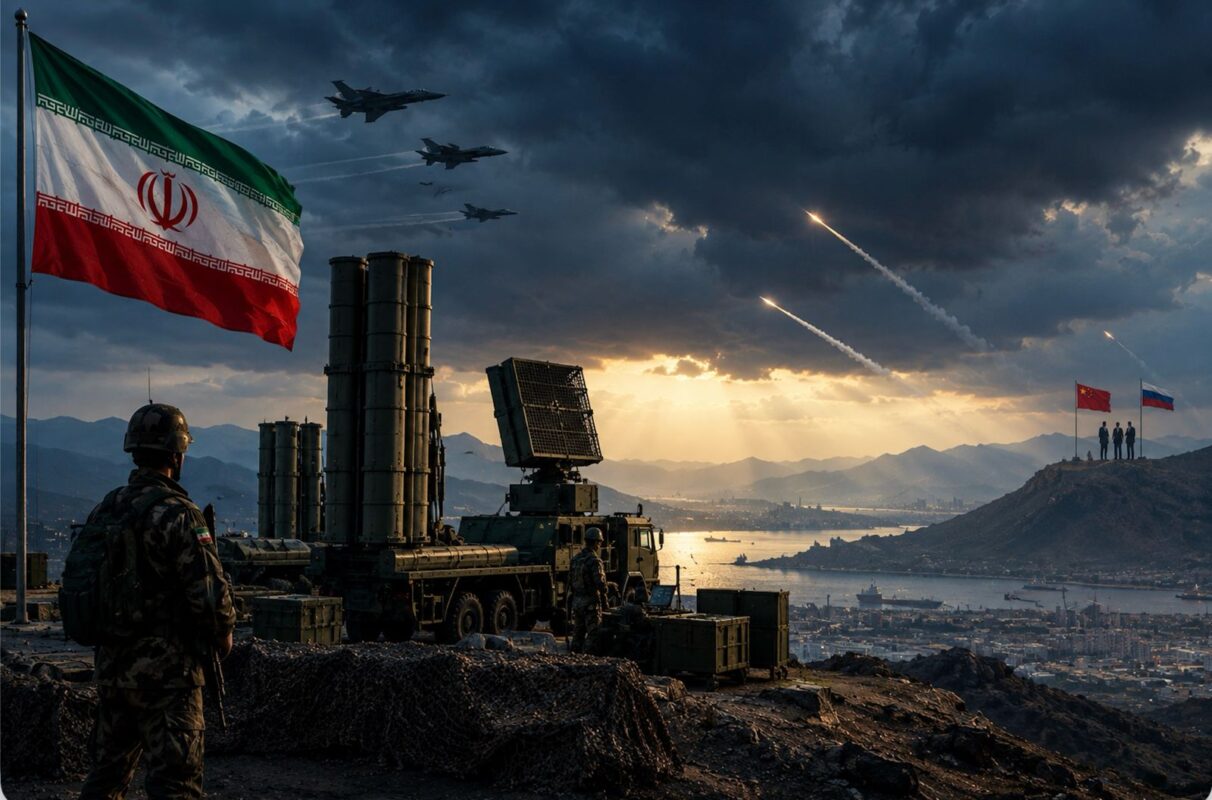
The second war was of a different order. On 28 February 2026 Israel and the United States launched a much larger campaign aimed not merely at the nuclear programme but at the Iranian state. It struck leadership and command targets, killed Supreme Leader Ali Khamenei, and was accompanied by open calls for regime change. The fighting continued for roughly six weeks before a ceasefire in April 2026, later underpinned by a Pakistan-mediated arrangement and a June 2026 memorandum of understanding. Iran retaliated across the region, striking bases that host United States forces in several Gulf and neighbouring states and launching missiles at Israel. That retaliation demonstrated genuine reach, and it is right to acknowledge it. But it did not reverse the strategic outcome, which left Iran’s leadership decapitated and its air defences and missile infrastructure heavily degraded. The honest summary is neither triumph nor rout: Iran endured as a state and inflicted costs while suffering a historic blow to its command and to the programme at the centre of the dispute.
Beneath the military detail lies the conceptual point the NPT has never resolved. The non-proliferation regime is not a security guarantee. It restricts and monitors capability; it does not protect the facilities it monitors, and it offers the compliant no shelter that the defiant do not also forfeit. A state can sign the treaty, accept safeguards, open its sites to inspection, and still watch those sites destroyed from the air. There is a serious and unsettled legal debate about whether attacks on safeguarded nuclear installations are lawful, and Iran and many international lawyers argue that they are not. But the strategic lesson does not wait on the legal one, and every other non-nuclear state has now seen it.
The IAEA and the Crisis of Verification
The IAEA is the information infrastructure of the NPT. Without it, the treaty is a set of undertakings that no one can check, and its central promise, that compliance is knowable, becomes hollow.
The wars degraded that infrastructure faster than they degraded the programme itself. After the June 2025 strikes, Iran suspended cooperation and barred inspectors; limited access later resumed at unaffected sites such as the Bushehr power reactor, but not at the bombed facilities, and Iran provided no updated accountancy for the material held there. By November 2025 the Agency reported that it had lost continuity of knowledge over Iran’s nuclear material. After the February 2026 attacks, the position deteriorated sharply further: the Agency reported that it had lost continuity of knowledge across all of Iran’s declared facilities, was receiving no updated declarations, and had been unable to conduct visits, leaving it to reconstruct the picture from commercial satellite imagery and inference.
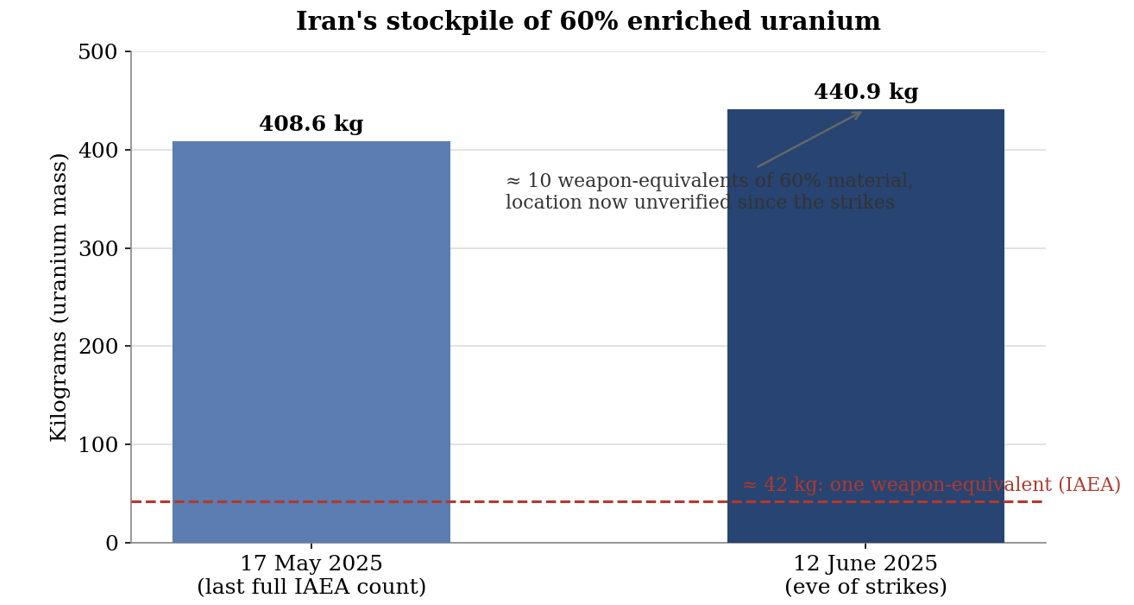
The result is the paradox that sits at the centre of the argument. A large quantity of highly enriched uranium, including a stockpile of roughly 441 kilograms enriched to 60 per cent, is believed to have been buried in the bombed Isfahan complex, damaged but not necessarily destroyed and, by most assessments, still potentially retrievable. The strikes did not eliminate the most sensitive material; they removed the world’s ability to locate and account for it. Destroying nuclear infrastructure can, in other words, make proliferation harder to monitor rather than impossible to pursue. Three consequences follow, each corrosive of the confidence the treaty is meant to produce. Uncertainty rises, because absence of evidence is no longer evidence of absence. National intelligence displaces international inspection as the arbiter of fact, which politicises what was meant to be neutral. And states begin to reason from worst cases, because prudence in the dark demands it. A verification system that has gone blind does not merely fail to reassure; it actively manufactures suspicion.
Figure 1. Iran’s stockpile of 60% enriched uranium (kilograms, uranium mass) on the eve of the June 2025 strikes, against the IAEA one-weapon benchmark. Source: IAEA, GOV/2025/24 (31 May 2025) and September 2025 verification report.
Does Non-Nuclear Status Still Provide Security?
Here the analysis must move beyond Iran, because the deepest question the wars pose is addressed to every other signatory.
If a non-nuclear state can join the NPT, accept safeguards, and still see its nuclear facilities bombed and its leadership killed, what does compliance actually secure? The honest answer is less than the bargain implies. It would be wrong, and analytically lazy, to predict a wave of proliferation; treaties are sticky, and the barriers to weaponisation remain high. The more plausible and more insidious danger is a shift in the strategic calculation of technically capable states towards latency, the deliberate acquisition of the means to build a weapon quickly without yet crossing the threshold.
Latency is attractive precisely because it can be pursued lawfully. Enrichment and reprocessing sit inside the Article IV guarantee of peaceful use, yet they are the hardest and most weapons-relevant steps on the fuel cycle. A state that masters them buys an option without breaching the treaty. The lesson some governments may take from Iran’s experience is not “do not enrich” but “do not be caught in the middle, transparent and half-built, with neither a deterrent nor a guarantee”. That is the worst possible signal for the regime to send, because it penalises the transparency the treaty rewards and quietly commends the ambiguity it was designed to prevent. A regime that makes honesty dangerous is a regime working against itself.
Article VI and Article X: Both Halves of the Bargain
Non-proliferation cannot be judged solely by the compliance of the non-nuclear, because the bargain has a second half that the wars have also strained.
Article VI binds the parties to pursue nuclear disarmament in good faith. Iran, and much of the Non-Aligned Movement before it, has long argued that this pillar is honoured in declarations and neglected in practice. The argument gains rhetorical force when the coercive machinery of the regime is turned on a non-nuclear state while the arsenals of the nuclear-armed are modernised and, in several cases, expanded. The point is not to equate the legal obligations of nuclear and non-nuclear states, which genuinely differ, nor to excuse Iranian conduct. It is to observe that a regime cannot indefinitely demand restraint from the many while the disarmament commitment of the few is widely seen as unfulfilled. Legitimacy is a finite resource, and the wars have spent a great deal of it.
Article X is the pressure valve, and it has become louder. Withdrawal requires three months’ notice and a declaration of extraordinary events jeopardising supreme interests. Iran has repeatedly reached for the threat: in a formal letter to the Security Council in June 2025, it warned that it could begin the Article X process, and senior officials revived the threat through 2026, while continuing to insist that Iran would abide by the treaty for as long as it remained a party. Yet Iran also submitted five working papers to the 2026 NPT Review Conference, a signal that it still intended to operate within the regime rather than abandon it. The correct reading is therefore not that withdrawal is imminent, but that the wars have made Article X strategically more consequential than at any time since North Korea walked out in 2003. A treaty whose exit has newly acquired appeal is a treaty under quiet pressure, whether or not the door is ever used.
The Wider Middle East and the Supply-Side Cascade
The familiar anxiety is a demand-side cascade, in which Iran’s alarmed neighbours reach for their own weapons. Saudi Arabia has stated that it would match an Iranian bomb, and Saudi and Iranian proliferation could in turn draw in others. That risk is real, but it is contingent, slow, and easy to overstate.
The sharper and more current risk run is in the opposite direction, and it originates not in Tehran but in Washington. Reporting through 2026 indicates that the United States administration has begun to relax its long-standing opposition to the spread of enrichment and reprocessing, with both Saudi Arabia and South Korea positioned to move towards fissile-material capabilities with American support, in at least one case under a bilateral safeguards arrangement weaker than the Additional Protocol. Saudi Arabia’s pursuit of a civil nuclear programme with enrichment potential has to be read against exactly this backdrop. If the principal guardian of the regime begins to treat latency as a reward for strategic alignment, no Iranian trigger will be required to set a cascade in motion; the erosion will have been written into policy. This, more than any single Iranian decision, is the development that should most trouble anyone concerned for the treaty’s future, because it normalises hedging from the top down and hollows out the non-proliferation norm at its source.
Can the NPT Be Repaired?
The regime is strained, not finished, and the damage these particular wars have done suggests where repair should begin. Five measures stand out.
First, states should work towards clearer international norms discouraging military attacks on safeguarded nuclear facilities, which endanger non-proliferation and nuclear safety at once and set a precedent no nuclear power should welcome. Second, restoring IAEA access in Iran must be treated as a first-order diplomatic priority rather than a bargaining chip, because every month of absence compounds the loss of knowledge and hardens worst-case assumptions. Third, the Agency needs pre-agreed emergency verification mechanisms for maintaining continuity of knowledge during and after conflict, the very moment at which verification is most needed and least available. Fourth, the three pillars must be rebalanced and treated as interdependent; progress on non-proliferation cannot indefinitely substitute for visible neglect of disarmament, nor can peaceful-use rights be honoured selectively. Fifth, the regime must rebuild positive incentives, because compliance sustained only by coercion is brittle. States remain within the treaty when membership visibly serves their security and their development, and they drift when it does not.
Conclusion
The greatest danger to the NPT after the Iran wars is not that Iran ultimately builds a weapon, and not even that it leaves the treaty. It is the lesson the wars have taught to everyone else: that a state can comply, accept safeguards, and open its facilities, and still be attacked, and that the regime which demanded its restraint could neither protect it nor say afterwards where its nuclear material had gone. The NPT has always endured less because states are legally bound by it than because they have continued to believe that membership serves their interests. The Iran wars have made that belief harder to hold. Whether it can be rebuilt, and whether the guardians of the regime are willing to rebuild it, is now the central question of nuclear order.
Tahir Azad
Related posts
Rivers as Leverage: India’s Suspension of the Indus Waters Treaty and the Logic of Hydro-Coercion in South Asia
Iraq After Operation Inherent Resolve: Testing Security and State Control
The Electrostate Thesis: Geopolitics, Clean Energy Dominance, and China’s New Global Leverage
A Last Open Letter to President Mr D. J. Trump
Iran’s Reliance on “Self-Defence” in the Shadow of “Strategic Loneliness”
From Chokepoint Diversification to Coupling: Hormuz, Bab al-Mandab and the New Fragility of Gulf Energy Security
Imran Khan’s Solitary Confinement and the Mandela Rules
The South Atlantic Flashpoint: Argentina Tests Britain, Chile, and the US
Religious Rhetoric Around the Mecca Defence Agreement and Its Long-Term Impacts for Pakistan
Operationalising The Maritime Dimension Of The Makkah Joint Defence Agreement
The Arithmetic of Saturation: What the Iran War Taught About the Limits of Layered Air Defence
Beyond the Mecca Accord: Why Pakistan Must Choose Deterrence over Entanglement in Yemen
London Dialogue — Founding Statement
Publication Categories
- Analysis (102)
- Book Review (1)
- Commentary (6)
- Essay (9)
- Journal (0)
- Journal Article (0)
- Policy Brief (6)
- Policy Paper (1)
- Research Article (2)
- Research Report (5)
- Young Writers Corner (0)