

Publications
The Emissions We Do Not Count: Militaries and the Missing Climate Ledger
Commodore Ehsan Ahmed Khan
Analysis Series
Analysis/0105/October/2026/London-Dialogue. 26 October 2026
By Cde Ehsan Ahmed Khan SI (M) Retd
Every navy keeps a careful account of its fuel, because consumption governs endurance, operational reach and the ability to apply combat power in time and space. A ship's engineer knows exactly how much fuel has been burnt, how much remains and how far the ship can sail before replenishment becomes necessary. Yet when states submit their greenhouse gas inventories to the United Nations, emissions from military activity are folded into broader national categories, reported incompletely or left out altogether. In November 2022, Scientists for Global Responsibility (SGR) and the Conflict and Environment Observatory (CEOBS) estimated that the world's militaries account for approximately 5.5 per cent of global greenhouse gas emissions. Were the world's armed forces a single country, they would have the fourth-largest national carbon footprint, greater than that of Russia. The figure is an estimate built from limited published data, and it excludes warfighting itself. That uncertainty is precisely the point. The problem lies less in the volume of military emissions than in the absence of transparent, consistent and internationally comparable accounting.
An Exemption Born at Kyoto
The reporting gap has its origins in Kyoto. Decision 2/CP.3, adopted in December 1997, provided that emissions from multilateral operations conducted under the United Nations Charter would be reported separately and not counted in national totals, and recalled that fuel sold to ships and aircraft engaged in international transport is likewise excluded. According to CEOBS, the wider exclusion of military emissions reporting at Kyoto followed US pressure during the negotiations. The 2015 Paris Agreement did not carry forward a general military exemption, but it introduced no obligation in its place. As a 2025 Griffith University briefing observes, no state is currently required to report the emissions from its military activity to the UNFCCC. Where military fuel use does appear, it is usually recorded under the residual IPCC category 1.A.5 (‘non-specified’), merged with civilian sources or withheld as confidential.
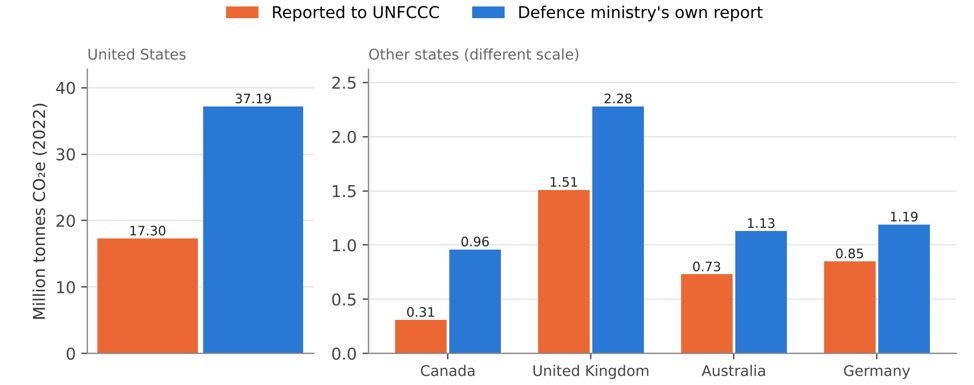
The result is a ledger with large blank columns. SGR’s November 2025 assessment found that, of 70 leading nations, only 38 reported any military data to the UN for 2022 and 37 for 2023. For the five countries where a direct comparison was possible, defence ministries’ own figures for direct emissions were on average about 95 per cent higher than those submitted to the UNFCCC (Figure 1). Drawing on Norway, the only state with a well-developed supply-chain inventory, SGR concluded that less than 10 per cent of military carbon footprints routinely appear in UN data, and that reported figures should be multiplied by roughly ten to fourteen to approximate the true footprint. A CEOBS review of the 2025 submission cycle found that reporting is getting worse. The United States, the world’s largest military spender, submitted no inventory at all. Russia’s reported military emissions moved from 40 to 15 and back to 42 million tonnes between 2020 and 2023 without a credible operational explanation, and China, which as a non-Annex I party has no formal obligation to report, lists military emissions as ‘not occurring’.
Figure 1. Direct military emissions in 2022: what states told the UN versus what their own defence ministries reported
Source: Scientists for Global Responsibility, SGR report (November 2025), Tables 1a and 1b. Reporting periods differ slightly between sources.
Rearmament Without a Meter
The gap is widening during a period of rapid rearmament. SIPRI reported in April 2026 that world military expenditure rose by 2.9 per cent in real terms in 2025, to about US$2.9 trillion or 2.5 per cent of world GDP, the eleventh consecutive annual increase. At The Hague in June 2025, NATO leaders committed to spending 5 per cent of GDP annually on defence and security-related items by 2035, of which at least 3.5 per cent is for core defence requirements. Higher expenditure does not automatically translate into proportionately higher emissions. Money spent on personnel, digital infrastructure or energy-efficient platforms has different environmental consequences from money spent on fuel, munitions and heavy industry. Even so, a sustained expansion of fleets, air wings, stockpiles and defence-industrial capacity will lock in emissions for decades. In 2022 NATO developed its own emissions methodology and pledged to cut the alliance’s emissions by at least 45 per cent by 2030, and it is not yet clear how the new spending targets will be reconciled with that pledge. Rearmament therefore strengthens, rather than weakens, the case for rigorous accounting.
The Footprint of War
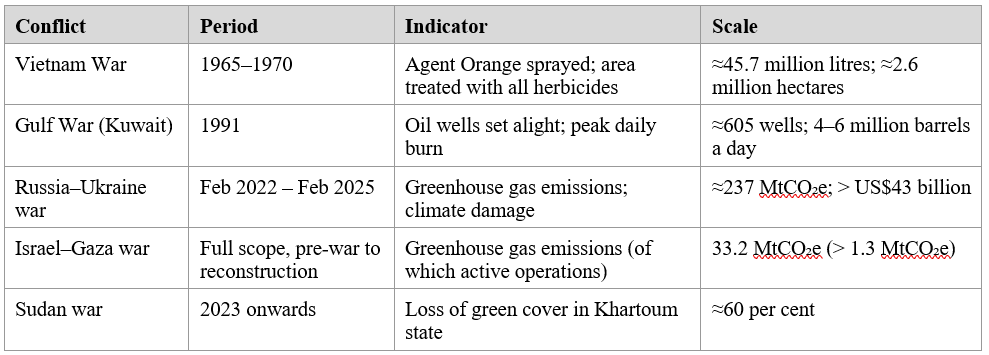
War and armed conflict add a further layer, one that sits almost entirely outside formal reporting (Table 1). During the Vietnam War, US forces sprayed some 45.7 million litres of Agent Orange between 1965 and 1970 as part of a wider defoliation and crop-destruction campaign that covered more than 2.6 million hectares; between 2.1 and 4.8 million people may have been present during the spraying. Dioxin contamination continues to affect soils, vegetation and human health in southern Vietnam. In 1991, retreating Iraqi forces set fire to more than 600 Kuwaiti oil wells, which at their peak burnt between four and six million barrels of oil a day, and the last well was not capped until November 1991. The accompanying oil spills killed more than 25,000 birds, contaminated a resting area used by two to three million migratory birds, and led scientists to predict effects on Gulf fisheries lasting more than a century. In Sudan, the current war has accelerated deforestation; Khartoum state has lost an estimated 60 per cent of its green cover, and local officials describe the 1,500-hectare Al-Sunut forest reserve, once home to more than 100 bird species, as completely wiped out.
The emissions of recent wars can now be measured with greater precision. Emissions attributable to the first three years of Russia’s full-scale invasion of Ukraine reached almost 237 million tonnes of carbon dioxide equivalent, matching the combined annual emissions of Austria, Hungary, the Czech Republic and Slovakia, with climate damage valued at more than US$43 billion. A peer-reviewed One Earth study put the full-scope carbon footprint of the Israel–Gaza war at 33.2 million tonnes of carbon dioxide equivalent, comparable to the total annual emissions of Jordan. Active military operations accounted for more than 1.3 million tonnes, while most of the remainder arises from the reconstruction of destroyed infrastructure, with pre-war defensive works making up the rest. The climate cost of war, in other words, extends well beyond the battlefield, and much of it is incurred years after the fighting stops.
Table 1. Selected environmental footprints of armed conflict
Sources: Stellman et al., Nature (2003); US Department of Defense, GulfLINK; Initiative on GHG Accounting of War, Ukraine assessment; Neimark et al., One Earth (2026); EWN (February 2026). Figures use different methods and are not directly comparable.
A Frigate's Arithmetic
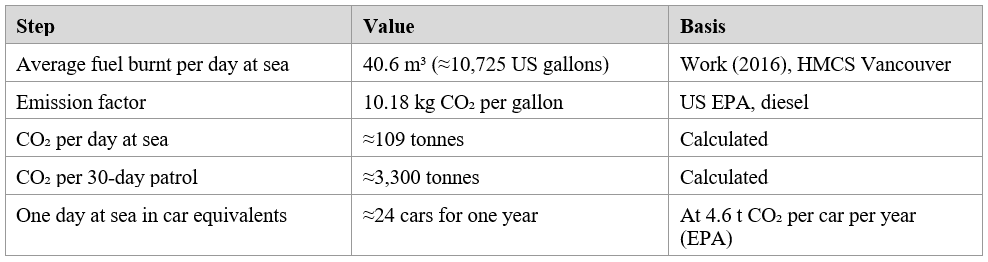
At sea, open data allow a rough but empirical estimate. Fraser Work’s 2016 study of the Canadian patrol frigate HMCS Vancouver found that the ship burnt an average of 40.6 cubic metres of fuel on each of its 71 days at sea. Applying the US Environmental Protection Agency’s emission factor of 10,180 grams of carbon dioxide per gallon of diesel gives roughly 109 tonnes of carbon dioxide a day. A single day at sea therefore equals the annual emissions of about 24 typical passenger cars, at the EPA’s estimate of 4.6 tonnes per car per year, and a 30-day patrol would release some 3,300 tonnes (Table 2). Actual consumption varies with speed, sea state, mission profile and the electrical load of sensors and weapons. Moreover, the emissions of a warship or naval task group cannot be measured by the fuel burnt in its principal combatants alone. A full account would include shipbuilding, weapons manufacture, dockyard maintenance, logistics and eventual disposal. Norway’s data suggest that such supply-chain emissions make up around four-fifths of a military’s total footprint, yet comparable public data for most navies remain scarce.
Table 2. Estimated carbon dioxide emissions of a patrol frigate
Sources: Work, Harvard thesis (2016); US EPA, vehicle emissions. Illustrative estimate: the EPA road-diesel factor stands in for naval distillate fuel, and methane and nitrous oxide are excluded.
The Digital Battlefield
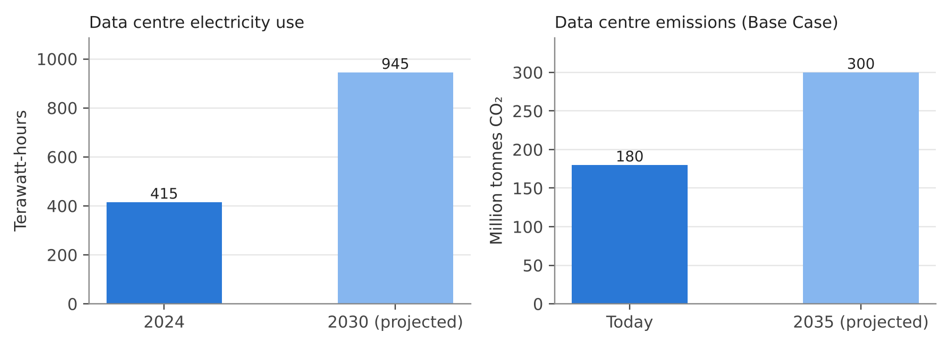
Military computing adds another, largely unmeasured, dimension. The International Energy Agency estimates that data centres consumed around 415 terawatt-hours of electricity in 2024, roughly 1.5 per cent of global electricity use, and projects that this will more than double to around 945 terawatt-hours by 2030, with artificial intelligence as the main driver. Associated emissions are projected to rise from about 180 million tonnes of carbon dioxide today to 300 million tonnes by 2035 in the IEA’s Base Case (Figure 2). Defence establishments are now significant customers. In July 2025, the US Department of Defense’s Chief Digital and Artificial Intelligence Office awarded contracts with a ceiling of US$200 million each to Anthropic, Google, OpenAI and xAI. A typical hyperscale data centre uses three to five million gallons of water a day, the daily consumption of a town of 40,000 people, and draws 20 to 50 megawatts of power, equivalent to the domestic consumption of 70,000 to 170,000 homes in England. Because most military computing is bought through commercial cloud contracts, its emissions fall into the supply-chain category that defence ministries are least likely to report. As AI is integrated into intelligence, targeting and logistics, this blind spot will only grow.
Figure 2. Global data centre electricity use and emissions, current and projected
Source: IEA, Energy and AI (2025), Base Case.
Why It Matters for Pakistan
For Pakistan, this debate carries particular significance. The country contributes less than one per cent of global greenhouse gas emissions, yet its first Biennial Transparency Report notes that Germanwatch ranked it the most climate-affected country in its 2025 index, and the federal climate minister has again described Pakistan as among the most vulnerable nations. Pakistan has suffered repeated and devastating floods since the 1950s, of which those of 2010 and 2022 were the worst in its history. The 2022 floods affected about 33 million people, caused 1,739 deaths and resulted in damage and losses exceeding US$30 billion. There is also a strategic dimension at the confluence of military activity and climate change. Countries confronting acute military threats cannot simply abandon their defence requirements, and Pakistan, situated in a region marked by longstanding disputes, evolving nuclear deterrence and growing maritime competition, understands this dilemma better than most. The objective, therefore, should not be to present national defence and climate responsibility as mutually exclusive choices. It should be to establish that legitimate security requirements do not extinguish environmental obligations.
Pakistan also has a practical interest in better accounting. Its transparency report records zero emissions under category 1.A.5, where military fuel use is ordinarily placed, so, like most states, it offers no public baseline against which its armed forces’ efficiency gains could be recognised. A climate-vulnerable state that volunteered aggregated defence fuel data would strengthen its standing in loss-and-damage and climate-finance negotiations. It would also place the onus on the largest military spenders, whose emissions are many times greater, to follow suit.
A Framework for COP31
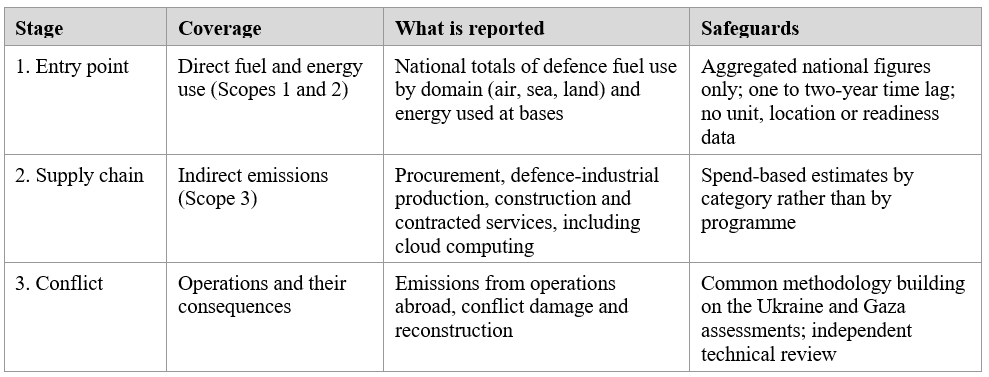
The forthcoming COP31, to be held in Antalya, Türkiye, from 9 to 20 November 2026, under a Turkish presidency with Australia presiding over the negotiations, offers a timely opportunity to advance this discussion. Parties could begin work on standardised military emissions disclosure within the Paris Agreement’s Enhanced Transparency Framework, under which the first biennial transparency reports fell due at the end of 2024. Such a framework would require international agreement, common accounting standards and appropriate safeguards for genuinely sensitive military information. A phased approach (Table 3) would begin with aggregated national defence fuel use and stationary energy, reported with a time lag and without unit-level detail, and then add procurement, supply chains and conflict-related emissions in later stages. Each stage draws on data that defence ministries already hold for budgeting and logistics.
Table 3. A phased framework for military emissions disclosure under the Enhanced Transparency Framework
Source: author’s proposal, informed by SGR and CEOBS analysis.
The military profession has long treated accurate accounting as an indispensable element of operational effectiveness. Fuel, ammunition, equipment and manpower are measured because responsible command requires an understanding of the resources consumed. An agreed, aggregated and time-delayed reporting standard would place the climate cost of military power on the record without compromising operational security, and COP31 is the first real opportunity to open that negotiation. It is time to apply the same discipline to the environmental consequences of military power.
Commodore Ehsan Ahmed Khan
Related posts
Can Britain Bring Iran Back to the Table?
Yemen’s Forgotten Human Rights Crisis: Geopolitical Rivalries, Maritime Security and the Cost of War
The Democratic ‘Tsunami’: What It Means for Trump’s War on Iran?
What the Democratic Sweep in the US Midterm Elections Means for Trump’s Iran Policy and Gulf Security
Breaking the Taboo: The Strategic Folly of a US Nuclear Strike on Iran
Blurred Lines: Federalism and Provincial Autonomy in Pakistan
Paper Shields: The Makkah Pact and the Hard Test of Collective Defence
Iran’s Axis of Resistance Now: Less Than an Axis, More Than Resistance?
Leading through Uncertainty: Building Resilient Interdependence in a Multipolar World
Why Does the Game of Chicken Between Iran and the United States Keep Going?

Trojan APCs: Ukraine’s Kamikaze BTR-60s in Operation Vivaldi
Another Iran War? Diplomatic Evacuations and the Politics of Escalation
London Dialogue — Founding Statement
Publication Categories
- Analysis (117)
- Book Review (1)
- Commentary (8)
- Essay (17)
- Journal (0)
- Journal Article (0)
- Policy Brief (7)
- Policy Paper (1)
- Research Article (3)
- Research Report (6)
- Young Writers Corner (0)