
Publications
The Electrostate Thesis: Geopolitics, Clean Energy Dominance, and China’s New Global Leverage
Dr. Safdar Hussain
Analysis Series
Analysis/0096/October/2026/London-Dialogue. 08 October 2026
By Dr. Safdar Hussain
Introduction
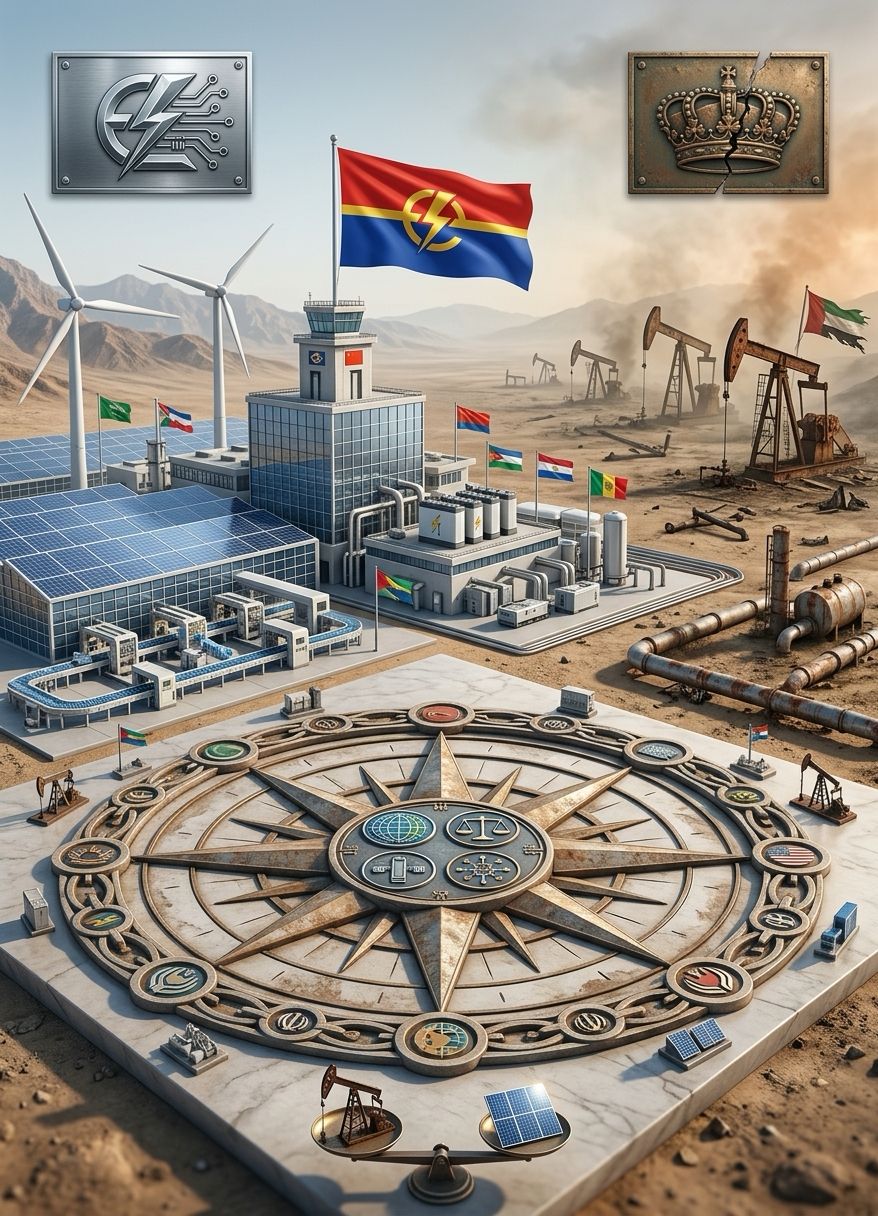
For much of the 20th century, energy geopolitics revolved around a single commodity and a single kind of state. Petrostates such as Saudi Arabia, Russia, and, more recently, the United States have increasingly derived influence from control over oil and gas reserves and the willingness to use that control as an instrument of state or foreign policy. However, in more recent academic scholarship, a new term has entered the vocabulary of energy analysts and policy institutions over the past two years: the electrostate. Unlike the petrostate, whose power rests on subterranean reserves, the electrostate’s power rests on manufacturing capacity, technological standard-setting, and the ability to supply the physical hardware of decarbonisation to the rest of the world.
A substantial body of academic and institutional analysis supports the view that China is the first true electrostate. Therefore, the central objectives of this investigation are to critically evaluate the conceptual transition from the traditional petrostate framework to the emerging model of the electrostate and to examine China’s position as the primary empirical case of a global electrostate, assessing how its dominance in green energy supply chains reframes contemporary international relations debates surrounding energy dependency and industrial policy in a multipolar order. This concept deserves closer attention from international relations scholars, since it challenges existing ways of thinking about economic dependency between states, state-directed industrial strategy, and the distribution of power in a more multipolar world.
This article proceeds in four parts. It first defines the electrostate and distinguishes it from the petrostate. It then assesses China’s position as the first electrostate. Building on this, it explores the implications for energy dependency and structural power. Finally, it outlines a research agenda for future study.
What is an Electrostate
In current debates about China’s influence in clean energy, international relations experts increasingly use the term “electrostate”, and they most often link it to China. Many of them believe China is the dominant leader in this field. The term “petrostate” is in decline within the literature. It was traditionally applied to countries such as Saudi Arabia and Russia, whose political economy and international influence were built on exporting hydrocarbon resources for hard currency. A consumer electrostate is a country where electricity increasingly replaces fossil fuels such as gasoline, diesel, and gas in transportation, industry, and buildings. This transformation is driven not only by what individuals and corporations decide to buy but also by government policies. In the meantime, a producer electrostate produces and exports the technology, such as solar panels, batteries, wind turbines, grid transformers, and increasingly compact modular nuclear components that make this shift possible. China has characteristics of both categories simultaneously, and the extent of this is significant.
The scale of China’s non-carbon energy sector has grown sufficiently large. China’s renewable energy sector has become so significant that analysts now compare it to the oil and gas exports of traditional petrostates. This sector made up more than ten percent of Chinese GDP in 2024, and the country’s electrification ratio has continued to excel even as the equivalent figures in the United States and the European Union have stagnated. For example, the analysts at the Carnegie Endowment for International Peace have maintained that the scale of Chinese exports can essentially be compared with the export volume of oil and gas by Saudi Arabia, Russia or the United States. This explains why the petrostate analogy has gained acceptance in policy analysis.
China’s dominance extends to production too, holding a near-monopoly across solar, wind, EVs and battery manufacturing. Chinese factories account for roughly 80% of global solar panel production and around 60% of global wind turbine manufacturing. It, in essence, gives Beijing substantial influence over global pricing. Chinese solar panel exports reached 236 gigawatts in 2024, more than triple the volume recorded in 2019, and industry trackers expected a further record in 2025. Victor Gao, Vice President of the Center for China and Globalisation, has consistently maintained that China’s leadership in energy geopolitics has translated into significant geopolitical leverage. Electric vehicle exports rose sharply again in 2025, continuing a trajectory that has seen Chinese EV exports increase by more than 1500% since 2019. China’s share of global power battery installations now exceeds two thirds. These are not marginal figures. They describe a supply chain in which a single state has achieved what amounts to a near monopoly across several of the most strategically important manufacturing sectors of the 21st century.
Asymmetry and Periphery Dynamics in the Global South and China
The preceding analysis suggests that from an international relations perspective, the most consequential dimension of the electrostate thesis is not great-power competition but how China’s clean energy dominance creates structural asymmetries and deepens developing nations’ dependence on Beijing. In other words, this is not to suggest that the major Western powers find themselves directly dependent on Beijing, but rather that developing nations are becoming structurally reliant on China for their green energy transition. Analysts writing for the Geopolitical Monitor have applied the Keohane and Nye framework of asymmetric interdependence to this relationship, arguing that Global South states which have rapidly adopted Chinese clean energy technology, Pakistan being the most frequently cited example, are becoming structurally locked into a relationship in which China holds the greater bargaining power. Pakistan imported over fifty gigawatts of Chinese solar panels in 2025 alone, and the share of its electricity generated from solar power rose from roughly four percent in the first half of 2021 to almost twenty-two percent by the first half of 2025.
It is to argue that this reliance extends well beyond basic material supply, because China retains vital technical knowledge and proprietary maintenance expertise rather than transferring core manufacturing processes, ensuring that developing nations must continually return to Beijing for ongoing operational support. Consequently, these high switching costs, driven by ongoing dependencies for maintenance, spare parts, and technical servicing, create structural relationships that reinforce Beijing’s long-term geopolitical leverage, particularly among emerging economies like Bangladesh and Saudi Arabia. A Carnegie Endowment briefing has also documented in relation to Bangladesh and Saudi Arabia, both of which are pursuing electrification strategies substantially built on Chinese hardware even though the political character of that dependency differs sharply between an energy-importing state and a hydrocarbon exporter hedging its own long-term position.
Ember, the London-based energy think tank, has tracked the pace of this shift closely, and its researchers have observed that the traditional assumption in Western development policy, namely that wealthy countries adopt clean technologies first and then help poorer countries follow, is being reversed. A researcher at Ember described this shift as changing the global balance of power, moving away from formal climate talks and into tough industrial competition. It can mainly be described as a contest between traditional oil states and rising technology states, where manufacturing muscle matters more than diplomatic promises. Because of this Chinese production power, most of the world living across the Sun Belt now has access to the cheapest clean energy technology in history, fundamentally reshaping relationships between wealthier and developing nations.
Structural Asymmetry: Petrostate versus Electrostate Leverage
The analogy between petrostates and electrostates requires careful theoretical scrutiny before it can be treated as a reliable guide to how Chinese leverage might actually be exercised in a crisis. Classical petrostate leverage, of the kind Russia exercised over European gas markets before 2022, depends on the physical difficulty of substituting a piped or shipped commodity in the short term, combined with the buyer’s inability to accumulate meaningful reserves against a potential cutoff. Electrostate leverage operates rather differently, since the goods in question, solar panels, batteries and turbines, are durable capital assets rather than continuously consumed commodities. Once installed, a solar array or battery system continues to generate or store power for years regardless of whether the exporting country chooses to restrict future sales, meaning that any Chinese attempt to weaponise clean technology exports would affect a country’s ability to expand or maintain its installed base rather than immediately cutting off its existing electricity supply, a materially different and arguably less coercive mechanism than an oil or gas embargo.
This distinction should not be read as minimising the significance of electrostate dependency, however, since the maintenance, component replacement and software elements of modern clean energy infrastructure create their own continuing points of leverage, and the sheer scale of China’s manufacturing cost advantage means that genuine diversification away from Chinese suppliers would be extremely costly and slow for most importing states even if it remains theoretically possible in a way that diversifying away from a single gas pipeline is not. A rigorous comparative theory of electrostate dependency should therefore avoid simply importing petrostate-era assumptions wholesale and should instead develop its own vocabulary for describing a form of leverage that is simultaneously more diffuse, in that it operates through thousands of individual transactions rather than a single chokepoint, and potentially more durable, in that it is embedded in physical capital stock that will take decades to turn over even under an aggressive diversification strategy.
Strategic Contestation and Western Countermeasures
It’s worth being careful here, since the picture is more complicated than a simple story of coordinated strategy. The commentary from the Center for Strategic and International Studies has pointed out that Chinese solar exports owe as much to domestic overcapacity and the industry’s own boom-and-bust cycles as to any deliberate geopolitical plan. The sector went through a difficult period starting in 2012, when anti-dumping measures from Europe and the United States closed off major export markets almost overnight. What followed was a wave of consolidation, and a fragmented industry made up of many smaller firms gradually became a smaller number of larger, more resilient ones.
Moreover, the researchers at CSIS have traced how Chinese firms responded to a more recent round of tariffs and other trade barriers. Rather than retreating, companies diversified where they sold their products and shifted toward intermediate goods such as wafers and cells. This allowed them to work around the European Union’s requirements for more diversified supply chains, even as American efforts to close off transshipment routes through Southeast Asia became stricter. Seen this way, what looks like strategy from the outside may really be commercial adaptation under pressure, with firms responding to new constraints as they arise rather than following a single, coordinated plan.
The European Union’s institutional response illustrates how seriously European policymakers now take the question. Taken together, The Foreign Subsidies Regulation, the Net-Zero Industry Act and the proposed Industrial Accelerator Act are an attempt to limit reliance on single suppliers, set targets for domestic manufacturing and speed up the growth of Europe’s own clean technology industry. The Carbon Border Adjustment Mechanism adds further pressure, placing indirect costs on Chinese exporters through the carbon reporting rules attached to steel and aluminium inputs. Even so, none of these measures has shifted China from its central position in the global solar industry. If anything, CSIS analysis suggests the opposite has happened. Rather than simply adjusting to these new restrictions, Chinese firms appear to have embedded themselves more deeply into global supply chains while also widening their lead in innovation.
Climate Diplomacy and the Erosion of Multilateral Consensus
The electrostate thesis also challenges something international relations scholars have long taken for granted, namely that serious progress on decarbonisation would have to come through binding agreements negotiated at successive climate conferences. Analysts at Ember have argued that this is no longer where the real action lies. In their view, the centre of gravity in the climate fight has shifted away from diplomatic commitments and toward a technological revolution driven largely by falling costs, one that has unfolded mostly outside the pledges made in international negotiating rooms. It can be argued that certain products, solar panels being the clearest example, deliver far more value to the consumer who ends up with cheap, reliable electricity than to the manufacturer, whose profit margins on the panels themselves remain thin. This goes some way toward explaining why governments across the Global South have taken up Chinese clean technology so readily, even in cases where they remain cautious about China’s political influence more broadly. The appeal of the technology, in other words, does not depend on trusting the supplier.
What follows from this is a reversal of a pattern international relations scholars are used to. Historically, wealthy industrialised states adopted new energy technologies first, with poorer countries following later, often with outside assistance. That pattern no longer holds. Roughly two thirds of emerging economies have now overtaken the United States in the share of their electricity generated from solar power. This matters for the field, since it suggests that the spread of green technology, and the power that comes with controlling it, can no longer be explained through the old assumption that wealthy states lead and poorer ones follow.
This reordering has real consequences for how China positions itself within international climate diplomacy. Rather than relying only on the pledge and review system set up under the Paris Agreement, Chinese diplomacy increasingly points to something more tangible, the sheer scale of cheap Chinese solar panels and batteries reaching the rest of the world, as evidence of climate leadership. This is a different kind of influence. It does not depend on the binding multilateral commitments that have proven so difficult to secure from other major emitters, including the United States under its current administration.
This creates an odd imbalance in how China is judged internationally. Western critics often point out that China continues to expand coal-fired power at home, yet at the same time, China can credibly claim to have done more than any other single state to bring down the global cost of decarbonisation technology. Both things are true at once, and this is precisely what makes the case worth studying closely. A serious treatment of the electrostate concept needs to look not only at the dependency this creates for importing countries but also at the reputational and diplomatic credit China gains from a form of climate leadership that works through export markets rather than through treaty commitments.
Conclusion
For anyone studying Chinese foreign policy who wants a topic with real global relevance, the idea of the electrostate opens up several useful lines of enquiry. The first is theoretical. Classical interdependence theory, developed by Keohane and Nye to explain dependency in the age of oil, was built around a finite resource that could not be replaced. Does this theory still work when the source of leverage is manufactured goods, which can in principle be copied or built elsewhere? Unlike oil, a country that depends on Chinese solar panels or batteries could, over time, build its own factories and reduce that dependence. A country dependent on another state’s oil reserves has no such option, since it cannot simply create oil of its own. This raises the question of whether the balance of power in these relationships is more changeable than in the old oil-based model.
The second line of enquiry is empirical and comparative. It asks how Chinese influence differs depending on the position of the country receiving it. Pakistan, for example, depends heavily on importing Chinese clean energy technology, and this dependence runs mostly in one direction. Saudi Arabia is a different case. It imports Chinese clean technology too, but as part of a deliberate strategy to protect its own oil exports for as long as possible. Comparing these two cases shows that Chinese leverage does not work the same way everywhere, and it depends on the choices and strategies of the countries involved. The third line of enquiry is institutional. It asks how far Western policies, such as the American Inflation Reduction Act, the European Union’s Net-Zero Industry Act and its Critical Raw Materials Act, can realistically make up for a manufacturing advantage that China has spent more than a decade building through sustained state investment. This raises doubts about whether such policies can catch up quickly, given how far ahead Chinese industry already is. The fourth and increasingly important question concerns reputation and diplomacy. As the most significant actor in global decarbonisation increasingly exercises influence through trade and exports rather than through international treaties and agreements, international relations scholars may need to rethink how they define and measure climate leadership. The usual way of judging climate leadership, through participation in multilateral agreements, may no longer capture where the real influence lies.
Dr. Safdar Hussain
Related posts
Can Britain Bring Iran Back to the Table?
Yemen’s Forgotten Human Rights Crisis: Geopolitical Rivalries, Maritime Security and the Cost of War
The Democratic ‘Tsunami’: What It Means for Trump’s War on Iran?
What the Democratic Sweep in the US Midterm Elections Means for Trump’s Iran Policy and Gulf Security
Breaking the Taboo: The Strategic Folly of a US Nuclear Strike on Iran
Blurred Lines: Federalism and Provincial Autonomy in Pakistan
Paper Shields: The Makkah Pact and the Hard Test of Collective Defence
Iran’s Axis of Resistance Now: Less Than an Axis, More Than Resistance?
Leading through Uncertainty: Building Resilient Interdependence in a Multipolar World
Why Does the Game of Chicken Between Iran and the United States Keep Going?

Trojan APCs: Ukraine’s Kamikaze BTR-60s in Operation Vivaldi
The Emissions We Do Not Count: Militaries and the Missing Climate Ledger
London Dialogue — Founding Statement
Publication Categories
- Analysis (117)
- Book Review (1)
- Commentary (8)
- Essay (17)
- Journal (0)
- Journal Article (0)
- Policy Brief (7)
- Policy Paper (1)
- Research Article (3)
- Research Report (6)
- Young Writers Corner (0)