

Publications

The Data Dilemma: Navigating the AI Systems Matrix

Picture of Huma Rehman

Huma Rehman

Analysis Series

Analysis/0078/September/2026/London-Dialogue. 07 September 2026

Author: Huma Rehman

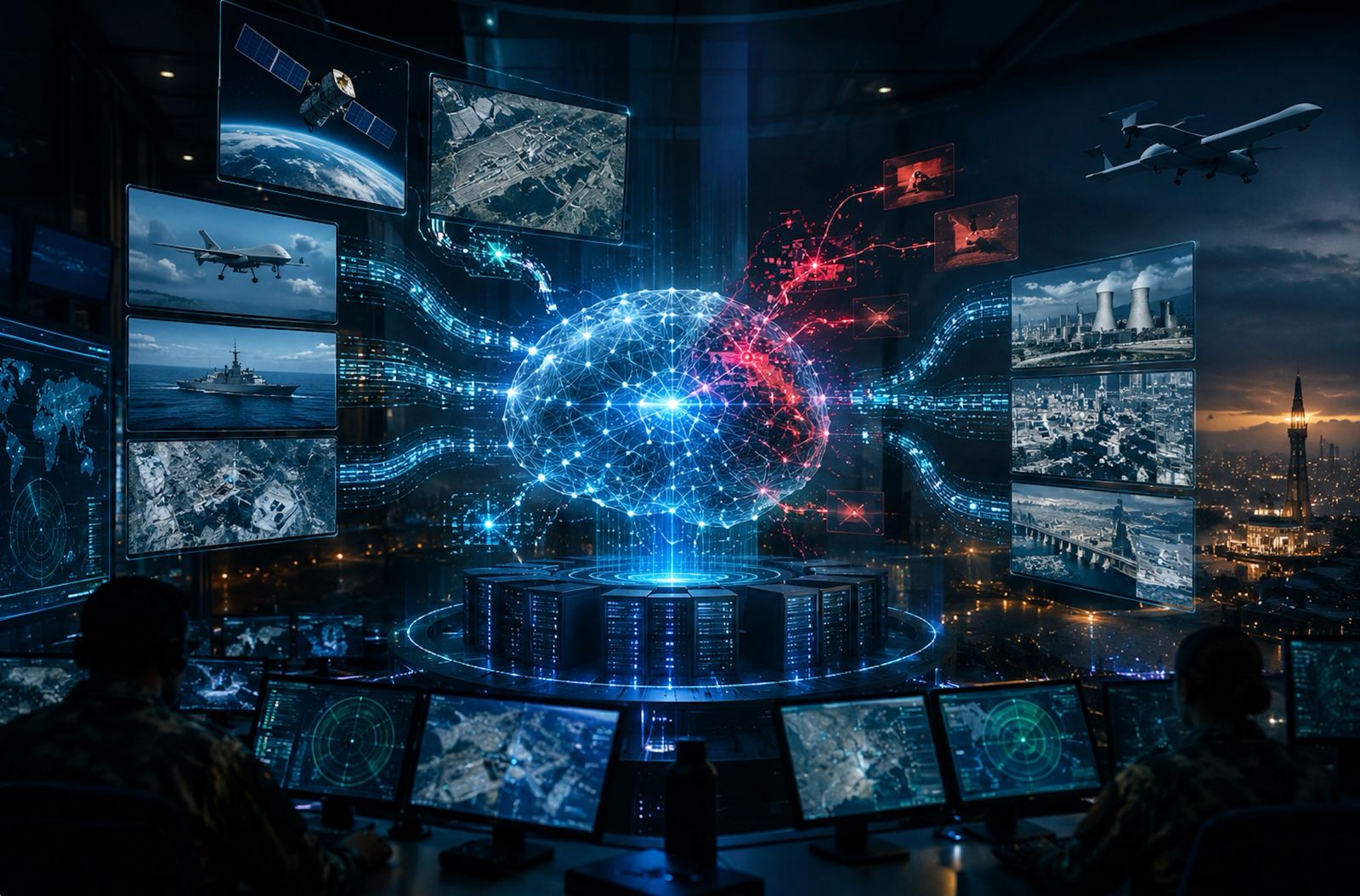
Advanced Artificial Intelligence (AI) systems are increasingly deployed to defend civilian and military infrastructure from emerging threats. Yet the same capabilities that make these systems effective autonomy, adaptability, and reliance on vast data also make them exploitable in ways existing security frameworks were never designed to address. This is not merely another cybersecurity challenge that can be solved with stronger firewalls and faster detection. It marks a fundamental shift in how vulnerability and risk are understood in the security domain.

AI-enabled targeting and intelligence systems require vast amounts of data to function effectively. This creates a complexity: the data required for algorithmic precision is scarcest precisely where irregular threats operate, risking flawed inferences, misattribution, and accountability gaps in targeting decisions under international humanitarian law.

Conventional defense and security architectures build on human decision-making and operate against a relatively predictable threat matrix. AI-enabled systems disperse that assumption. The threats they face are adaptive, capable of learning, and often emerge from system interactions that developers themselves do not fully understand. As a result, the most dangerous vulnerabilities no longer sit at the network perimeter; they now reside inside the AI-enhanced systems within the network itself. In recent research on AI in cybersecurity, this is a structural shift, not merely a new threat category.

The Evolving Threat Landscape

AI and Algorithmic systems integration across defense and security platforms creates a complex web of threats. Systems theorists have long argued that such risks reside not in individual components but in their interactions. This landscape presents a fundamentally different challenge: securing the dynamic interfaces between interconnected systems and applications, not merely the systems themselves.

Threat Vectors in AI-Enabled Systems

Understanding AI security requires mapping the specific threat vectors that traditional cybersecurity frameworks were not built to address:

  • Supply Chain Vulnerability poses a high risk where AI models can be compromised during training and development, embedding invisible biases that quietly influence downstream programmes, including strategic decisions. This threat vector indicates open-source dataset contamination, compromised defence-contractor pipelines, or unverified ingestion of sensor logs. Such as, when an AI detection system is used for automated target recognition (ATR), it can be compromised by open-source synthetic radar or satellite imagery. A small percentage of variation in target images or information, when introduced through specific levels of misinformation, may lead to miscalculation. It will lead to major disruptions in operations and overall assessment; for instance, civilian assets may appear to be high-value military targets.
  • Decision-making is a challenge in which it is difficult to trace AI’s influence on strategic assessment, creating uncertainty in critical processes once a system is suspected of compromise. Specifically, military decision frameworks are the rules, data flows, and command structures commanders use to evaluate threats and act. Adding AI turns these systems into hybrid human-machine mechanisms. It includes three contending factors: velocity mismatch, in which AI processes battlefield data in milliseconds, forcing human commanders to either blindly trust the machine or lose tactical advantage; opacity, the deep learning models do not show why they reached a specific conclusion, leaving decision makers unable to verify if a target or risk assessment is correct; Volatility of AI models fail unpredictably when faced with data they were not trained to handle, leading to sudden, catastrophic errors. This can cause chaos in emergencies and crises.
  • Interface Manipulation arises from unpredictable interactions between AI systems, letting attackers trigger malicious behaviour while the system continues to appear normal. Adversarial evasion alters operational data at the point of inference to deceive a deployed AI model without corrupting its underlying baseline data. This threat vector is associated with Electronic Warfare (EW), in which signal noise is injected into synthetic aperture radar (SAR) systems, or with deceptive acoustic profiles in submarine sonar processing. For example, an autonomous Unmanned Aerial Vehicle (UAV) uses computer vision for terrain navigation and threat identification. The tempering of physical modifications, such as specific geometric tape patterns on defence equipment or active infrared lighting pulses to a surface-to-air missile site. To a human operator, the target remains obvious, but the computer vision model fails to classify it due to high-dimensional (HD) feature distortion, blinding the autonomous platform’s target recognition system.
  • Speed is the defining vector of the threat landscape. The world is engaged in an information and AI systems race in which AI vulnerabilities grow exponentially. AI-based systems can manipulate and plan malicious actions faster than human defenders can detect. This asymmetry makes such systems difficult to defend while giving attackers powerful new tools. Deepfake material, social engineering content, and algorithmic manipulation can now be generated at scale in minutes; catching them still requires careful, often manual analysis.
  • The Governance-Accountability Gap is the counterproductive element of threat vectors. The most serious vulnerability is not technical; it is governance. Traditional security governance assumes clear, singular accountability resting with a human decision-maker. AI security instead requires frameworks built for distributed decision-making, where responsibility is shared among systems, developers, and end users. No amount of technical patching bridges that gap on its own. There is a pressing need to establish new frameworks for evaluating the operational value of AI system integration, and to ensure that human oversight remains substantive rather than merely nominal.

Mitigating AI-Specific Risks

Securing AI systems is complicated; the data that makes these systems useful is also the data that makes them targets. Defending against that requires a strategy spanning technology, process, and governance; they are mutually inclusive. The AI-specific security risks and their primary mitigation strategies can be understood through facts as follows.

  • The risk of data poisoning can be addressed by implementing robust validation and anomaly detection during data collection and conducting regular audits before installing datasets into strategic systems.
  • To mitigate the risks of integrating AI systems into decision-making tools, decision-support systems should undergo secure verification processes to validate the required AI program before integrating into the operational setup.
  • To address the risk of interface manipulation, privacy-preserving techniques such as differential privacy and output rate limiting can reduce the likelihood that AI systems memorise or expose sensitive inputs through user-facing interactions.
  • To address the speed challenge in AI systems, a zero-trust approach should be adopted, one that extends scrutiny to cognitive operations, not merely system access. This means requiring human verification for high-impact decisions, supported by decision-provenance tracking, continuous monitoring, and cognitive circuit breakers that can halt an automated process before a flawed decision compounds. This is a critical safeguard, not merely a computational function.
  • To bridge the gap in governance and accountability for AI systems frameworks. A one-time technical fix is inadequate. Securing AI integration requires an ongoing, comprehensive mechanism spanning the entire AI system lifecycle, from the end user.

Proposed Steps for Securing AI Systems Integration

As AI systems become deeply embedded in core strategic functions, they simultaneously expand across organisations and down to high-level setups. This section proposes an immediate, structured approach to securing AI integrations, addressing critical threats from data poisoning to model inversion before they impact the network.

Global AI Regulation: Current Trajectories and Compliance Trends

As artificial intelligence systems integrate deeply into global infrastructure, global and national governing bodies are shifting from theoretical frameworks to enforceable legal mandates. This article outlines the evolving regulatory landscapes across key jurisdictions, highlighting the immediate compliance implications for organisations.

Global AI regulation is fragmenting along three distinct tracks, and defence-adjacent AI systems increasingly sit at their intersection. The European Union has moved furthest toward binding law: the AI Act entered into force in August 2024, with prohibited-practice and AI-literacy provisions active since February 2025 and General-Purpose AI model obligations since August 2025, while the regulation became fully enforceable on August 2, 2026. Under the Digital Omnibus agreed in 2026, however, the compliance deadline for high-risk Annex III systems was deferred to December 2, 2027, giving organisations a longer runway, even as transparency duties remain binding. The Act explicitly excludes military and national-security applications from its scope, which limits its direct reach into defence AI even as it sets a de facto global compliance benchmark.

The United States (US) is navigating state-level processes and implementation options, including the balance between federal deregulation efforts and a growing body of state-level AI laws. China continues to regulate through targeted, sector-specific instruments, generative AI measures, algorithm-recommendation rules, and deep-synthesis governance rather than a single comprehensive statute.

For defence specifically, the more relevant instrument is the U.S.-led Political Declaration on Responsible Military Use of Artificial Intelligence and Autonomy, launched at the February 2023 REAIM Summit in The Hague, which had been endorsed by 58 states as of late 2024. Though non-binding, it commits endorsing states to auditable systems, rigorous lifecycle testing, senior-level review of high-consequence applications, and the ability to deactivate systems exhibiting unintended behaviour principles that map directly onto the zero-trust and provenance-tracking measures this paper recommends.

The practical implication for defence institutions: civilian AI law sets documentation and transparency norms worth adopting voluntarily, while military-specific governance remains soft law, making internal oversight architecture the primary safeguard until harder international norms emerge.

Conclusion

The paradox at the heart of AI-enabled defence systems is not resolvable through technology alone. The same properties that make these systems militarily valuable speed, adaptability, and dependence on vast data are precisely what render them structurally vulnerable in ways legacy security architectures cannot address. Supply chain contamination, interface manipulation, and the sheer velocity of machine-driven decisions have moved the locus of risk from the network perimeter to the cognitive core of the system itself.

What this threat landscape demands, above all, is a redefinition of accountability. Technical patches can close individual vulnerabilities, but they cannot substitute for governance frameworks built for distributed responsibility, where developers, operators, and institutions share ownership of outcomes that no single actor fully controls. Zero-trust principles, decision-provenance tracking, and human verification at high-impact junctures are not bureaucratic overhead; they are the mechanisms that keep speed from outrunning judgement.

Regulatory efforts like the EU AI Act signal that governments recognise the stakes, but compliance timelines will not keep pace with the threat curve. The defence and security community cannot wait for regulation to catch up; it must treat AI integration as an ongoing security discipline, not a one-time deployment decision.

Picture of Huma Rehman

Huma Rehman