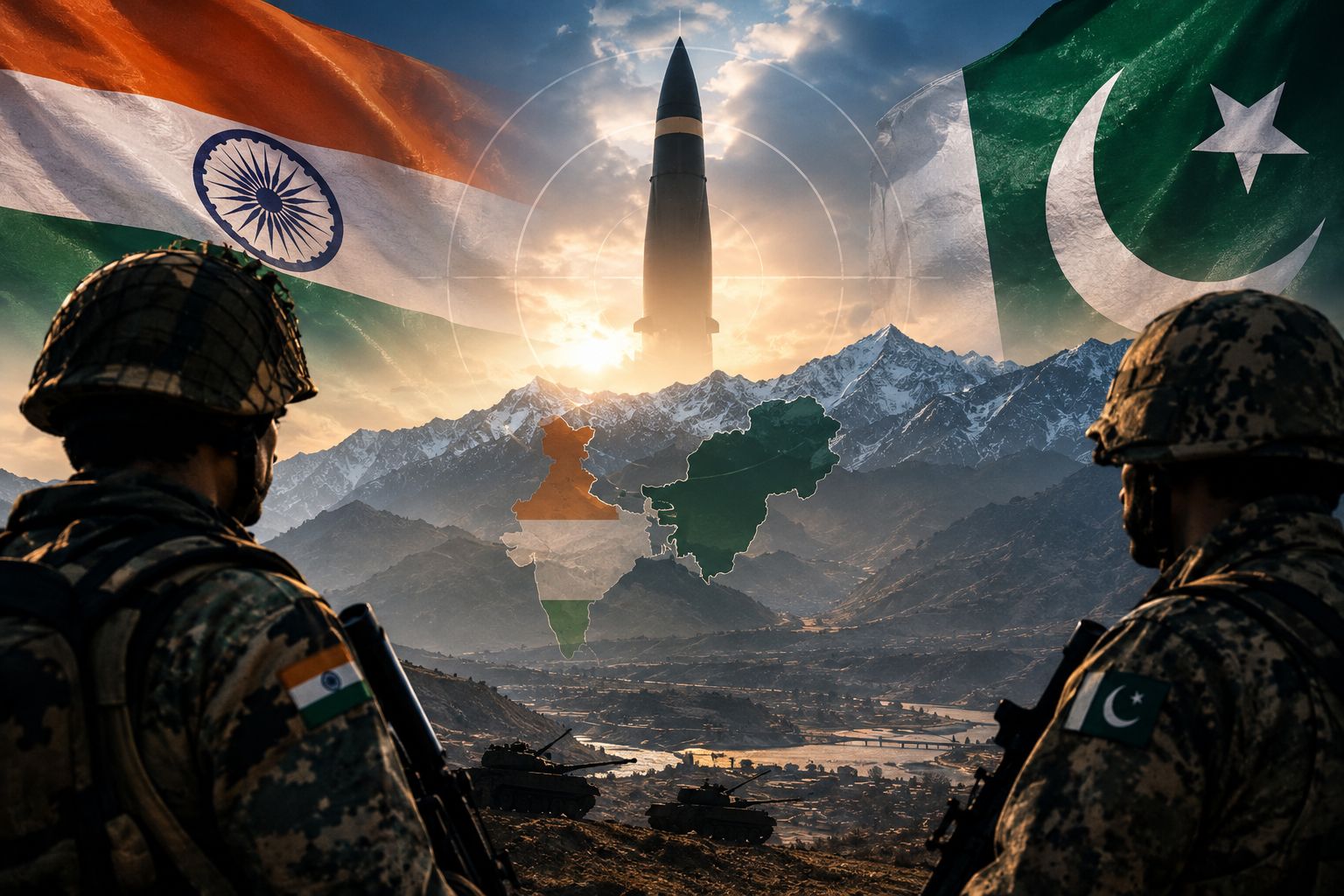
When India and Pakistan tested their nuclear weapons in 1998, many expected that the fear of nuclear escalation would make major conflict between them unthinkable. Instead, Kargil followed within a year. So did the 2001-02 military standoff, the 2019 Pulwama-Balakot crisis and the four-day conflict of May 2025, which SIPRI describes as “an unusually severe military crisis”. Yet none of these crises escalated into the kind of full-scale war the two states fought before overt nuclearisation. That is the paradox of nuclear deterrence in South Asia. Deterrence has not failed, but nuclear weapons have reshaped the kinds of conflict India and Pakistan are willing to contemplate. The question, therefore, is no longer whether nuclear weapons deter war, since the record of the past quarter century suggests that they do. The question is what exactly nuclear deterrence deters in South Asia and what it leaves undeterred.
The answer matters because South Asia has become a bounded arena of violence. Nuclear weapons impose an upper limit on escalation by making full-scale war extraordinarily risky. However, that same constraint has encouraged both India and Pakistan to conduct calibrated but dangerous contests, including limited conventional strikes, coercive signalling and escalatory episodes, without crossing the nuclear threshold. The competition is no longer about avoiding conflict altogether; it is increasingly about testing where the boundaries of acceptable conflict lie. This is the central challenge of contemporary deterrence in South Asia. The danger is no longer simply escalation to nuclear war. It is that both India and Pakistan increasingly believe they can manipulate the space below it.
Deterrence works best when the boundaries of acceptable behaviour, and the risks of crossing them, are understood by both sides. Its credibility depends as much on whether an adversary understands where those boundaries lie as on a state’s willingness to use force. In South Asia, those boundaries have become increasingly contested. India and Pakistan have developed divergent approaches to nuclear deterrence, whilst repeatedly probing the limits of conventional action under the nuclear shadow. As a result, managing escalation has become as important as deterring it.
Escalation is the process through which states test those boundaries. It occurs when an increase in the intensity or scope of conflict crosses a threshold “considered significant by one or more of the participants”, whether deliberately, accidentally or inadvertently. In South Asia, escalation management involves not only preventing nuclear use but also regulating the space for conventional military action beneath it. The record of India-Pakistan crises shows that three issues have consistently complicated that task: the coercive use of nuclear ambiguity, blurred conventional and nuclear thresholds, and competitive escalation below the nuclear threshold.
India and Pakistan approach nuclear thresholds differently. India couples a no-first-use pledge with a threat of retaliation that is “massive and designed to inflict unacceptable damage”, with no provision for graduated escalation. As an IISS study notes, this creates a credibility problem in responding to a low-yield battlefield strike and raises hard questions about proportionality. Pakistan’s policy of full-spectrum deterrence (FSD), by contrast, seeks to deter conflict across the spectrum while retaining deliberate ambiguity about the conditions of nuclear use. Its short-range, low-yield weapons are designed to halt a conventional incursion or to signal further escalation. To Indian planners, such use would be disproportionate; to Pakistani planners, a limited nuclear response to a conventionally superior adversary signals restraint rather than recklessness.
Together, these approaches create an asymmetrical escalation problem. Pakistan seeks deterrence by persuading India of its willingness to escalate while retaining ambiguity about when and how it would do so. India, in turn, seeks to preserve space for conventional action without accepting Pakistan’s nuclear threats as binding limits. Both positions have hardened since May 2025. Prime Minister Narendra Modi declared that India “will not tolerate any nuclear blackmail” and that operations against Pakistan had “only” been kept “in abeyance”, a stance that former Indian diplomat Rakesh Sood reads as “an upward jump in escalation thresholds”. The warning by Field Marshal Asim Munir, Pakistan’s army chief, in the United States in August 2025, that Pakistan could take “almost half of the world” down with it in an existential war, drew an Indian rebuke that “nuclear sabre-rattling is Pakistan’s stock-in-trade”.
The respect for redlines has also eroded. During the Kargil conflict, India signalled its readiness to escalate by raising the alert status of its forces and moving elements of its missile inventory, yet its cabinet set a firm limit that Indian forces would not cross the Line of Control (LoC), even when early operations were faltering. That restraint was shaped as much by Pakistan’s perceived redlines as by concerns over sanctions and diplomatic isolation.
Two decades later, the 2019 Pulwama-Balakot crisis suggested that those assumptions were changing. Indian aircraft struck not only across the LoC but also across the international border, at Balakot in Khyber Pakhtunkhwa, the first Indian air strike on undisputed Pakistani territory since 1971. The targeting boundaries had expanded. Pakistan’s retaliatory air operation the following day and the capture of an Indian pilot showed that Islamabad would answer in kind. Even so, the crisis remained contained, which persuaded many in New Delhi that a limited reprisal below the nuclear threshold was both possible and survivable.
The events of May 2025 pushed that logic considerably further. After militants killed 26 civilians at Pahalgam in April, India struck nine sites inside Pakistan on 7 May. Over the following three nights the exchange widened to cruise missiles, drones and, from Pakistan, conventionally armed Fatah ballistic rockets. By 10 May India had hit at least eleven Pakistani sites, including Nur Khan airbase near Rawalpindi, according to Stimson’s reconstruction. SIPRI assesses that some of the bases India attacked were likely to have nuclear-related roles. That marks a qualitative change, since conventional strikes now reached into infrastructure tied to the adversary’s deterrent. Pakistan’s rapid retaliation under Operation Bunyan-um-Marsoos offset India’s attempt to establish a new normal. Yet the military’s announcement that the Prime Minister had convened the National Command Authority (NCA), followed within hours by the defence minister’s denial that any meeting was held or scheduled, revealed Islamabad’s difficulty in establishing and communicating its own thresholds.
Taken together, these crises tell a broader story. India and Pakistan are not merely operating within established deterrence boundaries. They are actively renegotiating them.
This dynamic highlights a fundamental paradox. Nuclear weapons in South Asia simultaneously generate fear of escalation and incentivise limited conventional war. They gave Pakistan space to adopt an asymmetric escalation posture designed to deter Indian retaliation, and they convinced India that conventional war is possible below the nuclear threshold, within certain limits. India’s efforts to develop rapid, limited operations under the Cold Start concept illustrate the search for military space beneath the nuclear trigger. To deny that space, Pakistan developed short-range, low-yield nuclear weapons as part of FSD. The result has not been strategic stability in any simple sense, but an ongoing competition over where deterrence begins and ends.
Since May 2025, that competition has been institutionalised. In August 2025, Pakistan created an Army Rocket Force Command to field conventional Fatah-series rockets and cruise missiles. It could act as a firebreak, giving leaders credible non-nuclear options, or as a fuse that starts future crises on a higher rung of the ladder. In November 2025, Pakistan’s 27th Amendment created a Chief of Defence Forces and an army-held Commander of the National Strategic Command, changes that critics argue sit uneasily with the NCA Act of 2010 and leave lines of nuclear authority unsettled. India, for its part, quietly commissioned its third ballistic missile submarine, INS Aridhaman, in April 2026, and SIPRI’s Yearbook estimates that India now holds about 190 warheads against Pakistan’s 170, with 12 Indian warheads deployed with operational forces. In October 2026, Lieutenant General (Retd) Khalid Kidwai, adviser to the NCA, warned that India’s sea-based deployment and canisterised missiles meant it “can undertake a first strike against Pakistan at zero notice”, and that Pakistan would “review and reconsider all options for appropriate deployments”. Each side now reads the other’s modernisation as a bid for escalation dominance, which narrows the space in which ambiguity can be safely managed.
This competition has also altered attitudes towards nuclear coercion. Verbal nuclear threats and missile readiness during Kargil and missile tests during the 2001-02 standoff demonstrated the coercive role nuclear weapons could play in crisis management while reinforcing the risks of further escalation. However, the Indian strikes of 2019 and 2025 signal New Delhi’s growing refusal to treat Pakistan’s nuclear signalling as a binding constraint and its attempt to establish a new normal below the nuclear threshold. Pakistan’s response has been to add conventional rungs to its own ladder rather than to sharpen its nuclear redlines. The contest has also spread beyond the battlefield. India has held the Indus Waters Treaty in abeyance since April 2025, and in July 2026 the LoC saw its first heavy firing since the ceasefire.
This does not mean that nuclear deterrence has ceased to function. Quite the opposite, the absence of large-scale war remains powerful evidence that deterrence continues to impose meaningful constraints on decision-makers, and both sides took deliberate steps to calibrate their strikes in May 2025. What has changed is the character of competition under deterrence.
The recurrent crises between India and Pakistan demonstrate that nuclear weapons prevent the most dangerous form of conflict while encouraging competition below the nuclear threshold. Conventional precision strikes, nuclear ambiguity and competing efforts to establish escalation dominance make deterrence less stable but not less powerful. This does not mean that India and Pakistan need sharply defined nuclear redlines. A high level of clarity could make deterrence more brittle by reducing uncertainty and potentially encouraging risk-taking just below declared limits. Some degree of ambiguity remains useful in promoting caution.
The challenge, therefore, is not to eliminate ambiguity altogether. It is to prevent ambiguity from becoming an invitation to test boundaries repeatedly during crises. The existing architecture shows what is possible. The Directors General of Military Operations (DGMO) hotline helped produce the 10 May ceasefire, although a BASIC study finds that face-saving narratives and third-party facilitation, principally by the United States, mattered just as much. In January 2026, the two states completed their 35th consecutive exchange of lists under the 1988 agreement prohibiting attacks on nuclear installations, even without any political dialogue. Building on that foundation, three steps would help. The first is a quiet political back channel to complement the military hotline, since Sood questions whether outside mediators would prove as effective next time. The second is extending the logic of the 1988 agreement to command-and-control and dual-use delivery infrastructure, given that conventional strikes now reach such sites. The third is widening the 2005 missile test pre-notification agreement, which excludes cruise missiles, to cover the cruise missiles and emerging hypersonic systems now entering both arsenals.
Such measures would not eliminate competition below the nuclear threshold. They would, however, make that competition safer. In nuclear South Asia today, the greatest danger lies not in either side wanting nuclear war or deliberately triggering it. It lies in the growing belief on both sides that they can manipulate the space below it.