

Publications
Saudi Arabia, the Houthis, and Bab al-Mandab: Prospects for Military Victory
Dr Hichem Karoui
Policy Brief Series
Policy Brief/007/October/2026/London-Dialogue. 29 October 2026
By Dr Hichem Karoui
Introduction
Is Saudi Arabia, with all its allies, able to win a military victory against Ansar Allah (Houthis)? The short answer is that Saudi Arabia and a broad coalition can degrade Houthi military capabilities, protect selected shipping, impose costs, and perhaps compel tactical pauses. They are unlikely, however, to obtain a durable, comprehensive military victory defined as destroying Ansar Allah as an effective political-military organisation, restoring a unified friendly government in Sana’a, and permanently securing Bab al-Mandab without a massive and politically risky ground war.
The central distinction is between battlefield superiority and war termination. Coalition forces possess overwhelming advantages in air power, naval power, intelligence, surveillance, precision strike, logistics, and finance. Yet Ansar Allah holds territory, governs through coercive institutions, recruits locally, operates within difficult highland terrain, and can use dispersed missiles, drones, mines, and small boats at low cost. Research on the 2023–25 Red Sea campaign concludes that multinational conventional superiority did not reliably deter because of asymmetric costs, divided command structures, and the Houthis’ management of escalation thresholds.
The most plausible favourable outcome is therefore armed containment backed by negotiation: stronger defences around Saudi territory and shipping; persistent interdiction and selective strikes; support for a more coherent Yemeni balance of power; and a Saudi-Houthi arrangement covering the border, attacks on the kingdom, salaries and revenues, ports, roads, and de-escalation. Such a strategy would not “solve” Yemen or disarm the Houthis. It could, however, reduce the threat to Saudi Arabia and make Red Sea attacks less frequent and more politically costly.
Defining Victory
“Victory” contains four separate objectives that should not be conflated.
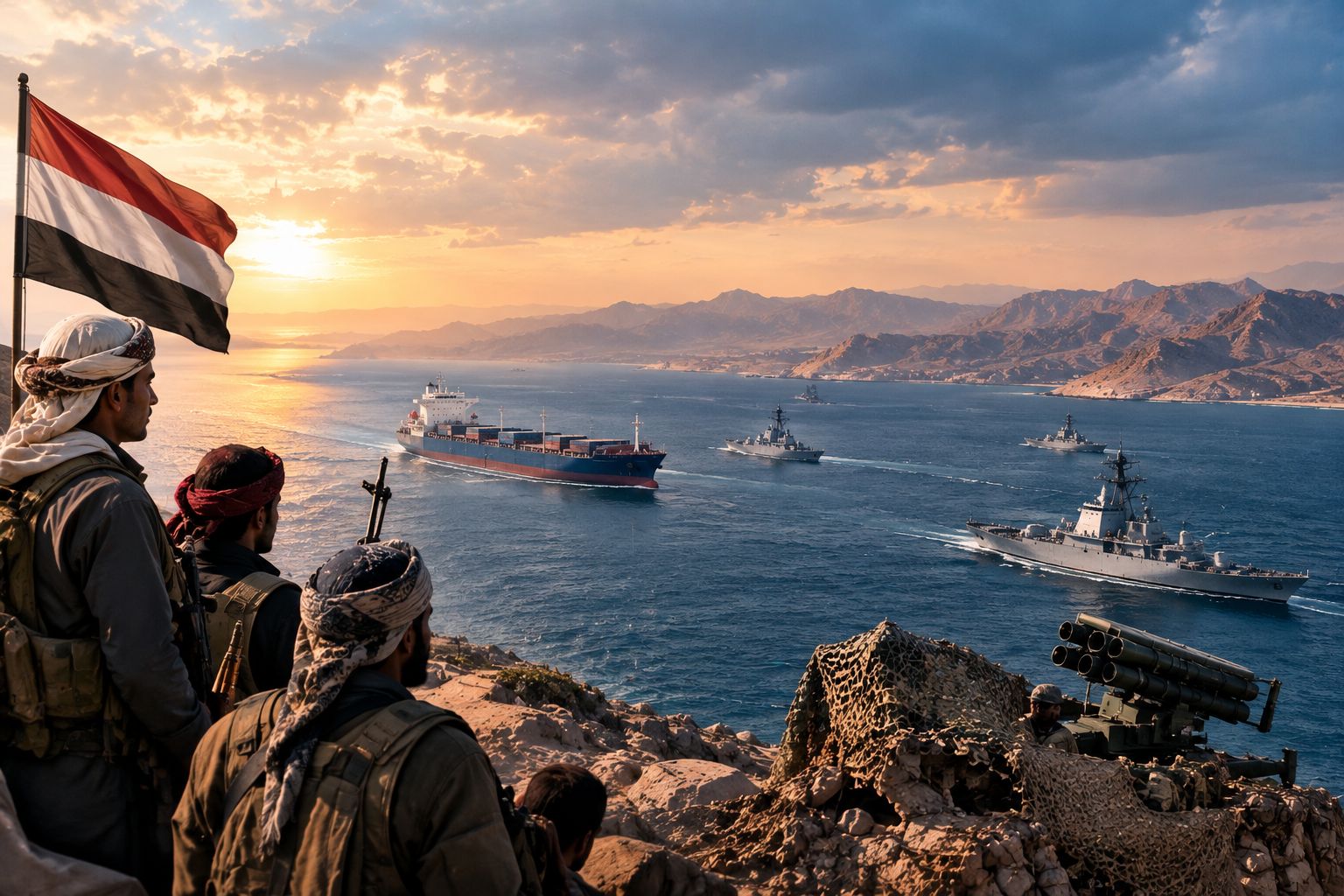
This distinction matters because the Houthis don’t need to control the sea to disrupt it. They need only retain enough coastal access and target information, plus mobile launchers, drones, missiles, mines, or unmanned boats, to create unacceptable risk for commercial operators. Since late 2023, attacks from northwestern Yemen have caused sustained rerouting around the Cape of Good Hope, illustrating how limited land-based capabilities can impose strategic effects far offshore.
Why Superiority Is Insufficient
- The Houthis Are Entrenched.
Ansar Allah is no longer merely an insurgent formation. It has evolved into a de facto governing authority with political, security, ideological, fiscal, and coercive institutions across northern Yemen. The Yemeni state and humanitarian system are now structurally bifurcated between Houthi-held and government-held areas, while internationally recognised government institutions retain limited administrative capacity.
Removing such an actor requires more than destroying weapons. A successful offensive would have to penetrate the northern highlands, take and hold major population centres, dismantle internal security networks, replace public administration, prevent guerrilla regeneration, and manage tribal and regional bargains. The 2015–22 Saudi-led intervention failed to achieve its stated strategic objectives despite years of air operations, extensive spending, and support for local forces; subsequent scholarship attributes that record partly to institutional and operational shortcomings in the coalition.
- The Coalition Lacks One End State
The phrase “Saudi Arabia … with all its allies” can overstate political cohesion. Saudi Arabia’s priority is border security and protection of its economic transformation; the UAE has cultivated southern and coastal partners and has distinct interests in ports, islands, and southern politics; Yemen’s Presidential Leadership Council contains competing factions; Western navies prioritise freedom of navigation; and Israel’s priority is deterring attacks on its territory and shipping. These agendas overlap tactically but do not automatically produce agreement over who should govern Sana’a, Hodeidah, Aden, or a postwar Yemen.
The anti-Houthi side’s internal fragmentation is not peripheral—it is a centre of gravity. By 2026, Yemen’s principal frontlines had remained broadly frozen since the April 2022 truce, while major violence increasingly occurred inside the anti-Houthi camp. A coalition can coordinate strikes without resolving this political fragmentation; it cannot translate strikes into a legitimate national order unless its Yemeni partners agree on command, resources, territorial administration, and the status of the south.
- Air Campaigns Have Limits
Air and missile strikes can destroy known storage sites, radars, launchers, ports, workshops, command nodes, and senior personnel. They can slow operational tempo and force dispersal. But they face diminishing returns against mobile launch systems, tunnels, decoys, redundant command structures, locally adapted manufacturing, and weapons hidden among civilian infrastructure.
This creates an unfavourable strategic exchange. The defender can threaten a high-value merchant vessel with comparatively inexpensive systems, while the coalition must maintain continuous surveillance and may expend costly interceptors. The 2023–25 campaign’s failure to establish lasting deterrence has been linked to this asymmetric cost structure and fragmented response architecture. Even a technically successful strike campaign may therefore suppress attacks without removing the capability or political motive to resume them.
- Bab El-Mandab Is A Land-Sea Problem
The strait is approximately 32 kilometres wide and links the Gulf of Aden and Indian Ocean to the Red Sea and Suez route. Naval escorts and air defence can lower the probability that an attack succeeds, but they cannot guarantee commercial confidence. Shipowners respond not only to actual losses but also to insurance premiums, crew safety, schedule uncertainty, and the possibility of escalation.
Durable maritime security consequently requires action ashore: persistent intelligence; control or monitoring of launch areas; interdiction of weapons and components; pressure on command networks; and political arrangements that reduce the incentive to attack. Recent scholarship describes the Red Sea as a hybrid security arena in which terrestrial conflict and maritime coercion have merged, making purely naval solutions inherently incomplete.
What A Decisive Campaign Requires
A campaign aimed at regime defeat rather than limited degradation would probably require simultaneous operations on several axes:
- A western-coast offensive to take or isolate Hodeidah, Salif, and Ras Isa and launch areas overlooking the southern Red Sea.
- Pressure from Marib and al-Jawf to stretch Houthi forces and threaten Sana’a from the east.
- Operations around Taiz to reopen routes and prevent reinforcement between fronts.
- Persistently interdict arms, dual-use components, finance, fuel, and targeting support.
- An integrated air-and-missile campaign against command, production, storage, and launch networks.
- A unified Yemeni command able to hold territory, pay forces, police liberated areas, and deliver basic services.
- A credible post-conflict political settlement addressing northern Zaydi constituencies, tribal interests, southern demands, revenue sharing, and local autonomy.
The last two requirements are the hardest. Without legitimate local forces and an agreed political order, external air power risks enabling territorial advances that cannot be consolidated. Conversely, a large foreign ground deployment would give the Houthis a powerful nationalist mobilisation narrative and expose coalition troops to mountain warfare, mines, ambushes, drones, and missile attacks.
A western-coast campaign also carries humanitarian and commercial dangers. Hodeidah is not simply a military node; disruption around the port and transport system could intensify civilian hardship in a country whose health and public-service systems have already been devastated by prolonged war. Any assault that interrupts imports or aid would face international opposition and could convert tactical gains into strategic and reputational losses.
Probability Assessment
The following ranges are analytic judgments for roughly the next 12–24 months, not statistical forecasts.
The key implication is that the easiest military objective—degradation—is not the same as the most important political objective—durable security. Force can improve bargaining leverage and deny specific capabilities. It cannot by itself determine Yemen’s governing settlement or permanently eliminate low-cost maritime coercion.
Factors That Could Improve Prospects
- A unified Yemeni coalition
The most important improvement would be political, not technological: a functioning compact among the Presidential Leadership Council, southern actors, west-coast forces, tribal networks, and local authorities. It would need a common chain of command, reliable salaries, transparent revenue allocation, and an agreed-upon interim formula for the southern question. Without these, additional weapons may intensify competition inside the anti-Houthi camp rather than generate strategic momentum.
- Persistent Interdiction
The coalition would need to shift from episodic retaliation to an intelligence-led interdiction system covering maritime routes, overland networks, finance, dual-use imports, local assembly, and targeting support. Total blockade is neither feasible nor desirable; it would impose severe humanitarian costs. The practical aim should be to raise the cost and slow the replenishment of sophisticated components while preserving civilian trade and aid.
- Layered Maritime Defence
A viable Bab el-Mandab posture would combine escort corridors, airborne and space-based surveillance, electronic warfare, counter-drone systems, mine countermeasures, rapid attribution, and pre-agreed rules for proportionate retaliation. The goal should be resilient navigation, not the unrealistic promise of complete protection from missile or drone penetration. The sharp drop in vessel traffic and subsequent rerouting after the attacks show that military interception must be paired with credible risk communication to insurers and shipping firms.
- A Political Off-Ramp
A settlement must move beyond the older assumption that Yemen can simply return to the pre-2014 political order. A 2025 assessment argues that mediation has been constrained by an increasingly unrealistic framework and recommends acknowledging rival governance realities, facilitating Riyadh-Sana’a talks, and opening a broader inter-Yemeni dialogue. This does not require legitimising coercive Houthi practices; it recognises that disarmament and institutional reintegration are more likely to emerge from a phased political bargain than from maximalist preconditions.
- Escalation Risks
A renewed Saudi-led war would expose the kingdom to missile and drone retaliation against airports, desalination facilities, energy installations, ports, and investment projects. Even where defences intercept most attacks, occasional penetration could have disproportionate economic and psychological effects. The Houthis could also broaden target definitions in the Red Sea, use deniable attacks, or seek to draw Saudi Arabia into a wider confrontation linked to Israel, Iran, or Gaza.
Coalition escalation could strengthen rather than weaken Houthi domestic legitimacy. Ansar Allah has repeatedly framed external attacks as proof that it defends Yemeni sovereignty and the Palestinian cause. Civilian casualties or damage to ports would amplify that narrative, complicate local defections, and place pressure on Western and Arab partners.
There is also a war-termination problem. If strikes degrade capabilities without a negotiated exit, the coalition may become trapped in an open-ended cycle: Houthi attack, interception and retaliation, tactical pause, rearmament, and renewed attack. The evidence from the Red Sea campaign suggests that conventional punishment alone struggles to alter behaviour when the armed actor gains status, mobilisation, and bargaining leverage from confrontation.
Strategic Course
Saudi Arabia’s optimal strategy is not passivity but coercive containment:
- Maintain strong homeland air and missile defence and strengthen border surveillance.
- Support maritime defence and intelligence without assuming that naval operations can settle Yemen’s land war.
- Condition assistance to Yemeni partners on command integration, fiscal accountability, and non-aggression inside the anti-Houthi camp.
- Do not conduct a maximalist bombing campaign with no political end state. Retain credible, limited strike options against imminent threats.
- Develop a Saudi-Houthi security arrangement including cross-border attacks, buffer mechanisms and verification.
- Link economic incentives (salary regimes, port access, road openings, revenue arrangements) to phased de-escalation and monitoring.
- Launch an inter-Yemeni track addressing governance, resources, southern self-determination claims, and security-sector arrangements.
- Build a permanent Red Sea security mechanism with Egypt, Djibouti, Eritrea, Somalia, Gulf partners, major naval powers, and commercial shipping stakeholders.
This approach accepts an uncomfortable reality: the near-term objective is not Houthi capitulation but a change in the incentive structure. Saudi Arabia should seek to make attacks less effective, replenishment harder, internal governance more costly, and de-escalation more rewarding—all while preventing its Yemeni partners from fracturing.
Outlook
A Saudi-led coalition could win battles and seriously damage Houthi capabilities. It is unlikely to achieve an unambiguous military victory that simultaneously pacifies northern Yemen, rebuilds a unified state, and permanently secures Bab el-Mandab. The movement’s territorial entrenchment, the resilience of asymmetric weapons, the fragmentation of its opponents, and the absence of an agreed post-Houthi order make that outcome improbable.
The strongest prospect is a negotiated and deterrence-backed modus vivendi: Saudi territory becomes largely insulated; the main Yemeni front remains contained; shipping receives layered protection; and Red Sea escalation is managed through regional diplomacy. Such an outcome would be incomplete and reversible, but it is strategically more attainable than regime-change warfare and better aligned with the kingdom’s security and economic interests.
Dr Hichem Karoui
Related posts
Can Britain Bring Iran Back to the Table?
Yemen’s Forgotten Human Rights Crisis: Geopolitical Rivalries, Maritime Security and the Cost of War
The Democratic ‘Tsunami’: What It Means for Trump’s War on Iran?
What the Democratic Sweep in the US Midterm Elections Means for Trump’s Iran Policy and Gulf Security
Breaking the Taboo: The Strategic Folly of a US Nuclear Strike on Iran
Blurred Lines: Federalism and Provincial Autonomy in Pakistan
Paper Shields: The Makkah Pact and the Hard Test of Collective Defence
Iran’s Axis of Resistance Now: Less Than an Axis, More Than Resistance?
Leading through Uncertainty: Building Resilient Interdependence in a Multipolar World
Why Does the Game of Chicken Between Iran and the United States Keep Going?

Trojan APCs: Ukraine’s Kamikaze BTR-60s in Operation Vivaldi
The Emissions We Do Not Count: Militaries and the Missing Climate Ledger
London Dialogue — Founding Statement
Publication Categories
- Analysis (117)
- Book Review (1)
- Commentary (8)
- Essay (17)
- Journal (0)
- Journal Article (0)
- Policy Brief (7)
- Policy Paper (1)
- Research Article (3)
- Research Report (6)
- Young Writers Corner (0)