

Publications
Sanctioning the Unownable: Crypto, Code and the Limits of Financial Statecraft
Fatima Mehr
Essay Series
Essay /015/October/2026/London-Dialogue. 22 October 2026
Author: Fatima Mehr
Sanctioning the Unownable: Crypto, Code and the Limits of Financial Statecraft
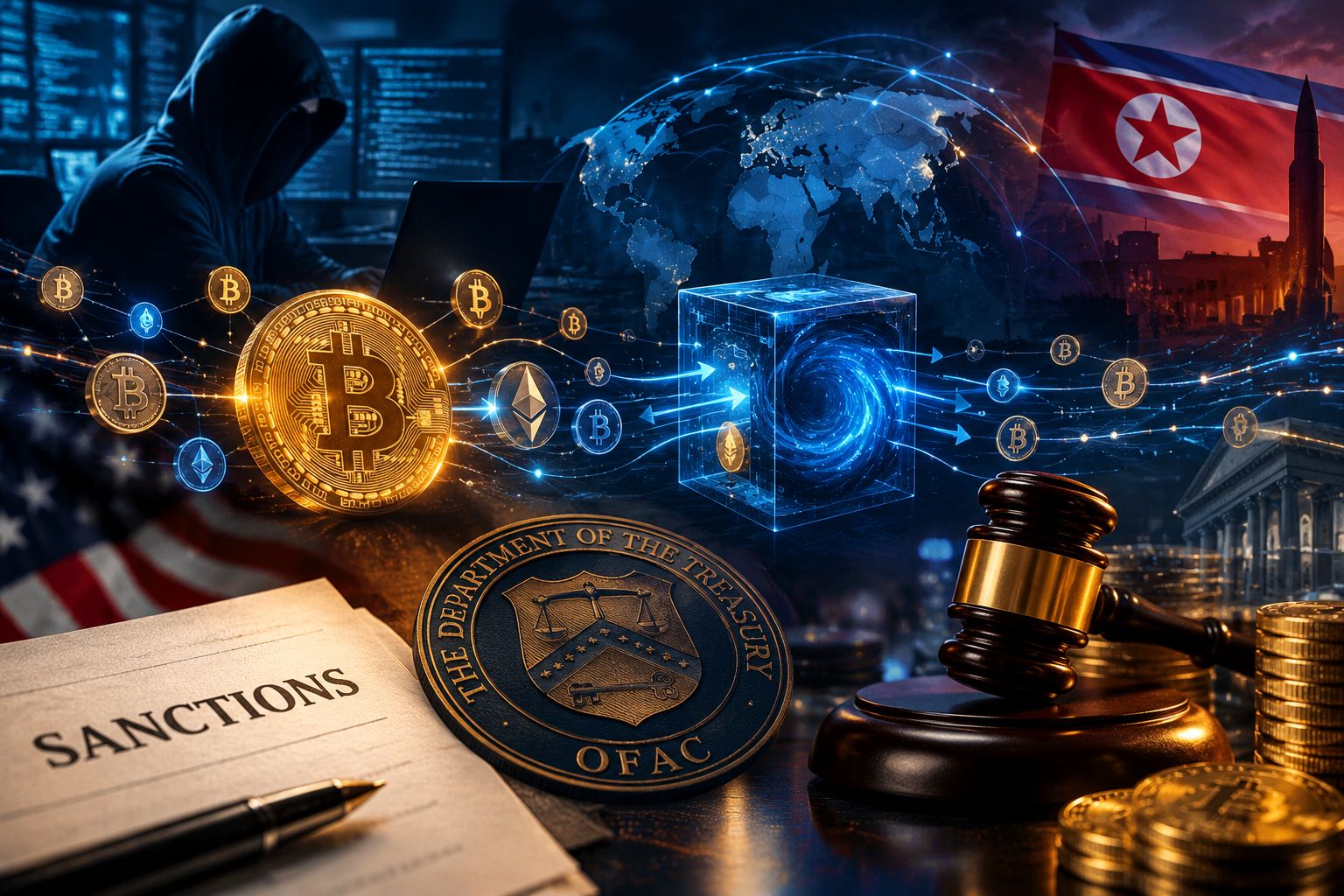
In February 2025, roughly 1.5 billion dollars in digital assets drained out of the cryptocurrency exchange Bybit in a matter of minutes, the largest theft of any kind in financial history. Within days the Federal Bureau of Investigation had attributed the heist to the Lazarus Group, the hacking arm of the North Korean state, and watched the stolen funds scatter across thousands of wallets and through the mixing services that launder digital money. By the time Bybit secured a United States asset freeze against North Korea in August 2026, most of the money was long gone. The episode captured, in a single case, the problem now facing every government that relies on financial pressure as an instrument of power. The sanctions regime was built to freeze property held by people and institutions, and a growing share of the world’s illicit money now moves as something that is neither.
Economic sanctions are the West’s preferred coercive tool precisely because they promise pressure without troops. Their machinery, administered in the United States by the Treasury’s Office of Foreign Assets Control, works by designating named persons and entities and then blocking the property they own or control, enforced through a banking system that still runs, in the end, through a handful of correspondent institutions and the dollar. That design assumes an owner who can be named and an asset that can be frozen. For most of the history of financial statecraft, the assumption held, because money sat in accounts, and accounts belonged to somebody.
Cryptocurrency strains that assumption, and one case has exposed the strain more sharply than any other. In 2022 the Treasury sanctioned Tornado Cash, an Ethereum mixing service that obscures the trail between sender and recipient and which North Korean launderers had used heavily. A group of users challenged the designation, and in November 2024 the Fifth Circuit ruled in Van Loon v. Department of the Treasury that the agency had exceeded its authority. The court’s reasoning went to the heart of the matter. The mixer’s immutable smart contracts, the self-executing lines of code that actually move the funds, cannot be owned, altered or controlled by anyone, and so they are not property within the meaning of the sanctions statute. You cannot freeze what nobody holds. In March 2025 the Treasury delisted Tornado Cash altogether. The law had met a technology that its central concept simply did not fit.
The decision cut in two directions at once, which is what makes it such a rich problem for a lawyer. It protected a genuine principle, because a mixing protocol is a neutral tool that privacy-conscious users and criminals alike can pick up, and sanctioning the software itself sits awkwardly with the principle that liability should follow conduct rather than attach to a line of code. Yet it also left a visible hole in the enforcement net, because the same immutability that places the code beyond ownership places it beyond the reach of a freeze order. The court was careful to say that Congress, not the judiciary, should decide whether the sanctions statutes ought to be rewritten for a decentralised age, an invitation that has so far gone unanswered.
It would be comfortable to treat all this as a narrow doctrinal defeat, were the threat it concerns not so large and growing. Blockchain analysts at Chainalysis estimate that sanctioned jurisdictions and entities moved around 104 billion dollars in cryptocurrency during 2025, and in March 2026 the Financial Action Task Force warned that stablecoins, the dollar-pegged tokens that now carry most crypto value, have become the rail of choice for evasion and laundering. North Korea funds a meaningful part of its weapons programmes this way, having turned the mixers and decentralised services that the RUSI has studied into a standing laundering machine. The enforcement need has not receded; the instrument built to meet it has buckled.
The response now taking shape is a quiet shift in where the law reaches. Rather than sanctioning autonomous code, regulators are turning to the points in the system that remain unavoidably human and corporate: the centralised exchanges that convert digital assets into spendable currency, the issuers of stablecoins who keep the technical ability to freeze individual tokens, and the fiat on and off ramps where crypto meets the banking system. The Financial Action Task Force travel rule, which requires virtual asset service providers to identify the parties to a transfer, pushes in the same direction as does the European Union’s markets in the crypto-assets regime. The strategy is to regulate the people and companies at the edges of a decentralised network rather than the network itself, because the edges can still be named, licensed and held to account, even as the shadow economy at the centre keeps growing.
This is the real frontier of financial technology law, and it is more than a technical adjustment. Sanctions work by controlling chokepoints, and decentralisation is, at its core, an attack on the very idea of a chokepoint. The contest is therefore not a simple matter of the law catching up with the code, a framing that flatters the law and misreads the technology. It is a question of whether states can rebuild chokepoints at the margins of the system faster than the technology dissolves them at the centre, and whether they can do so without the kind of blunt overreach the Fifth Circuit rejected. For an international order that increasingly reaches for financial coercion as its alternative to armed force, the answer will help decide how much that alternative is still worth.
Fatima Mehr
Related posts
Can Britain Bring Iran Back to the Table?
Yemen’s Forgotten Human Rights Crisis: Geopolitical Rivalries, Maritime Security and the Cost of War
The Democratic ‘Tsunami’: What It Means for Trump’s War on Iran?
What the Democratic Sweep in the US Midterm Elections Means for Trump’s Iran Policy and Gulf Security
Breaking the Taboo: The Strategic Folly of a US Nuclear Strike on Iran
Blurred Lines: Federalism and Provincial Autonomy in Pakistan
Paper Shields: The Makkah Pact and the Hard Test of Collective Defence
Iran’s Axis of Resistance Now: Less Than an Axis, More Than Resistance?
Leading through Uncertainty: Building Resilient Interdependence in a Multipolar World
Why Does the Game of Chicken Between Iran and the United States Keep Going?

Trojan APCs: Ukraine’s Kamikaze BTR-60s in Operation Vivaldi
The Emissions We Do Not Count: Militaries and the Missing Climate Ledger
London Dialogue — Founding Statement
Publication Categories
- Analysis (117)
- Book Review (1)
- Commentary (8)
- Essay (17)
- Journal (0)
- Journal Article (0)
- Policy Brief (7)
- Policy Paper (1)
- Research Article (3)
- Research Report (6)
- Young Writers Corner (0)