
Publications

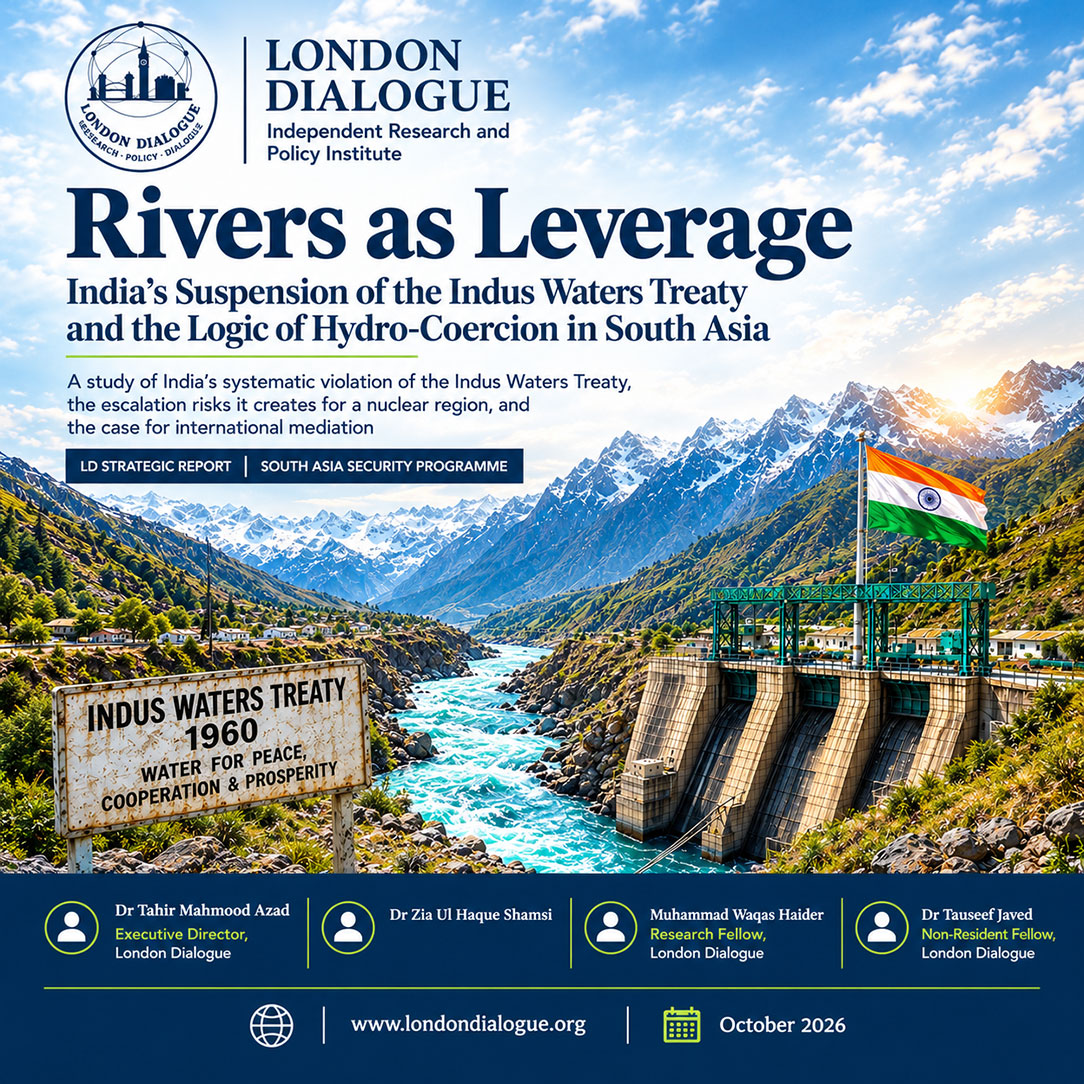
Rivers as Leverage: India’s Suspension of the Indus Waters Treaty and the Logic of Hydro-Coercion in South Asia

Picture of Tahir Azad

Tahir Azad

Research Report

Research Report/04/October/2026/London-Dialogue. 09 October 2026

Authors: Dr Tahir Mahmood Azad, Dr Zia Ul Haque Shamsi, Muhammad Waqas Haider and Dr Tauseef Javed.

Executive Summary

The problem. On 23 April 2025, one day after the Pahalgam attack in which 26 civilians were killed, India announced that it would hold the Indus Waters Treaty (IWT) in abeyance until Pakistan credibly and irreversibly ended support for cross-border terrorism. Within two weeks, the two countries fought a four-day military conflict involving missile strikes, air battles, and attacks on air bases deep inside each other’s territory. A ceasefire was reached on 10 May 2025 with American involvement. However, the treaty was not restored. Through 2026, India’s External Affairs Minister, Water Resources Minister, and Home Minister have all confirmed that the abeyance stands, with the Home Minister saying the treaty “will never be restored”. Pakistan calls the treaty fully operational and binding, has taken the matter to the United Nations Security Council (UNSC), and has warned publicly that it would treat any attempt to stop its waters as an act of war.

What this report argues. The report examines India’s actions as hydro-coercion, using an upstream position on a river to pressure a downstream state. It reaches five main findings.

First, coercion is currently more symbolic than real, but it is becoming real. The treaty limited India to run-of-the-river projects on the three western rivers, with very little storage. India today cannot hold back the roughly 135 million acre-feet that flow into Pakistan each year; its total permitted storage on those rivers is about 3.6 million acre-feet. The much-publicised flow interruptions in May 2025 lasted at most a few days. The danger lies in the trajectory. India has accelerated a chain of projects on the Chenab, including Ratle, Pakal Dul, Kiru, Kwar, and Dulhasti Stage II, and has advanced diversion schemes such as the Chenab-Beas link. Over five to ten years, these works will give India greater control over flow timing, especially in the dry season, when timing is everything for Pakistani agriculture.

Second, the policy damages India more than it damages Pakistan. Legally, India now openly defies the treaty’s own Court of Arbitration, which ruled in June 2025 that the treaty contains no provision for unilateral abeyance and in May 2026 that it places firm limits on India’s water-control abilities. Diplomatically, India has handed Pakistan a strong legal narrative at the Security Council, where Pakistan sits as an elected member. Economically, a permanent confrontation with a nuclear neighbour raises India’s risk premium and works against its ambition of sustained high growth. Strategically, India is teaching a lesson it will not enjoy learning from others: India is itself a downstream state on rivers that rise in Chinese-controlled territory.

Third, the Modi government’s domestic politics drives the policy and makes retreat difficult. The suspension is popular at home and fits a governing style built on Hindu majoritarian nationalism practicing Hindutva philosophy, muscular responses to Pakistan, and the framing of Muslims, inside and outside India, as a threat. Documented hate speech against minorities in India rose from 668 incidents in 2023 to 1,318 in 2025, most of them in states governed by the ruling party. A government that has staked its prestige on the slogan that blood and water cannot flow together has left itself little room to restore the treaty without appearing weak. This is the classic shape of a commitment trap.

Fourth, the nuclear factor cannot be ignored, and it is worsening. India and Pakistan held an estimated 190 and 170 warheads, respectively, in January 2026, and both are adding new delivery systems, sea-based weapons, and multiple-warhead missiles that shorten decision time in a crisis. Pakistan’s nuclear doctrine exists precisely to protect the state against threats it cannot meet by conventional means, and its officials have repeatedly placed water in that category. The May 2025 conflict showed that both sides believe they can strike each other’s territory and manage the escalation. That belief is the single most dangerous idea in South Asia today. The report traces a realistic pathway in which a dry-season flow crisis, a strike on water infrastructure, and compressed decision timelines combine to carry a limited war toward a full-scale one, and from there toward possible nuclear use, no matter how limited it could be. The pathway is not a prediction. It warns that probabilities are moving in the wrong direction.

Fifth, international mediation is not optional; it is built into the treaty itself. The IWT is not a purely bilateral bargain. The World Bank negotiated it, signed it for specified purposes, and appointed its neutral experts and arbitrators. Pakistan has formally approached the Security Council (SC). The United States (US) showed in May 2025 that it retains decisive crisis influence. The report sets out a staged mediation plan: quiet resumption of hydrological data-sharing as a humanitarian measure; a face-saving parallel process that addresses India’s terrorism concerns and the treaty’s genuine need for climate-era modernisation; and a return of both parties to the treaty’s dispute machinery. It also recommends practical steps for the United Kingdom (UK), the Gulf states, and China, each of which holds specific leverage.

The bottom line. India’s suspension of the IWT is a strategic blunder by the Modi government in an attempt to project power. It delivers modest pressure on Pakistan today at the price of dismantling the one institution that kept water out of South Asia’s wars. However, both countries’ arsenals are growing, and their threshold for using force is falling. If the abeyance becomes permanent and India’s storage capacity matures, a future water crisis will be harder to stop than the May 2025 crisis. Some ladders are easier to climb than to descend. As the treaty’s guarantor, the international community should act now, while the climb can still be prevented

Read The Report here

Picture of Tahir Azad

Tahir Azad