

Publications

Religious Rhetoric Around the Mecca Defence Agreement and Its Long-Term Impacts for Pakistan

Picture of Dr Tauseef Javed

Dr Tauseef Javed

Analysis Series

Analysis/0092/September/2026/London-Dialogue. 29 September 2026

By Dr. Tauseef Javed

Introduction

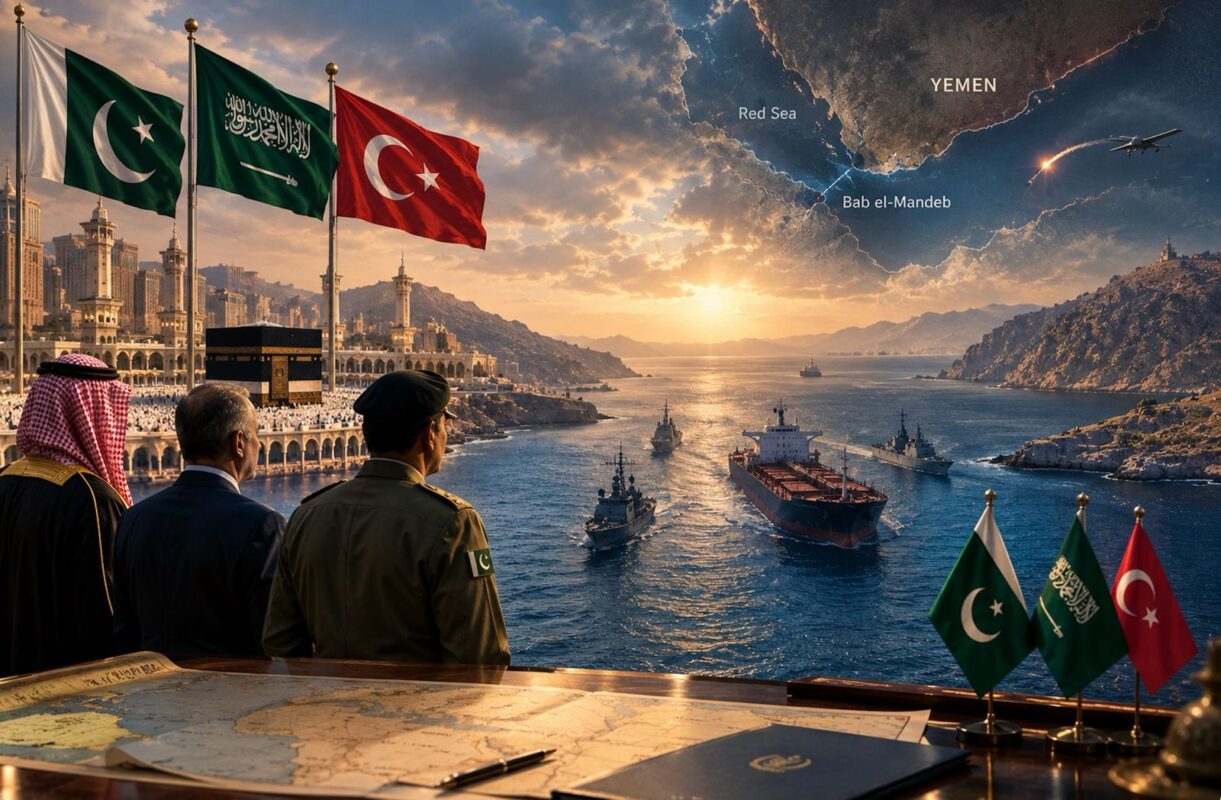
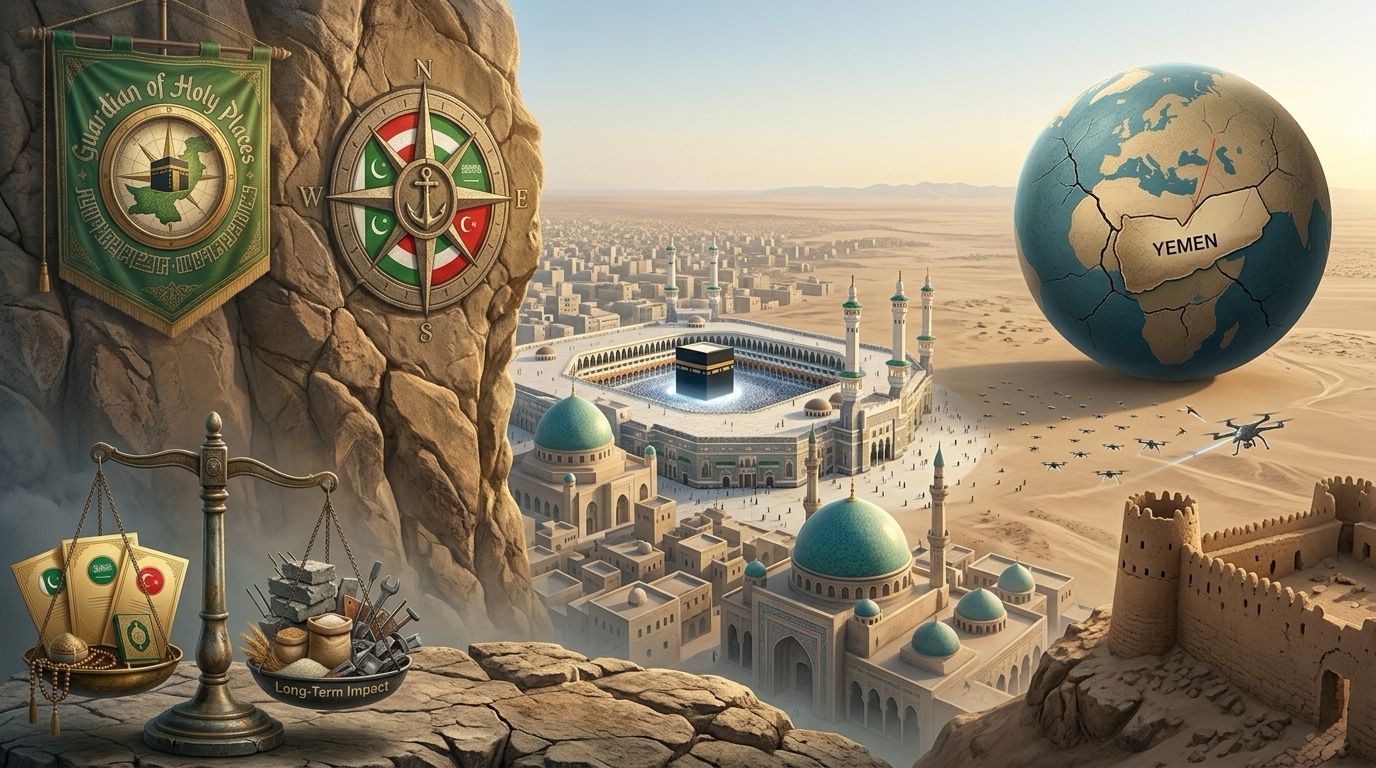
States make policies in their own interests. Those interests are well served when the scope determines the outcome of those policies. Therefore, policymakers are presumed to consider the broader long-term impact when making policy and avoid anything that offers short-term gains. Recently, Pakistan entered into the Mecca Joint Defence Agreement, a trilateral pact involving Pakistan, Saudi Arabia, and Türkiye. According to the announcement, the pact is defensive in nature and is not against any particular country. However, another layer shapes that approach when implementing any agreement like this for public consumption. In this pact, particularly in Pakistan, rhetoric is defining the narrative to appeal to the general masses, and it has become important to critically evaluate the rhetoric shaping it. It reflects that Pakistan is predominantly framing it through the angle of religion and its pride in being in this agreement to be the guardian of holy places in Islam. Therefore, the question of its scope becomes even more relevant for policymakers in Islamabad who were unaware of the long-term risks attached to implementing this agreement. A defence agreement is not poor policymaking; however, its material, economic, social, and long-term effects on the general masses also take a heavy toll. This analysis focuses more on the approach behind the rhetoric and narrative than on its tactical and strategic side.

Implementing this agreement will soon require a test, as the current standoff between Saudis and Houthis in Yemen is testing its applicability. There was an interception of a drone attack on Mecca recently, and Saudis alleged that Houthis were behind this attack on the holy city. However, the Houthis denied responsibility for targeting Mecca. However, in Pakistan, this attack was strongly condemned, and it was urged that Pakistan could go to any lengths when it comes to defending the holy cities. This is a serious and tricky situation where Houthis are also Muslims, and they understand the sanctity and emotional attachment of all Muslims to the holy cities. In this developing scenario, clear rhetoric for Pakistan’s domestic audience is crucial.

Historical Roots of the Saudi-Houthi Conflict

The territorial dispute predates the Houthi movement. After Ottoman authority collapsed following World War I, Yemen’s Zaydi Imamate and the expanding Saudi state contested the modern border, including Asir, Jizan and Najran. Saudi Arabia defeated Yemen in 1934, and the Treaty of Taif formalised its control over much of the disputed territory. Many Yemenis viewed the settlement as unequal and imposed after military defeat, fuelling resentment for decades. The border was not fully settled until the 2000 Treaty of Jeddah; scholarship continues to identify these territories as a major source of Yemeni resentment toward Saudi Arabia. However, the Houthi movement was not simply a territorial campaign to reclaim these lands. It emerged much later in northern Yemen, especially around Saada, the Zaydi heartland. Its roots lay in a 1990s Zaydi religious and cultural revival, partly prompted by Saudi Arabia’s growing promotion of Salafi institutions. Some Zaydis viewed these institutions, particularly in Saada, as threats to their traditions, fuelling counter-mobilisation. Religion mattered, but it requires nuance. Zaydism, a Shi’a branch, is doctrinally closer to Sunni Islam than Twelver Shi’ism. Thus, calling the Houthi–Saudi conflict a conventional “Sunni–Shi’a war” obscures key historical differences. The initial Houthi mobilisation aimed to preserve Zaydi identity and opposed Salafi expansion, political marginalisation and dissatisfaction with Yemen’s government.

The decisive military confrontation initially was not between the Houthis and Saudi Arabia, but between the Houthis and the Yemeni government of President Ali Abdullah Saleh. Six rounds of fighting occurred between 2004 and 2010. Hussein Badr al-Din al-Houthi was killed by government forces in 2004, after which the movement became increasingly militarised. The conflict reflected overlapping religious, political, tribal, and socioeconomic grievances rather than a single cause. Saudi Arabia became directly involved because the Houthi insurgency threatened its southern frontier. Riyadh feared instability, smuggling, cross-border tribal networks, and armed groups establishing positions near Saudi territory. Saudi forces fought the Houthis in 2009–10, before the larger Saudi-led intervention in 2015. It is observed that Riyadh’s growing focus is on controlling border access and preventing instability in northern Yemen from spilling into Saudi Arabia. The 2015 intervention reshaped the conflict. After the Houthis seized Sana’a in 2014 and advanced south, President Hadi fled Yemen. Saudi Arabia launched a campaign to reverse the takeover and restore the internationally recognised government, adding a stronger regional dimension marked by Saudi–Iranian rivalry.

Iran’s relationship with the Houthis shaped Saudi perceptions of the conflict, but the movement was not simply an Iranian creation. It grew from indigenous Yemeni roots predating its substantial ties with Iran, including Zaydi revivalism, local grievances, tribal networks, and conflict with the Saleh government. Research also cautions against explaining Houthi support solely through sectarian identity; geopolitical perceptions and political interests matter too. The answer depends on the historical layer. The Saudi–Yemeni rivalry has deep territorial roots, especially over Asir, Jizan, and Najran. The Houthi movement arose from northern Yemen’s Zaydi revival, partly in response to perceived Salafi encroachment. Yet the later Saudi–Houthi war involved more than territory or religion: domestic power, tribal structures, border security, and Saudi–Iranian rivalry also shaped it.

Therefore, the conflict is politically driven, with territorial and religious roots—not purely territorial or religious.

Religion-Based Rhetoric for Domestic Audience

Rhetoric in Pakistan about the Houthi conflict with Saudi Arabia focuses predominantly on religion. Pakistani officials have repeatedly said that the sanctity of “Haramain Sharifain” is Pakistan’s limit. The drone attack in Mecca—which the Houthis denied carrying out but Saudi Arabia alleged they had carried out—was treated as an attack on Islam. This framing presents the conflict entirely in religious terms, which could be misleading and could damage Pakistan’s social fabric over the long term. The Taliban’s fight against the Soviet Union offers a warning: the war was called “Afghan Jihad,” and its effects have lasted for generations. Pakistan is still grappling with an unstable Afghanistan. The conflict was long justified in the name of Islam, and now those same warriors are fighting against us as terrorists. The religion-based rhetoric is faulty in its very logic because the Houthis have never claimed or announced through credible statements available that they are up to promulgation of any new theological dimension when it comes to conflict with Saudi Arabia. In addition, they have never said at any point that Mecca and Medina, two holy cities, are their targets. Therefore, constructing a narrative in Pakistan against the Houthis reflects shortcomings in policymaking. In these circumstances, where the Middle East is tearing apart in strategic security architecture, this new trilateral alliance’s emergence is not surprising, but translating it at the domestic level through the lens of religion is myopic, and it is likely that policy circles are trying to make the Houthis common enemies through a religious denominator, even though they are naturally not in conflict with Pakistan or Turkey. They have conflict only with Saudi Arabia.

Discussion

Pakistan appears cautiously to be seeking to justify its participation in the conflict against the Houthis by invoking religious considerations. However, this course of action could draw the country into a protracted conflict far from its borders. Such involvement could impose a significant burden on Pakistan, where internal unrest in the largest province, Baluchistan, and escalating terrorism allegedly emanating from Afghanistan in Khyber Pakhtunkhwa present daily challenges. In this context, creating further adversaries in the form of the Houthis would not improve Pakistan’s overall security situation. It could also create opportunities for cooperation between the Taliban and the Houthis, as well as between these groups and separatists in Baluchistan. Such developments would further complicate Pakistan’s existing challenges, including a merger against Pakistan. Therefore, pursuing a defence agreement against the Houthis reveals the policy’s domestic demerits. These demerits clearly indicate that Pakistan has not learned from the flawed Afghan jihad policy, where religion was dominant in terms of justifying the alliance with the US against Russia. Alliances like this have tangible objectives, with military cooperation to combat and financial aid as obvious examples. Beyond those, objectives also include how the alliance would be justified domestically and what approach should be chosen: rhetoric built for general public consumption. Moreover, what if this religious rhetoric would backfire? What strategies does Islamabad have to mitigate those impacts? These are serious concerns that, apparently, are still not part of the discussion in the policy circles.

Conclusion

Pakistan’s policy around the trilateral defence agreement reflects flawed rhetoric and domestic narrative-building. The religious layer to this is quite risky, as the Saudi-Houthi conflict has geopolitical and territorial dimensions, and it has a decade-long history. Moreover, so far, the Houthis have never announced an attack on the holy cities of Mecca and Medina. In contrast, in Pakistan, official statements appear to draw on religious connotations to justify their participation in the agreement and its utility by referring to the sanctity of ‘Haramain Sharifain’. With the emerging multipolarity in the international system and current cracks in the Middle East’s security architecture, it is understandable to ally with Saudi Arabia, but Pakistan must actualise the repercussions of the religious angle in its rhetoric, building, and narrative. That actualisation would help protect against the long-term effects of this alliance on Pakistan.

Picture of Dr Tauseef Javed

Dr Tauseef Javed