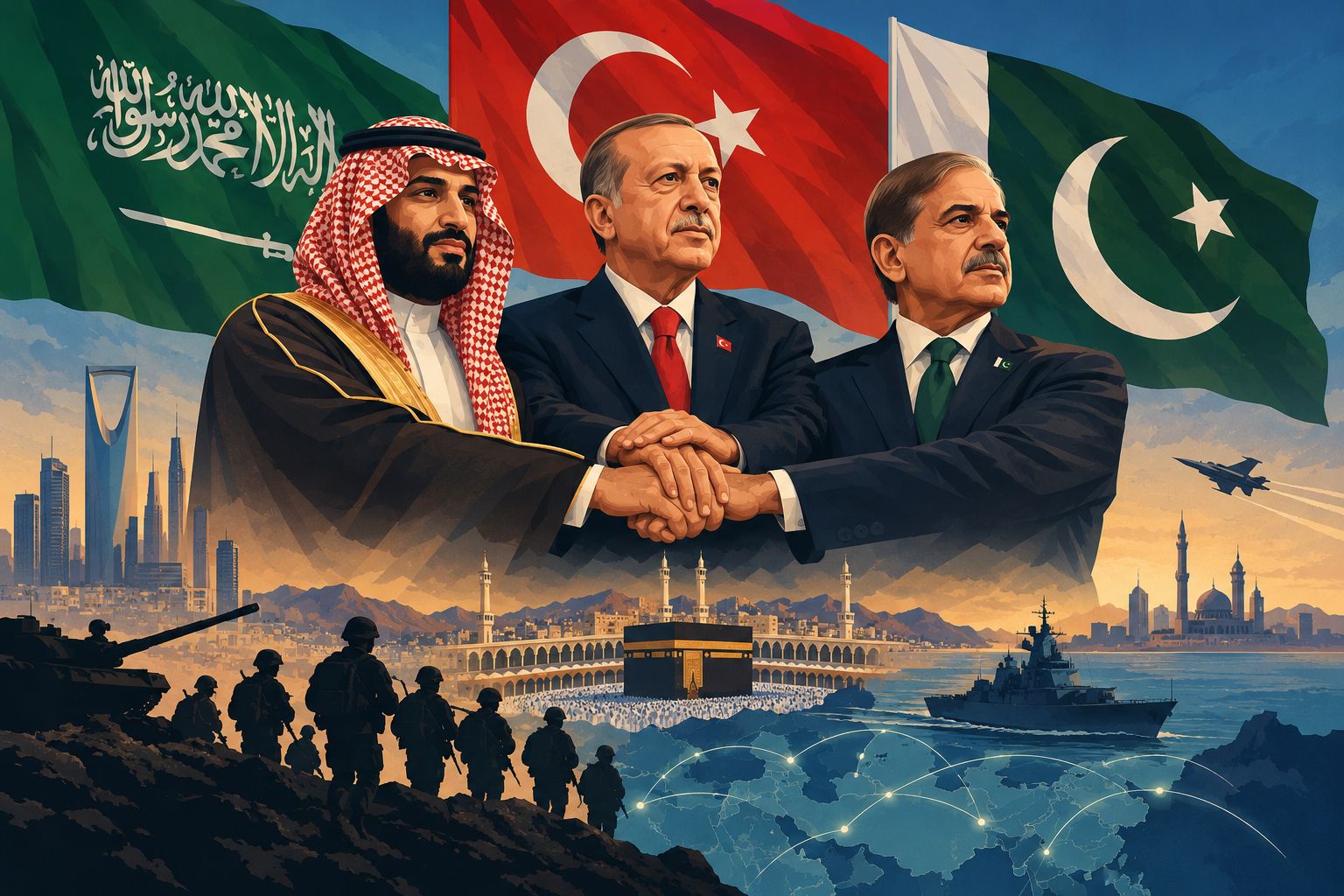
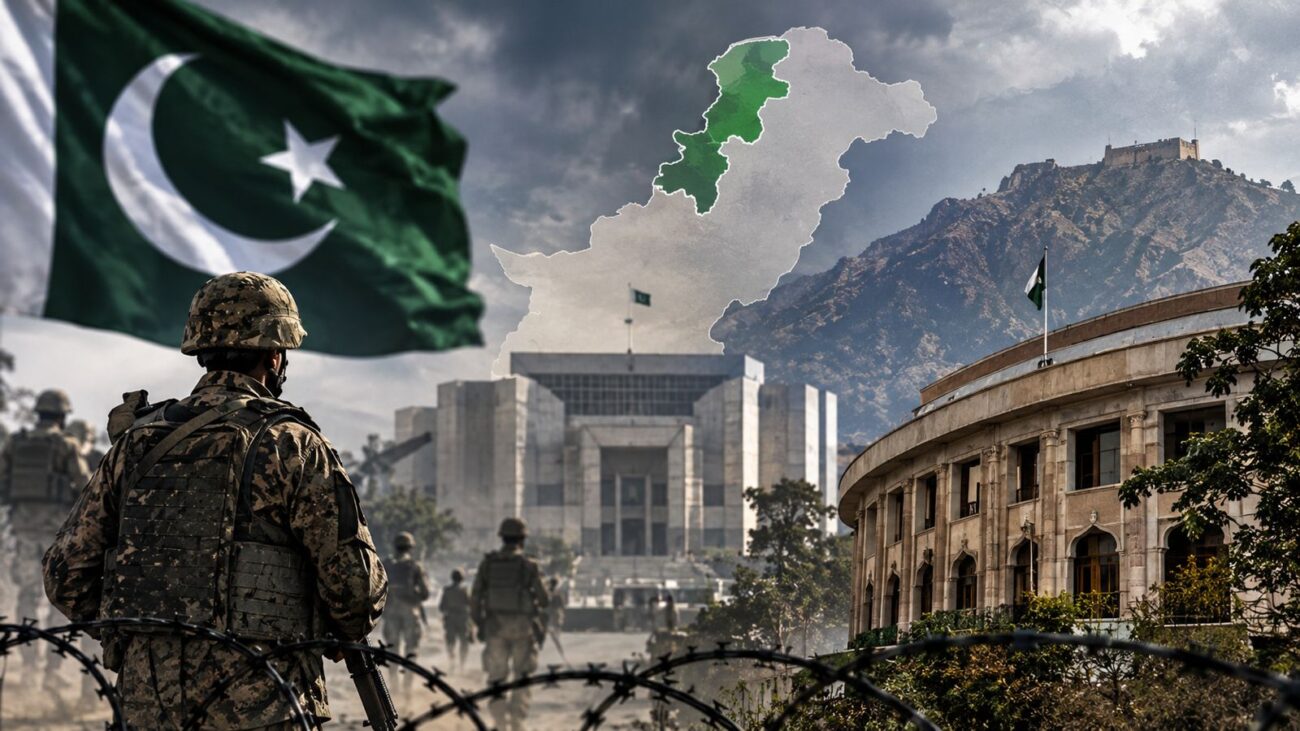
Barely two months after Saudi Arabia, Türkiye and Pakistan signed the Makkah Joint Defence Agreement in August 2026, they invoked it. Meeting in Riyadh on 5 October, the three governments’ defence and foreign ministers agreed to activate collective deterrence measures and to ensure the rapid deployment of agreed forces to Saudi Arabia in response to Houthi attacks. It was a swift and confident debut for a pact that sceptics had dismissed as symbolic, and it will be interpreted in all three capitals as evidence that the agreement has substantive force. Before that interpretation takes hold, however, it is worth recalling how a mutual-defence pact is truly tested. It is not tested by a threat its members are willing to confront collectively. Rather, it is tested by the threat they would prefer not to confront; on that question, the Makkah pact has so far revealed very little.
The full text, made public in October, merits close examination because its structure resembles that of every collective-defence treaty that has previously fallen short. Article 2 contains language as robust as any in this genre, declaring that an external armed attack against any party will be treated as an attack against all and invoking the right of self-defence under Article 51 of the United Nations Charter. Yet the same article immediately qualifies this commitment, stipulating that the parties will determine the scope and nature of any assistance after an objective assessment of what is required and that they will provide such assistance within the limits of available means. The treaty establishes no decision-making rule, timeline, force commitments, or joint command. The 5 October statement reinforced this point in its own wording, committing the parties to act under approved arrangements and, notably, in accordance with each country’s own laws. The pledge is categorical; the mechanism for fulfilling it remains entirely discretionary. This gap between the promise and the machinery is not a drafting flaw. It is the central issue in collective defence, and it will determine whether the Makkah pact endures or quietly fades away.
The cautionary example lies just north of the region, within an organisation built on nearly identical foundations. The Collective Security Treaty Organisation paired a robust mutual-defence clause with a separate provision that left the deployment of collective forces to the discretion of member-state leaders. The outcome was precisely what this structure could be expected to produce. When Armenia invoked the treaty in September 2022 after fighting spilt onto its own territory, the organisation sent an assessment mission rather than soldiers, and by February 2024 Yerevan had frozen its participation altogether. What made the failure damning was the contrast with Kazakhstan only months earlier, where the same organisation deployed within days in January 2022 to shore up a government facing internal unrest. One analysis fairly described the body afterwards as a lifeless, shambling alliance. The difference between the two cases was not the treaty text, which was the same in both, but the calculation behind it. Kazakhstan was a low-cost intervention among aligned interests; defending Armenia meant confronting Azerbaijan and, behind it, Türkiye, a price Moscow would not pay. The episode showed that a collective-defence pact fires for the convenient threat and freezes for the divergent one.
The CSTO is not an outlier, which is the uncomfortable part. The Arab League’s Joint Defence treaty of 1950 contained similarly worded provisions concerning attacks on a member and did not lead to military action when Iraq invaded Kuwait in 1990; the response was instead left to a Western coalition. In 2017, several alliance members imposed a three-year blockade on another member. Even NATO, the sole alliance whose guarantee is widely regarded as credible, rests on Article 5, which is notably permissive in its wording: each ally is bound only to take such action as it deems necessary. The credibility of the Atlantic guarantee derives not from the text itself but from the seventy years of integrated command, forward-deployed forces, joint planning, and demonstrated political will behind it. This is the lesson the comparative record offers to anyone assessing a new pact: the text is never self-executing. The machinery and the will constitute the guarantee; the wording is merely its advertisement.
Viewed in light of this record, the 5 October activation appears less to represent a successfully passed stress test than the easiest possible case. The threat was one that all three partners already shared; it was centred on the wealthy anchor state whose security underpins the entire arrangement; and the adversary was a movement that none of the three would regret opposing and that carried little diplomatic cost to confront. The fact that the pact was activated when all interests were aligned is reassuring with respect to its operational mechanisms but reveals little about its politics. The more revealing cases are those in which interests diverge, and they are not difficult to envision. Would Riyadh and Ankara regard an Indian strike on Pakistan as an attack on themselves and deploy accordingly, at the cost of their carefully cultivated relationships with New Delhi? Would Pakistani soldiers be sent to die on a Gulf frontier in a dispute that Islamabad does not consider its own? The discretion provided for in Article 2 exists precisely to allow the answer, when necessary, to be no. Each member of this pact is Kazakhstan in some contingencies and Armenia in others, and the treaty has been carefully designed to allow each of them to decide which.
For Pakistan, the agreement merits an honest assessment rather than celebration or dismissal. Its gains are tangible: it elevates Islamabad from a recipient of Gulf financial support to a significant security contributor, strengthens its partnership with two capable and affluent states, sends a deterrent signal, and reinforces the regional role Pakistan has sought to establish. The risks are equally substantial, reflecting the twin dangers long identified in alliance scholarship, from Glenn Snyder onwards: entrapment and abandonment. The Houthi deployment already points to the former, as the first blood the pact may require Pakistan to shed could be on a Gulf frontier in pursuit of a cause that serves the anchor state more than Islamabad. The latter risk is more subtle and more serious: the threat that most preoccupies Pakistan, a conflict with India, is precisely the contingency in which Saudi and Turkish restraint is most foreseeable. A clear-eyed Pakistan should therefore regard the industrial, financial, and deterrent benefits as the pact’s central value, while defining the collective-defence obligation as narrowly as the treaty’s own discretion permits. It should neither overstate the protection the pact offers domestically nor assume that this protection will be available in the crisis that matters most.
None of this means the Makkah pact is destined to join the graveyard. It means Article 2 will not decide its fate, whose wording is as firm as any and as discretionary as all of them. It will be decided by whether the three states build the machinery that text cannot conjure, the Strategic Political and Defence Committee and secretariat the treaty establishes, a standing joint force, interoperable command and genuine shared planning, and whether they sustain the political will to use it across changes of government and divergent threats. Türkiye is still moving the agreement through ratification; the institutions are only beginning to form. It is worth recalling that the CSTO had all the institutions and still froze when Armenia needed it. Makkah has made a fast and confident start on the easy case, which is more than several of its predecessors managed, but the graveyard of collective defence is full of pacts that opened the same way and then found, at the worst possible moment, that a promise assessed case by case is only ever as good as the case. Whether this one proves a shield or another headstone will be answered not in the city where it was signed, but in the first crisis its members privately wish it did not cover.