Publications

Multipolarity Without Consensus: What the Moscow Format’s Failure Reveals About Regional Security in Eurasia

Picture of Dr Tauseef Javed

Dr Tauseef Javed

Analysis Series

Analysis/0101/October/2026/London-Dialogue. 21 October 2026

ByDr Tauseef Javed

Introduction

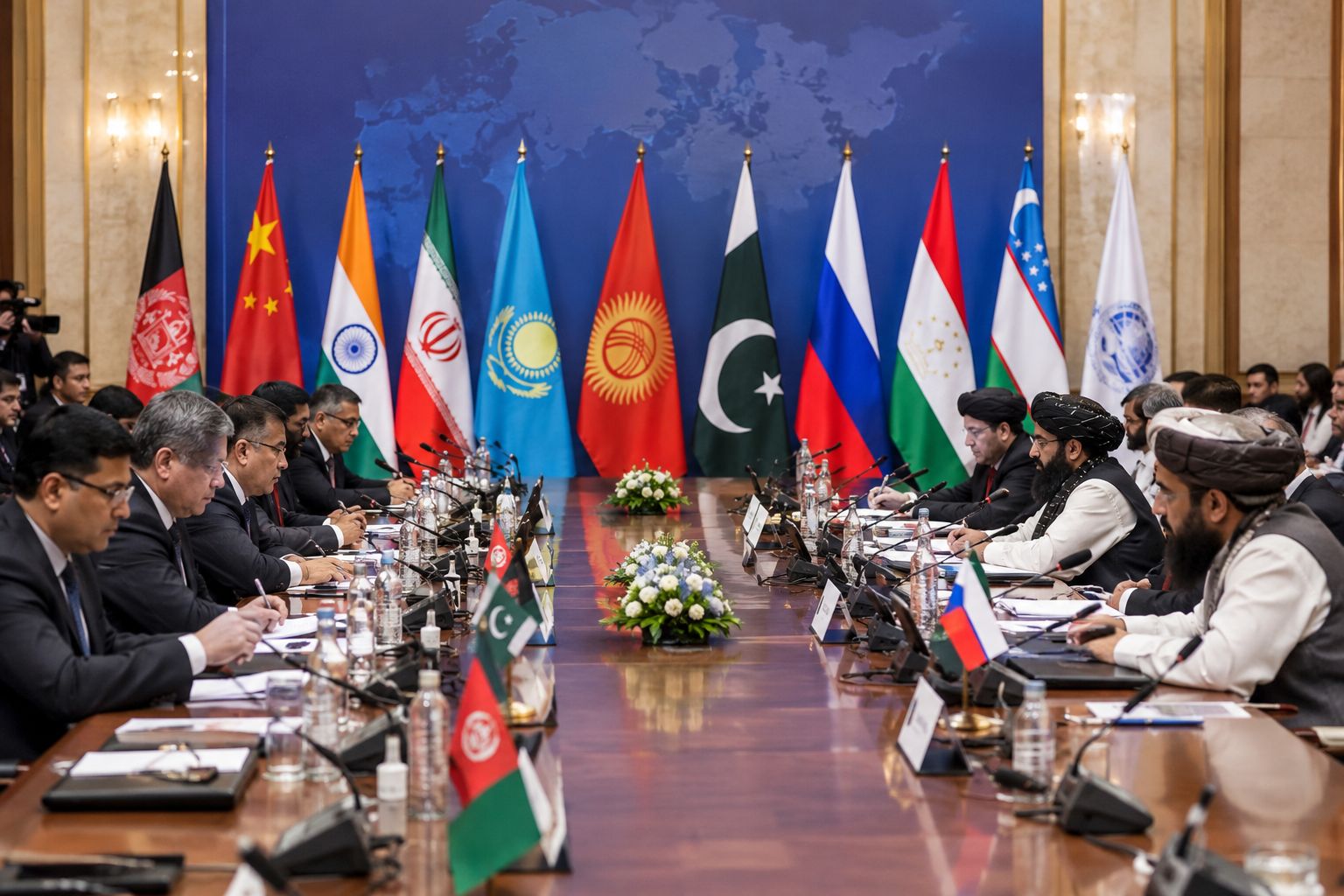
The eighth meeting of the Moscow Format Consultations on Afghanistan, held in Moscow on 5 October 2026, exposed a fundamental contradiction in the emerging multipolar international order: the expansion of regional diplomatic forums has not necessarily translated into a greater capacity to resolve security disputes. The meeting brought together representatives from Afghanistan, China, India, Iran, Kazakhstan, Kyrgyzstan, Pakistan, Russia, Tajikistan and Uzbekistan, with Belarus and Egypt participating as guests. However, the consultations concluded without a joint statement after Pakistan and the Afghan Taliban authorities failed to agree on the document’s language concerning terrorism.

The outcome was significant not simply because a multilateral meeting failed to produce a communiqué, but because it demonstrated the difficulties facing regional powers attempting to construct a cooperative security order without shared threat perceptions or agreed principles. For Russia, the meeting offered an opportunity to reinforce its diplomatic influence in Eurasia. For Pakistan and Afghanistan, it exposed the depth of their bilateral antagonism. More broadly, the episode illustrates why multipolarity should not be confused with consensus: a more geographically diverse distribution of diplomatic influence does not automatically generate effective regional governance.

The Moscow Format and Its Diplomatic Limitations

Established in 2017, the Moscow Format has developed into an important regional mechanism for consultations on Afghanistan. Its objectives include facilitating political dialogue, promoting regional cooperation and addressing security concerns, particularly terrorism and narcotics trafficking. Unlike Western-led diplomatic initiatives, the format brings together neighbouring states and other regional powers with direct strategic interests in Afghanistan’s future. Its composition reflects the geopolitical significance of Afghanistan, which connects South Asia, Central Asia and the wider Eurasian strategic environment. Instability within the country can affect cross-border militancy, trade routes, migration, narcotics trafficking and regional connectivity. Consequently, Russia, China, India, Iran and Pakistan all have reasons to participate in discussions concerning Afghanistan, although their priorities differ.

The October meeting was expected to produce a joint statement addressing regional cooperation, counterterrorism and counternarcotics efforts. Instead, the Pakistani and Afghan delegations disagreed over the proposed text. Russia’s presidential envoy for Afghanistan, Zamir Kabulov, explained that the Afghan delegation considered the draft’s references to Afghanistan in the context of terrorism unacceptable. Although previous meetings had produced joint statements, the deterioration of relations between Islamabad and Kabul had altered the diplomatic circumstances. The absence of a communiqué did not terminate the Moscow Format. Nevertheless, it revealed a central limitation of multilateral diplomacy: a forum may provide an institutional setting for negotiation without possessing sufficient leverage to reconcile incompatible national positions.

Pakistan–Afghanistan Tensions: Competing Security Narratives

The immediate source of the disagreement was the deteriorating relationship between Pakistan and the Taliban authorities. Islamabad has repeatedly accused the Afghan Taliban of allowing militant organisations, particularly Tehrik-e-Taliban Pakistan (TTP), to operate from Afghan territory and conduct attacks inside Pakistan. The Taliban authorities reject the allegation that Afghanistan is responsible for Pakistan’s militant violence and have criticised Pakistani military operations inside Afghanistan.

At the Moscow meeting, Pakistan’s special representative for Afghanistan, Mohammad Sadiq, argued that terrorism remained central to Afghanistan’s security problems and accused the Taliban authorities of complicity in militant activity. He cited more than 4,700 Pakistani deaths attributed to terrorism originating from Afghanistan over the preceding three years. These figures and allegations represent Pakistan’s stated position and should not be treated as independently established findings of the meeting.

Afghanistan’s Foreign Minister, Amir Khan Muttaqi, rejected Pakistan’s approach, criticised its air strikes and maintained that the bilateral dispute could be addressed through dialogue and diplomacy. The Taliban authorities argued that Pakistani military action had harmed Afghan civilians and challenged Islamabad’s claims that its operations had successfully eliminated dangerous militants. The disagreement was therefore more profound than a dispute over diplomatic wording. Pakistan sought explicit regional acknowledgement of its security concerns, whereas the Afghan delegation resisted language that it considered an unjustified attribution of responsibility to Afghanistan.

This distinction matters because effective security cooperation requires at least some agreement on the nature of a threat, the actors responsible for it and the measures needed to address it. Where governments disagree over these basic questions, diplomatic declarations become difficult to negotiate and even harder to implement. Pakistan’s decision to raise the issue in a multilateral forum was understandable given the cross-border character of its security concerns. However, the failure to obtain a joint statement demonstrated that other regional participants were not prepared, or were unable, to reconcile the competing positions in the text.

Russia’s Diplomatic Ambitions and Strategic Constraints

The Moscow Format is also an instrument of Russian regional diplomacy. Since the withdrawal of United States and NATO forces from Afghanistan in 2021, Moscow has sought to maintain an influential role in the country’s political and security environment. Russia formally recognised the Taliban government in July 2025, becoming the first country to do so.

Moscow’s engagement reflects several interests. These include preventing instability from spreading into Central Asia, limiting the threat posed by Islamic State Khorasan Province (ISKP), addressing narcotics trafficking and maintaining Russian influence across the former Soviet Union’s southern neighbourhood. At the October consultations, Russian Foreign Minister Sergei Lavrov praised the Taliban authorities’ counterterrorism and counternarcotics efforts and emphasised the importance of cooperation between regional security institutions. Russia also reiterated its opposition to the establishment of NATO military infrastructure in Afghanistan or neighbouring countries. These positions demonstrate Moscow’s preference for a regional security arrangement in which neighbouring states assume greater responsibility for Afghanistan, rather than relying on renewed Western military involvement.

Nevertheless, the absence of a joint statement exposed the limits of Russia’s diplomatic leverage. Moscow successfully assembled the principal regional stakeholders but could not secure agreement between two participants whose dispute directly affected the forum’s agenda. Russia’s role should not, however, be judged solely by this outcome. A diplomatic platform can remain useful even when a particular meeting fails to achieve consensus. Its continued value will depend on whether it facilitates communication, reduces the risk of escalation and supports practical cooperation. The Moscow meeting therefore revealed both Russia’s continuing convening power and the limitations of its ability to reconcile competing regional interests.

Multipolarity Without a Shared Security Order

The most important implication of the meeting concerns the relationship between multipolarity and regional security governance. Multipolarity describes an international system in which power and influence are distributed among several significant actors. It does not necessarily imply that these actors share common objectives or agree on the rules governing international relations.

The Moscow Format illustrates this distinction. Russia, China, India, Iran and Pakistan participate in a regional diplomatic process, but they approach Afghanistan through different strategic calculations. Russia prioritises regional stability and its own Eurasian influence. China seeks to limit security threats and protect its economic interests. India remains concerned with regional security and its strategic environment. Iran has its own border-security and political interests, while Pakistan prioritises the prevention of cross-border militancy. These interests overlap in certain areas but do not amount to a unified regional strategy. The inability to agree on the final statement demonstrated that institutional participation alone cannot resolve fundamental disagreements over responsibility and security.

The episode also challenges the assumption that the emergence of non-Western diplomatic institutions necessarily produces a more cooperative international order. Multipolarity can diversify diplomatic options and reduce dependence on a single dominant power, but it can also create additional arenas in which regional rivalries are expressed. In this sense, the Moscow Format’s failure represents a problem of coordination rather than proof that multipolarity itself has failed. Regional powers may possess sufficient influence to resist external pressure without possessing the political trust or institutional mechanisms necessary to manage conflicts among themselves.

The distinction is especially relevant to Eurasia, where security concerns are interconnected but political relationships remain fragmented. The presence of multiple influential states creates opportunities for mediation, yet their competing interests can prevent collective action when a dispute becomes politically sensitive.

Implications for Eurasian Security and Regional Cooperation

The absence of a joint statement carries three principal implications.

First, the deterioration of Pakistan–Afghanistan relations threatens to obstruct wider regional cooperation. Persistent disagreements over militancy, cross-border attacks and responsibility for insecurity can complicate trade, transit and diplomatic engagement. Without practical mechanisms for communication and incident management, local confrontations risk becoming more difficult to contain.

Second, Russia and other regional powers need to distinguish between diplomatic declarations and operational cooperation. Intelligence-sharing, functioning border mechanisms, evidence-based investigations and sustained bilateral dialogue may produce more tangible results than statements containing general commitments to counterterrorism. Regional institutions will remain limited if participants cannot agree on practical steps to address shared threats.

Third, the episode highlights the importance of smaller and middle powers maintaining diplomatic flexibility. Pakistan, for example, has an interest in engaging Russia, China, Iran and Central Asian states without assuming that their participation in the same forum guarantees support for Islamabad’s preferred position. Similarly, the Taliban authorities’ diplomatic engagement with regional governments does not eliminate the need to address concerns about militant activity and Afghanistan’s international responsibilities. A more effective regional approach would separate the establishment of facts from political attribution. Independent verification of allegations agreed channels for exchanging information and transparent procedures for investigating cross-border incidents could help reduce the political costs of cooperation. Such measures would not immediately resolve the dispute, but they could create a basis for more substantive engagement.

Conclusion

The eighth Moscow Format Consultation demonstrated that the emergence of a multipolar international order does not automatically produce regional consensus. The failure to issue a joint statement on 5 October 2026 reflected the depth of the Pakistan–Afghanistan dispute and the difficulty of reconciling competing security narratives within a broader multilateral framework.

For Russia, the meeting reaffirmed its position as an important diplomatic convenor while exposing the limits of its influence. For Pakistan and the Afghan Taliban authorities, it highlighted the absence of a shared understanding of the security challenges confronting their relationship. For Eurasia more broadly, it demonstrated that regional diplomatic institutions cannot substitute for political trust, agreed threat assessments and practical mechanisms for cooperation.

Ultimately, the significance of the Moscow meeting lies not simply in the absence of a communiqué but in what that absence reveals about the emerging international order. Multipolarity may expand the number of actors capable of influencing regional affairs, but it does not eliminate strategic competition or guarantee collective solutions. The challenge for Eurasian security is therefore not merely to establish alternative diplomatic forums but to make them capable of producing credible agreements and sustained cooperation despite profound political disagreements.

Picture of Dr Tauseef Javed

Dr Tauseef Javed