

Publications
Analysis Series
Analysis/0100/October/2026/London-Dialogue. 20 October 2026
By Ghazala Yamin Jalil
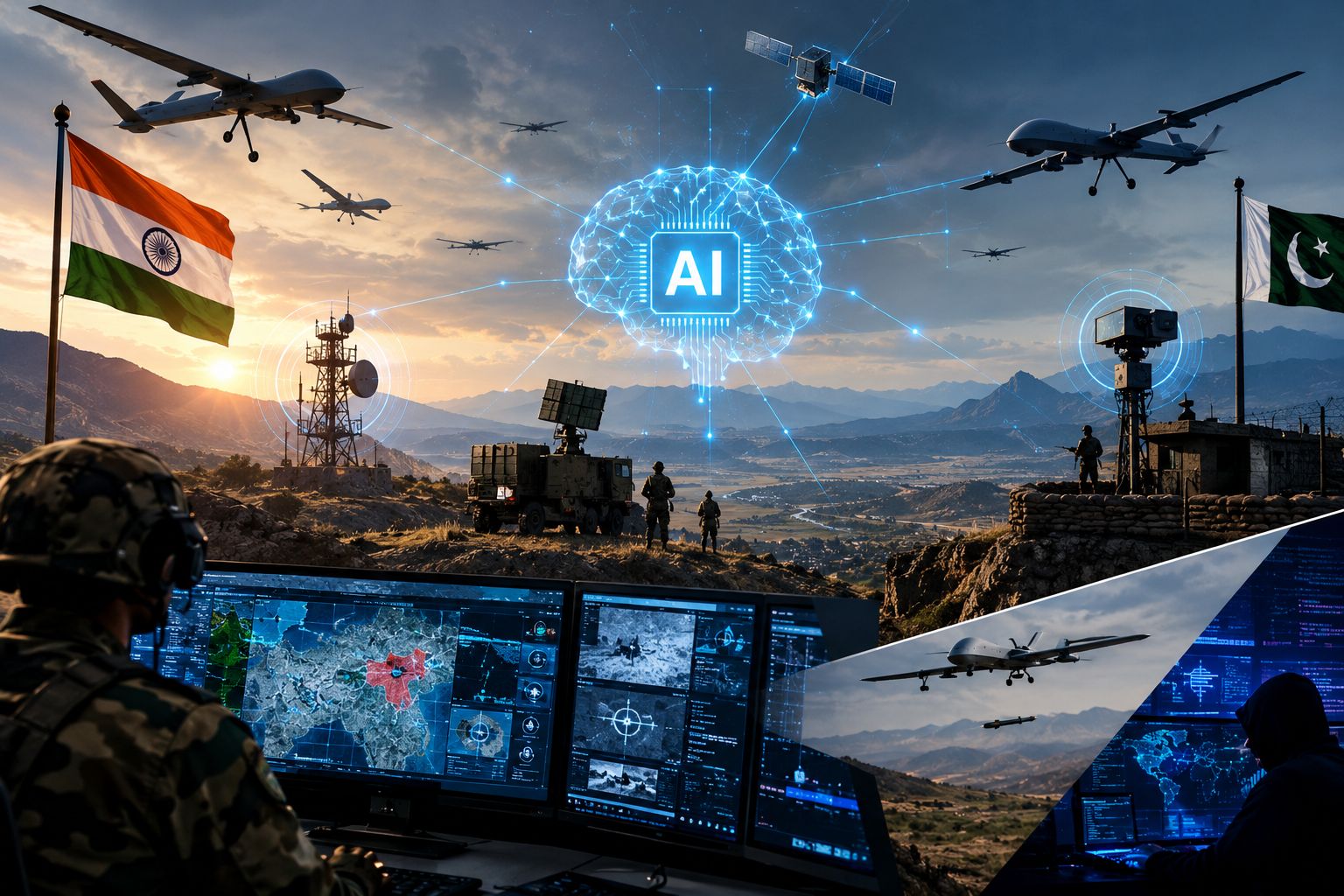
Major powers are increasingly integrating Artificial Intelligence (AI), machine learning (ML), and autonomous systems into their defence architectures to gain operational and strategic advantages. South Asia is no exception. India and Pakistan are incorporating AI into intelligence, surveillance and reconnaissance (ISR), border surveillance, unmanned systems, electronic warfare, cyber operations and decision-support systems. This is fundamentally reshaping strategic dynamics in South Asia and compounding an already precarious regional security dilemma.
The South Asia operational milieu is unique, characterised by contiguous borders, unresolved territorial disputes, and short geographical distances, where the militarisation of AI introduces unprecedented vulnerabilities. While AI can improve situational awareness, process large volumes of information and shorten the sensor-to-shooter cycle. Greater speed and automation can also compress decision-making timelines and increase the risks of misperception and inadvertent escalation.
The militarisation of AI in South Asia is no longer simply a future possibility. The May 2025 India-Pakistan conflict demonstrated the growing importance of AI-driven systems – drones, counter-drone systems, electronic warfare and networked surveillance where Indian statements indicated extensive use of AI-enabled tools during Operation Sindoor. The central concern is not AI itself, but its integration into military systems in ways that could increasingly blur the boundaries between conventional and nuclear deterrence.
India’s Pursuit of Military AI
India is aggressively leading the military AI race in South Asia, viewing technological dominance as central to its national security posture and global power ambitions. Partially driven primarily by its strategic competition with China, India seeks full-spectrum algorithmic sovereignty and comprehensive modernisation across its armed forces.
The Indian Ministry of Defence (MoD) operationalises its military AI vision through institutional bodies such as the Defence Artificial Intelligence Council (DAIC) and the Defence AI Project Agency (DAIPA), alongside the Centre for AI and Robotics (CAIR) under the Defence Research and Development Organisation (DRDO). India is working on projects across the armed services with reported applications including intelligence, surveillance and reconnaissance (ISR), data fusion, cyber defence, logistics, autonomous and unmanned systems, and decision support. Some reports indicate that more than a thousand Indian defence start-ups are codeveloping AI-enabled platforms with the armed forces under the ambit of iDEX and DRDO with an eye to full-spectrum algorithmic sovereignty.
India’s pursuit of military AI is also reflected in its doctrinal shift. Both the 2017 Joint Doctrine of Indian Armed Forces and the Land Warfare Doctrine (LWD) of 2018 explicitly acknowledge and lay the strategic groundwork for incorporating AI and other disruptive technologies into the country’s defence frameworks. Particularly LWD puts emphasis on leveraging AI to enhance India’s strategic edge. India is increasingly leaning towards integrated warfare that relies on intelligence-led operations, drone swarms, AI-driven sensors, and decision-support algorithms.
In 2022, the Ministry of Defence announced that it is actively fielding at least 75 AI-driven products and operational technologies across its armed forces, which included platforms designed for command, control, communication, computer, intelligence, surveillance, and reconnaissance (C4ISR), Unmanned aerial vehicles (UAVs), tracked robotic vehicles, and autonomous fast interceptor boats and AI-driven cybersecurity tools built to detect vulnerabilities and counter network threats autonomously. One of the key land-domain platforms includes approximately 200 DAKSH autonomous robots deployed for high-risk bomb disposal, alongside the ongoing development of the Multi-Agent Robotics Framework designed to enable coordinated operations among robotic systems in a battlefield environment. These systems can operate with minimal human involvement and raise risks of accidental engagements and escalation.
India has accelerated endeavours to modernise its military and adopt AI-driven technologies against its adversaries. India has deployed over 140 AI-powered smart surveillance systems along borders with China and Pakistan under the Comprehensive Integrated Border Management System (CIBMS), which aggregates inputs from cameras, thermal imagers, and radar. The system uses AI video analytics to autonomously detect, track, and classify targets to alert command hubs. India’s 2025 Mission SWAYAT experiment demonstrated its interest in developing indigenous autonomous weapon systems capable of selecting and engaging targets while incorporating human control.
In the electronic warfare & logistics domain India has developed the Himshakti EW system – developed by the DRDO – which utilises AI for autonomous signal interception, direction finding, sensor fusion, and predictive jamming against enemy communication channels. For logistics optimisation, India is deploying autonomous drone convoys in treacherous environments like the Siachen Glacier for autonomous ration and medicine resupply.
Beyond ground systems, the Indian military integrates sophisticated AI algorithms across missile kill-zone evaluations, automated image analysis, objective range estimations, and target identification.
India is pursuing AI-enabled drone technology. It has Inducted 12 sets of armed drone swarms known as Autonomous Surveillance and Armed Drone Swarms (A-SADS) with 50-75 AI-enabled aerial vehicles each and 100 Kamikaze loitering munitions jointly developed with Israel. The A-SADS will act as a force multiplier tool and provide efficient ISR capabilities. AI-driven armed drones potentially increase the risk of unintended escalation between nuclear-armed India and Pakistan by bypassing human intervention and lead to greater risk of war. The swift and autonomous responses can bypass human intervention and lead to a full-scale war.
Additionally, India has international partners. such as Japan and the US – to advance joint applications in military robotics and autonomous systems. In the last decade or so the US-India strategic partnership also had collaboration in developing semiconductors, military equipment, space programmes, and AI, primarily reflecting their mutual desire to counterbalance China’s technological advancements.
Pakistan’s Response: Asymmetric Balancing
Pakistan’s response is relatively constrained and driven by the need to maintain conventional deterrence with India and to counter India’s expanding AI capabilities. Pakistan’s AI militarisation is relatively constrained by its reliance on imports. However, in recent years it has taken a number of initiatives, like the Centre for Artificial Intelligence and Computing (CENTAIC), established by the Pakistan Air Force in 2020, which works on big data, machine learning (ML), predictive analytics and cognitive electronic warfare and the Army’s Centre for Emerging Technologies. These initiatives aim to use AI and ML to enhance decision-making across the military domain. Pakistan also has some cooperation with China in the cyber domain and UAVs like the Cai Hong 4 (CH-4) drones which are effective for targeting and reconnaissance. Resource limits, dependence on external technology and a smaller indigenous industrial base make Pakistan’s strategy one of asymmetric balancing rather than parity.
Ultimately, integration of AI into military systems provides an enabling layer in surveillance, sensor fusion, target recognition, electronic warfare, cyber operations, air defence, logistics and networked command systems. The AI-driven systems can improve situational awareness, precision targeting and defensive interception, but they also shorten the sensor-to-shooter cycle.
Although India cites China as a driver for its AI drive, India’s larger investment and desire for military AI dominance is perceived as a threat to Pakistan. Constrained by external technology dependence and industrial limitations, Pakistan views India’s unconstrained AI deployment through the lens of a classic security dilemma. Capabilities framed by India as defensive border surveillance are perceived in Islamabad as offensive force multipliers designed to enable rapid, intelligence-led conventional strikes.
AI-Nuclear Nexus in South Asia
AI has potential use in nuclear deterrence architectures such as ISR, early warning systems, command and control systems and delivery systems. While the integration of AI in nuclear deterrence ecosystems can afford advantages such as precision targeting, faster decision support, improved detection, targeting and survivability, it can also strain strategic stability.
Integrating AI even in basic sensing and targeting systems would shorten already compressed timelines, reducing the decision window, increasing risk or miscalculation and deepening crisis instability. Some potential dangers associated with military AI include biased or poisoned data, shortened decision-making timelines pushing decisionmakers to make faster decisions, and heightening the risk of miscalculation leading to conflict and nuclear escalation.
Integrating AI into South Asia’s defence ecosystem severely threatens the region’s precarious nuclear balance. Given the tight geographical proximity between India and Pakistan, missile transit times is a mere 3 to 5 minutes, leaving minimal room to detect, verify, and respond to incoming threats. As India expands its AI footprint in predictive modelling, uncrewed platforms, and ISR capabilities, its increased precision-targeting and counterforce potential risk eroding mutual vulnerability. By enhancing counterforce targeting precision by India, AI threatens the erosion of Pakistan’s rudimentary second-strike capability. AI-driven systems may also complicate the concealment of nuclear assets, increasing their vulnerability to a first strike. This technical edge could also incentivise aggressive doctrinal shifts by India – such as Launch-on-Warning postures or preemptive strikes – lowering the nuclear threshold. To mitigate this widening AI asymmetry and preserve its Full Spectrum Deterrence, Pakistan faces growing pressure to deploy its own AI-driven systems. However, introducing AI into target-acquisition and decision-making platforms compresses operational timelines and heightens crisis instability. Dual-use systems present another major risk where AI algorithms deployed on conventional platforms such as autonomous drone swarms or EW systems could inadvertently target dual-use command nodes or early-warning radars.
There are precedents – such as the Soviet Union’s Stanislav Petrov’s crucial human intervention during a 1983 automated false alarm and the 2022 “accidental” firing of an Indian BrahMos missile – where human decision-making prevented potential catastrophe. These near misses demonstrate the immense hazard reliance on automated responses could pose. They underscore how rapidly technical or procedural failures can spiral into conflict without stringent human oversight and fail-safe protocols. While there is a general consensus around the globe that AI cannot be given the weapons launch authority, the integration of AI in nuclear deterrence architectures has the potential to derail strategic stability.
Divergent Governance Narratives.
There is also an important asymmetry in governance narratives of India and Pakistan. Pakistan has long advocated legally binding restrictions on lethal autonomous weapons (LAWS) and meaningful human control in international forums. At the United Nations Office for Disarmament Affairs, Pakistan iterated its position: “LAWS are by nature unethical because there is no longer a human in the loop, and the power to make life-and-death decisions is delegated to machines. While India has built stronger implementation institutions and is pursuing broad defence integration, but its position on prohibiting lethal autonomous weapons has been more cautious; its policy debate instead emphasises managed or supervised autonomy.
May 2025 Conflict, AI and Escalation Risks
The May 2025 border conflict between India and Pakistan represented South Asia’s first multi-domain, network-centric military confrontation where artificial intelligence (AI) and machine learning (ML) capabilities directly shaped operational tempo and decision-making cycles. Both militaries integrated automated systems across multi-source intelligence processing, domain awareness, targeting, and counter-measures.
India leveraged AI-powered Intelligence, Surveillance, and Reconnaissance (ISR) architectures integrated with space-based satellite tracking to generate real-time situational awareness. Operating under the assumption of tactical speed and operational surprise, Indian forces deployed uncrewed aerial vehicle (UAV) swarms and loitering munitions to track Pakistani force movements and target assets across the border. These algorithmic swarm architectures were designed to execute precision strikes, overwhelm local air defences, and compress the sensor-to-shooter loop.
In response, Pakistan conducted active counter-intelligence and electronic warfare operations. Pakistani forces employed AI-driven Electronic Warfare (EW) systems featuring adaptive jamming algorithms to disrupt satellite datalinks, disable enemy communications, and neutralise incoming autonomous drone swarms. Concurrently, both Indian air defence networks and Pakistani counter-battery formations utilised automated target recognition (ATR) software to rapidly classify radar signatures, track mobile missile launchers, and process target coordinates.
The rapid integration of AI and autonomous capabilities by India – spanning real-time border surveillance, automated data fusion, and precision targeting, ISR and early warning systems – significantly enhances its offensive and defensive operational efficiency. While AI-driven systems accelerate the decision loop and improve situational awareness, they simultaneously exacerbate South Asia’s security dilemma. As India’s AI-driven precision capabilities expand, they threaten critical command infrastructure and mobile retaliatory assets, incentivising pre-emptive counterforce temptations and altering crisis coercion strategies between the two nuclear-armed neighbours.
Conclusion
The unconstrained militarisation of AI in South Asia is eroding conventional and nuclear stability and has significant implications for future conflicts between India and Pakistan. AI-enabled surveillance, data processing, target identification, and precision-strike capabilities can enhance operational efficiency and shorten decision-making timelines, providing military forces with faster access to information and improved real-time situational awareness. However, the increasing integration of AI and autonomous systems could also influence coercive strategies and escalation dynamics during crises. The use of AI-enabled systems against critical command infrastructure or nuclear-related assets could deepen the security dilemma, erode strategic stability, and potentially lower the threshold for escalation. Compressed decision-making cycles and reliance on AI-generated assessments may further increase the risk of miscalculation, inadvertent escalation, or unintended conflict. As autonomy in military systems expands, maintaining meaningful human oversight will therefore remain critical, particularly in the context of nuclear-armed states such as India and Pakistan. It is, thus, imperative to negotiate bilateral confidence-building measures such as a code of conduct for AI use in military operations, a bilateral framework for ensuring human oversight in nuclear weapons architecture; a cyber non-attack agreement on nuclear infrastructure; and the establishment of dedicated communication channels for AI-related matters.
Ms Ghazala Yasmin Jalil
Related posts
Can Britain Bring Iran Back to the Table?
Yemen’s Forgotten Human Rights Crisis: Geopolitical Rivalries, Maritime Security and the Cost of War
The Democratic ‘Tsunami’: What It Means for Trump’s War on Iran?
What the Democratic Sweep in the US Midterm Elections Means for Trump’s Iran Policy and Gulf Security
Breaking the Taboo: The Strategic Folly of a US Nuclear Strike on Iran
Blurred Lines: Federalism and Provincial Autonomy in Pakistan
Paper Shields: The Makkah Pact and the Hard Test of Collective Defence
Iran’s Axis of Resistance Now: Less Than an Axis, More Than Resistance?
Leading through Uncertainty: Building Resilient Interdependence in a Multipolar World
Why Does the Game of Chicken Between Iran and the United States Keep Going?

Trojan APCs: Ukraine’s Kamikaze BTR-60s in Operation Vivaldi
The Emissions We Do Not Count: Militaries and the Missing Climate Ledger
London Dialogue — Founding Statement
Publication Categories
- Analysis (117)
- Book Review (1)
- Commentary (8)
- Essay (17)
- Journal (0)
- Journal Article (0)
- Policy Brief (7)
- Policy Paper (1)
- Research Article (3)
- Research Report (6)
- Young Writers Corner (0)