


Publications

Iran’s Electro-Optically Guided Ballistic Missiles and the USA’s Countermeasure Problem

Picture of Tahir Azad

Tahir Azad

Analysis Series

Analysis/0083/September/2026/London-Dialogue. 16 September 2026

A Precision Problem, Not a New Physics

It has become fashionable to describe Iran’s electro-optically guided missiles as a technology standing in parallel to hypersonic weapons, a leap of comparable novelty. That framing is imprecise and worth correcting at the outset, because the correction is where the real analytical value lies. Electro-optical (EO) and imaging-infrared (IIR) seekers are mature techniques with a lineage stretching back decades, from the USA’s AGM-65 Maverick to the scene-matching guidance carried by the Tomahawk cruise missile. There is no exotic new physics in an optical seeker. What is genuinely consequential, and what has turned Iranian work into a defence-planning headache in Washington, is the integration of such seekers onto manoeuvring ballistic re-entry vehicles to deliver near metre-level accuracy without any reliance on satellite navigation. The threat is not the seeker; it is the marriage of a mature seeker to a fast, manoeuvring ballistic platform and the operational independence from the Global Positioning System that this marriage confers.

That distinction matters for policy because it reframes the countermeasure question. If the challenge were merely another guided munition, existing air and missile defences would absorb it. Because the challenge is GPS-independent terminal precision on a ballistic trajectory, the single most reliable USA electronic-warfare tool, denial and spoofing of satellite navigation, is neutralised before the engagement begins. This analysis sets out how the system works, where satellite navigation, including China’s BeiDou constellation, genuinely fits into the guidance chain, how Iran acquired the capability, China’s role, who else fields comparable weapons, and what realistic countermeasures remain to the United States and its partners.

How Does Electro-Optical Terminal Guidance Work?

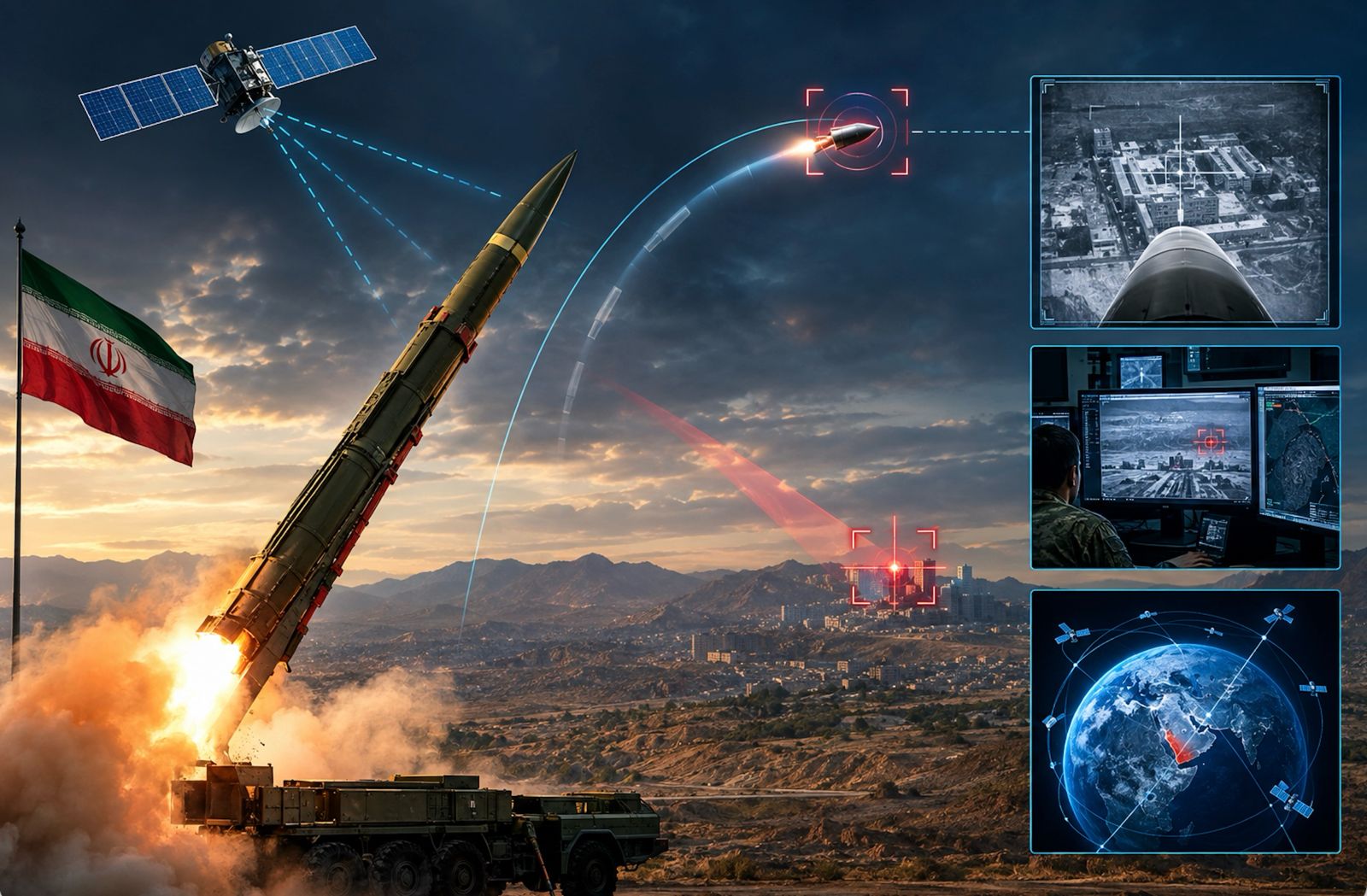
An EO-guided ballistic missile carries an imaging sensor, operating in the visible or infrared band, behind a protected window in the nose of the warhead. Guidance is divided across the flight. During boost and midcourse, the missile flies on inertial guidance, often corrected by satellite navigation. In the terminal phase, as the re-entry vehicle descends toward the target, the seeker window is uncovered, and the sensor acquires the target scene. Onboard processing then compares that live image against a stored reference, a technique known generically as scene-matching or area correlation, and computes steering corrections that a set of aerodynamic control surfaces or thrusters translate into a manoeuvring, precise final approach. The USA ancestor of this concept is the Pershing II, whose RADAG radar area-correlation system pioneered terminal scene-matching on a ballistic missile in the 1980s. Iran’s achievement is to accomplish an equivalent function optically, on a solid-propellant missile, at far lower cost.

The hard engineering is not the recognition algorithm but the re-entry environment. A warhead re-entering the atmosphere is enveloped in aerodynamic heating and, at higher speeds, a partially ionised plasma sheath that degrades or blinds an optical window. The seeker must therefore be shielded for most of the descent and uncovered late, cooled or ablatively protected, and the guidance loop must acquire, correlate and correct within a very short window of a few seconds. The canonical Iranian example is the Khalij Fars anti-ship ballistic missile, derived from the Fateh-110 family and unveiled around 2011, which pairs an EO/IIR seeker with a manoeuvring warhead to strike ships at ranges reported in the region of 300 kilometres. Related seekers appear across the broader Fateh, Zolfaghar and Hormuz families, the Hormuz-2 variant being explicitly configured for anti-ship strike. Iranian test claims of single-digit-metre accuracy should be treated as claims rather than verified figures, but even a conservative discount leaves a genuinely precise weapon.

The Guidance Architecture: Where BeiDou and Satellite Navigation Actually Fit

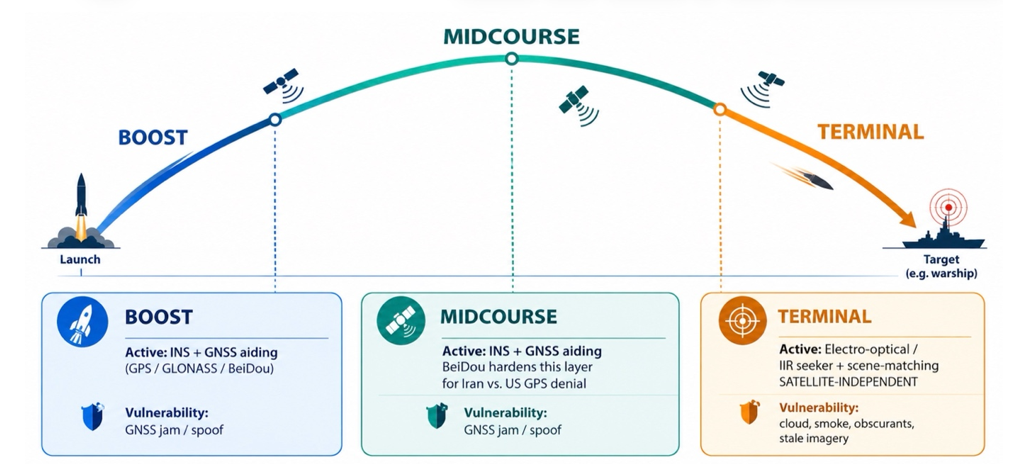
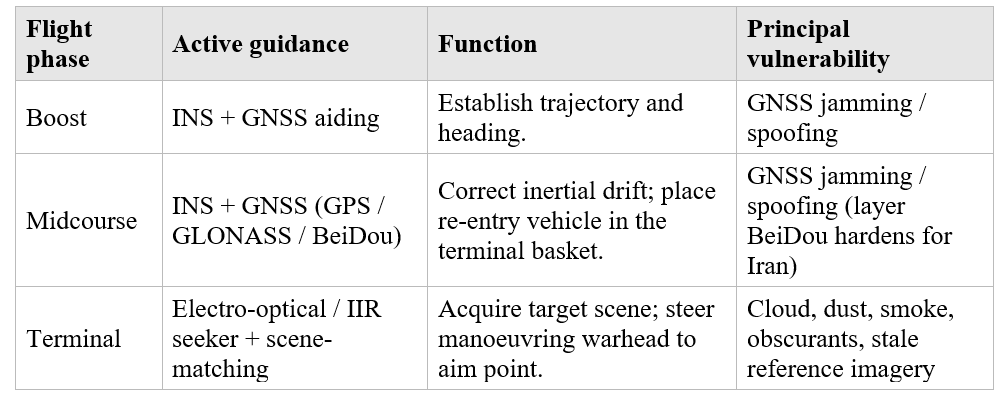
A recurring confusion, present in much popular commentary, is the assumption that a satellite constellation such as BeiDou guides the missile onto its target. It does not, and understanding why is central to understanding the weapon. Modern precision ballistic missiles use a layered guidance architecture with three distinct components, each active in a different phase and each with a different vulnerability profile, as summarised in Figure 1 and Table 1.

Figure 1: Flight-phase guidance handoff on an electro-optically guided (anti-ship) ballistic missile.

The satellite layer (including BeiDou) aids boost and midcourse; the electro-optical seeker alone drives the satellite-independent terminal phase.

Source: LD schematic, drawing on CSIS Missile Threat and open-source guidance descriptions.

First, an inertial navigation system (INS) runs for the entire flight. It is wholly self-contained, emitting nothing and receiving nothing, and therefore immune to jamming, but it accumulates drift over time, so an unaided INS alone is insufficient for metre-level precision at ballistic ranges.

Second, a global navigation satellite system (GNSS) aid corrects that inertial drift during boost and midcourse. This is precisely where BeiDou, or GLONASS, or GPS, enters the chain. GNSS aiding tightens the missile’s midcourse accuracy so that the re-entry vehicle arrives inside the small terminal basket in which the seeker can acquire its target. This layer is the vulnerable one, susceptible to jamming and spoofing, and it is the layer USA electronic warfare has traditionally attacked.

Third, the electro-optical terminal seeker takes over in the final seconds and is entirely independent of any satellite. It is this third layer that defeats GNSS denial: even if an adversary jams or spoofs every satellite signal in the theatre, the optical seeker still recognises the target scene and steers the warhead home. The strategic point, therefore, is not that BeiDou makes the missile accurate, but that the EO seeker makes the missile accurate even when the satellite layer is denied. BeiDou is a helpful accelerant to midcourse accuracy and, for Tehran, a politically significant alternative to an USA-controlled GPS that Washington could degrade at will. The seeker is the insurance policy that renders the satellite question secondary in the terminal fight.

Table 1: The layered guidance architecture and where each layer can be attacked

Source: CSIS Missile Threat and open-source guidance literature; LD compilation.

Operational Advantages and Real Limitations

The advantages are considerable. Terminal accuracy is independent of satellite navigation, so the weapon survives the GPS jamming and spoofing that would defeat a GNSS-only munition. Circular error probable falls to the order of metres against fixed targets, which converts a ballistic missile from an area weapon into a precision one. The seeker can engage moving targets, most consequentially warships, which is why the anti-ship application has drawn the sharpest concern in the Gulf and the Strait of Hormuz. And because the sensor is passive, receiving light rather than radiating it, the weapon is harder to detect and characterise than a radar-seeking equivalent.

The limitations are equally real and are frequently understated by enthusiasts. Optical and infrared seekers are degraded by cloud, fog, dust, smoke and battlefield obscurants; infrared mitigates some of this but does not eliminate it, and heavy weather or a deliberate smokescreen can defeat acquisition. Scene-matching depends on accurate, current reference imagery, which is an intelligence requirement rather than an engineering one: the seeker is only as good as the reference picture loaded into it, and a target that has moved, been camouflaged or been visually altered can break the correlation. These weaknesses are not incidental. They define the countermeasure space, because the most cost-effective defences attack the seeker’s dependence on a clear, recognisable optical scene rather than trying to out-run a manoeuvring warhead.

How Iran Acquired the Technology

Iran’s missile enterprise grew from Scud-derived foundations acquired historically through North Korea and matured over three decades into one of the largest and most diverse missile inventories in the region, catalogued in successive editions of the IISS Military Balance and by the CSIS Missile Threat project. The solid-propellant Fateh line, from which the EO-seeking variants descend, reflects a domestic industrial base that has moved steadily up the value chain from reverse-engineering imported designs toward indigenous development.

The EO seeker itself is generally assessed as substantially indigenous. It draws on a maturing Iranian electronics and optics sector, on reverse engineering, and on the ready availability of dual-use commercial imaging components, which are far harder to interdict than complete weapons because the same sensors populate civilian cameras, industrial inspection systems and drones. Proliferation-tracking resources maintained by the Wisconsin Project (Iran Watch) and the Nuclear Threat Initiative document the recurring pattern of dual-use procurement that underpins this class of capability. The analytically honest position is that the precise transfer pathways for the seeker technology are contested, and any published claim of a specific foreign origin for the optics should be hedged rather than asserted.

China’s Role and the BeiDou Question

China’s contribution to Iranian missile capability is real but must be located precisely, because loose claims invite legal and reputational risk. The clearest, best-documented Chinese contribution is not to the EO ballistic missiles at all but to Iran’s anti-ship cruise missile line: the Iranian Noor is a locally produced derivative of the Chinese C-802, and this transfer, together with related coastal-defence and cruise-missile assistance in the 1990s, is the firmest historical link. Successive USA administrations have also sanctioned Chinese entities for missile-related and dual-use transfers to Iran, a pattern chronicled by the Arms Control Association and in United States government non-proliferation reporting.

On the EO ballistic seekers specifically, the evidence for direct Chinese design transfer is thinner and should not be overstated. What can be said with more confidence is that China is the conceptual pioneer of the anti-ship ballistic missile with a terminal seeker, through the DF-21D and DF-26 systems, and that the maturation of that operational concept has plainly informed thinking in Tehran even absent a direct component pipeline. Chinese seeker suites for these systems are assessed to combine radar with possible electro-optical or infrared terminal sensing, though open-source detail is limited and should be treated cautiously.

BeiDou deserves separate and careful treatment, not least because your question raises it directly. BeiDou is China’s global navigation satellite constellation, an alternative to GPS, and Iran has been reported as a cooperation partner with access to it, a relationship that sits comfortably within the broader twenty-five-year China-Iran cooperation agreement concluded in 2021. Its military relevance to the missiles under discussion is confined to the midcourse guidance layer described above: BeiDou can substitute for GPS in correcting inertial drift, which matters strategically because it frees Iranian midcourse guidance from dependence on a USA-controlled system. But BeiDou does not perform the terminal precision function, which is the EO seeker’s job. The correct formulation for publication is therefore that BeiDou strengthens Iran’s navigation resilience and reduces its exposure to USA GPS denial, while the electro-optical seeker, not the satellite constellation, is what delivers the terminal accuracy that alarms defence planners. Conflating the two overstates China’s role in the precision itself.

Who Else Fields Electro-Optical and Scene-Matching Guidance

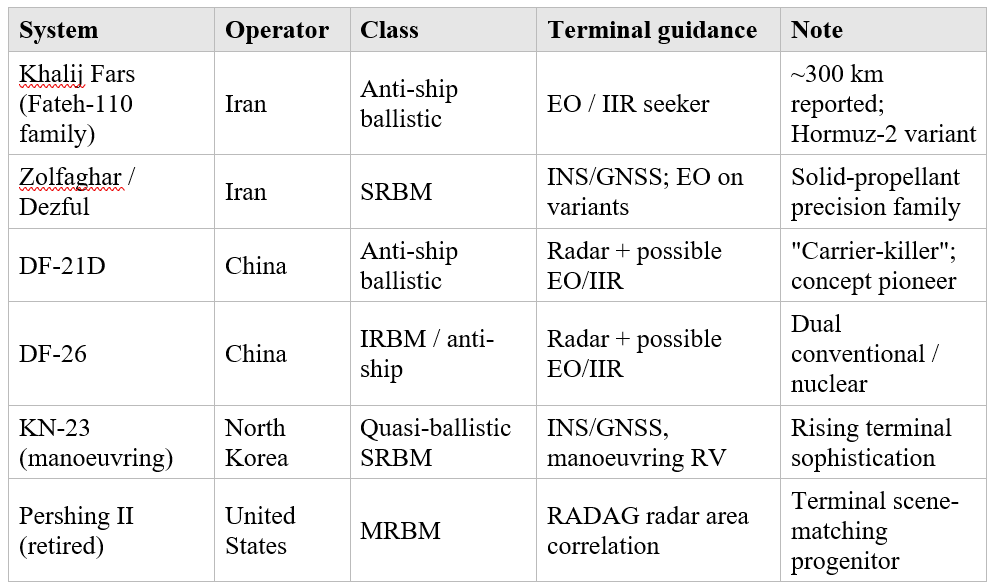
EO and IIR terminal guidance is widespread once the aperture is drawn broadly. On cruise missiles and precision munitions it is routine: the United States has fielded scene-matching and optical guidance for decades, from Maverick to the digital scene-matching correlator on Tomahawk, and Israeli, Russian and Chinese precision munitions carry comparable seekers. The narrower and more strategically significant club, that of electro-optically or terminally guided quasi-ballistic and anti-ship ballistic missiles, is smaller and is set out in Table 2. China leads it; North Korea has fielded increasingly sophisticated manoeuvring systems; Iran sits firmly inside the group; and the historical progenitor remains the USA Pershing II, whose radar area-correlation guidance established, forty years ago, that a ballistic warhead could recognise and steer onto its target in the terminal phase.

Table 2: Selected terminally guided ballistic and anti-ship ballistic missile systems

Source: CSIS Missile Threat and IISS; designations to be verified before publication.

The USA Countermeasure Problem

The countermeasure challenge is genuinely awkward, and its awkwardness follows directly from the guidance architecture. Because terminal accuracy is GPS-independent, jamming or spoofing satellite navigation, the mainstay of USA and allied electronic warfare against precision threats, achieves nothing against the terminal seeker. It can degrade midcourse accuracy and force the re-entry vehicle to arrive at the edge of its terminal basket, which is not nothing, but it cannot defeat the engagement. The United States is therefore pushed toward a different and less mature toolkit, summarised in Table 3.

Four lines of defence are available, each with limits. The first is to attack the seeker directly through the electromagnetic spectrum: directed-energy dazzling or hard-kill of the optical sensor and the flooding of the seeker’s field of view with decoys, flares and false scenes. This is promising against an optical threat precisely because the sensor is a physical eye that can be blinded, but it demands the seeker be detected and engaged within a very short terminal window. The second is to defeat scene-matching before the seeker ever acquires obscurants, smoke, camouflage, visual and thermal decoys, and the deliberate alteration of a target’s recognisable signature. This is the cheapest and often the most effective approach, and it exploits the seeker’s hardest dependency, its need for a clear reference-matching scene.

The third line is conventional layered interception, the Aegis combat system with SM-3 and SM-6, THAAD, and Patriot, catalogued by the CSIS Missile Defense Project. These systems work, but a manoeuvring re-entry vehicle combined with an EO seeker stresses them: manoeuvre complicates the intercept solution, and mass raids threaten to exhaust expensive interceptor inventories in an unfavourable cost exchange. The fourth, and arguably most decisive, is the set of left-of-launch options: striking launchers, transporter-erector vehicles, command nodes, and the intelligence-surveillance-reconnaissance and reference-imagery pipeline on which the seeker depends. Because scene-matching requires accurate target imagery, disrupting how an adversary collects, processes and loads that imagery attacks the weapon at its most vulnerable and least protected point.

Table 3: The United States and allied countermeasure options against EO-guided ballistic missiles

Source: CSIS Missile Defense Project; LD compilation.

Assessment

Iran’s electro-optically guided ballistic missiles are best understood not as a novel physics rivalling hypersonic but as the skilful, low-cost integration of a mature seeker onto a manoeuvring ballistic platform, yielding GPS-independent terminal precision. That is a meaningful operational advance, particularly in the anti-ship role in the Gulf, and it degrades the value of the West’s most reliable electronic-warfare tool. China’s role is real but bounded: firmest in the cruise-missile lineage and in pioneering the anti-ship ballistic missile concept, more diffuse in the EO seeker itself, and, through BeiDou, confined to strengthening the midcourse navigation layer rather than delivering the terminal accuracy. The seeker’s own weaknesses, its dependence on a clear optical scene and on current reference imagery, define the countermeasure space more usefully than any attempt to defeat the missile in flight. For Washington and its partners, the durable response lies less in chasing the warhead and more in blinding the seeker and dismantling the targeting chain that feeds it.

Picture of Tahir Azad

Tahir Azad