
Publications

Iran’s Axis of Resistance Now: Less Than an Axis, More Than Resistance?

Picture of Benedict Moleta

Benedict Moleta

Essay Series

Essay /018/October/2026/London-Dialogue. 31 October 2026

Author:By Benedict Moleta

Iran’s Axis of Resistance Now: Less Than an Axis, More Than Resistance?

Shortly before the Israeli election on 27 October, there were reports of new threats made by Iran and Hamas, and preparedness to resume hostilities on the part of Hezbollah. The networked danger of Iran’s so-called axis of resistance appeared to be newly tangible. US Director of National Intelligence Jay Clayton reportedly sent an intelligence memo to Secretary of War Marco Rubio warning that Iran had “substantially increased efforts to target US personnel” in the Middle East and elsewhere. Hamas was reported to have delivered a message to UN Humanitarian Coordinator Ramiz Alakbarov to be passed on to Israel, announcing that Hamas was ready to mount an attack. Reuters then reported that Hezbollah had spent the past three months using tens of millions of dollars recently received from Iran to ready itself for “a new regional war”.

The suddenly increased level of danger to US personnel was signalled by US embassy staff being reduced in Jordan, Lebanon, Qatar and the United Arab Emirates. And in the days before the election in Israel, Prime Minister Benjamin Netanyahu emphasised in the strongest terms “the existential threat posed by Iran and the Shiite axis.” Two Iranian officials were anonymously quoted confirming the Islamic Republic’s threats to US personnel. By contrast, Hamas swiftly issued a statement denying any plan to attack and rejecting as false any related announcements.

The veracity of any such reports cannot be ascertained by academic analysis. Nor can academic analysis provide precise judgements on the day-to-day variations in regional threats from Iran or its allies.

What is an Axis?

A more productive analytical approach is to consider this renewed prominence of threats by Iran and its allies – whatever the mix of perception and reality – in relation to the longstanding idea of Iran’s so-called “axis of resistance”.

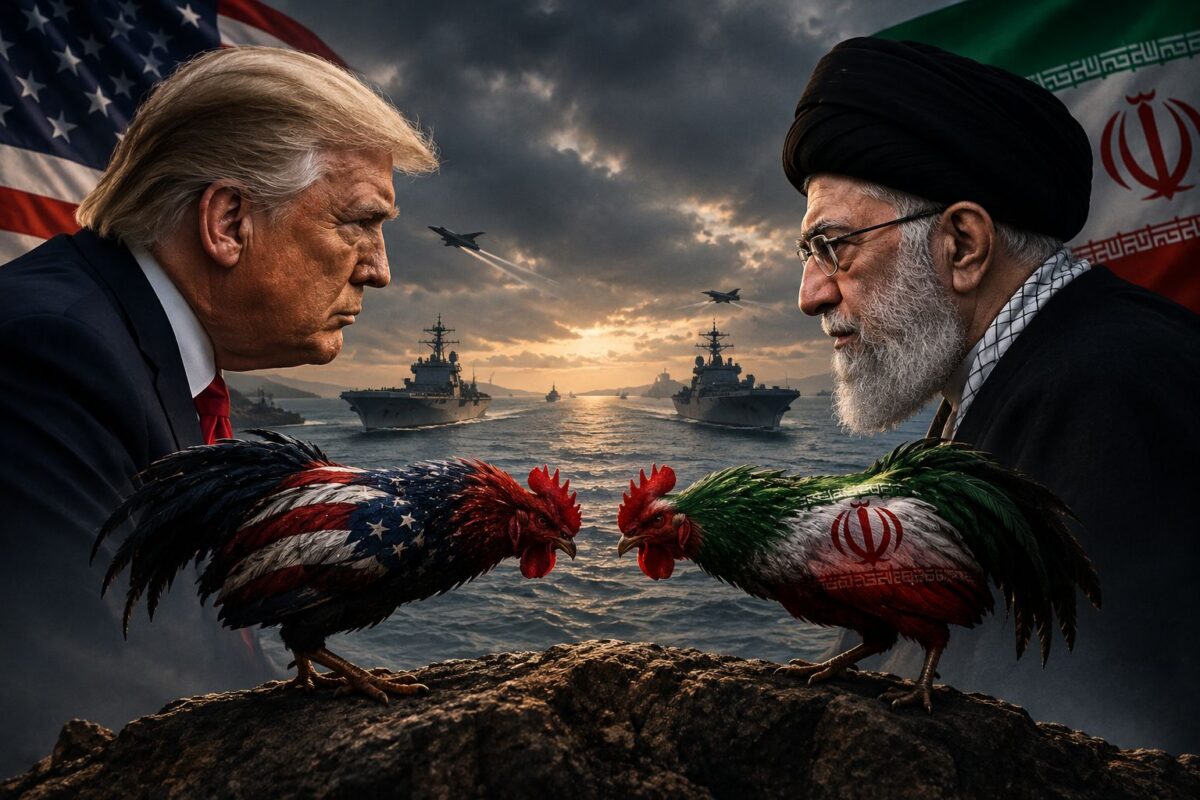
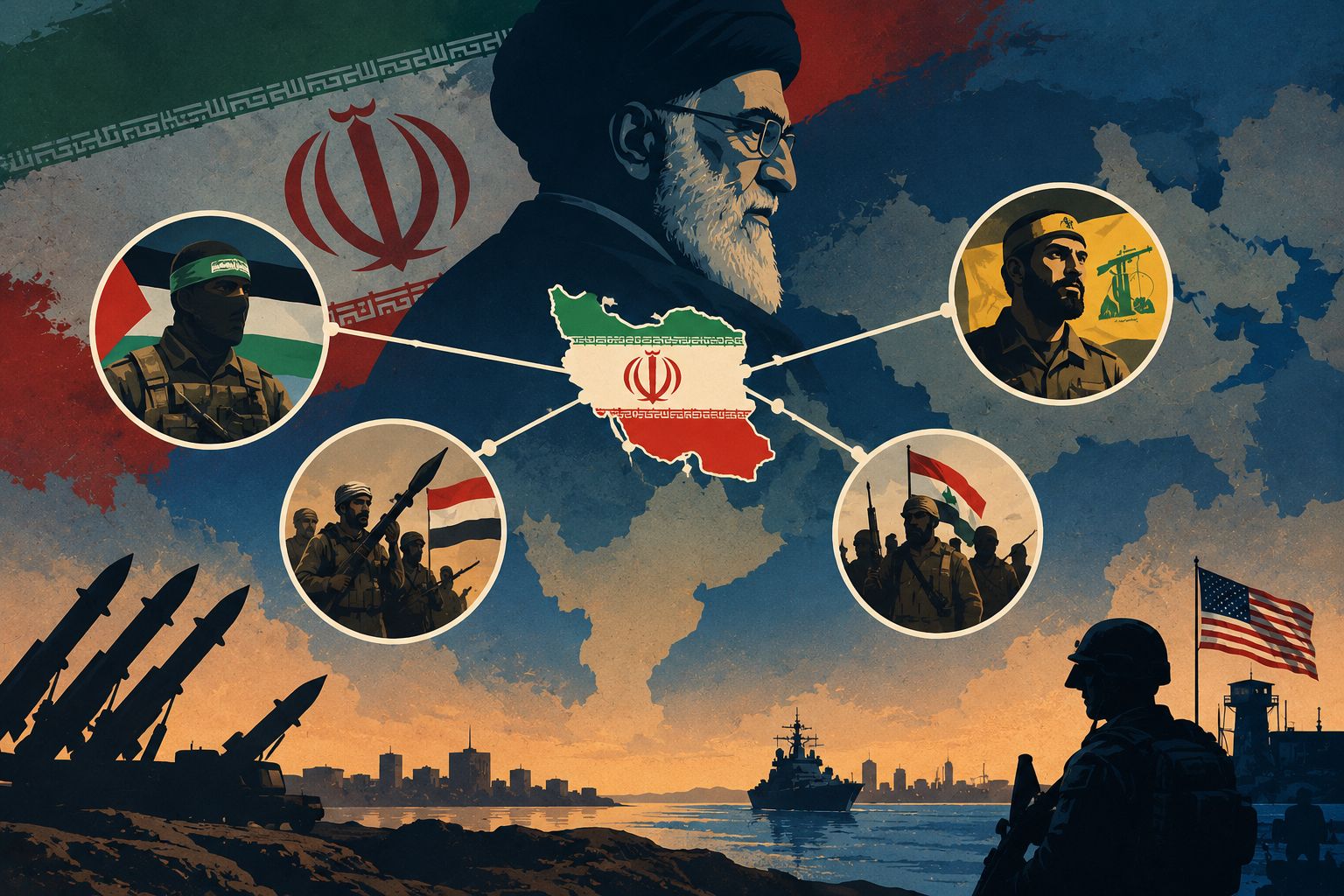
This idea emerged after US President George W. Bush’s 2002 reference to an “axis of evil”, composed of Iran, Iraq and North Korea. Rejecting this designation, the idea of an “axis of resistance” may have been first articulated by Iranian officials, or it may have been an invention of the media. Whatever the origin of the phrase, the guiding idea of an axis or front united in resistance against Iran’s regional and international adversaries has been prominent in public Iranian statements in recent years. After the assassination of Iran’s Quds Force commander General Qasem Soleimani, for example, Supreme Leader Ali Khamenei praised Soleimani’s efforts in strategically revitalising and consolidating the resistance front across countries, so that Iran’s adversaries “will not be able to pull down the flag of resistance in Lebanon, Palestine, Syria, Iraq, and Iran.”

Hezbollah is central to any account of Iran’s regional allies. Accordingly, the development of the axis of resistance is typically traced back to the early 1980s, following Israel’s 1982 invasion of Lebanon and the formation of Hezbollah under Iranian patronage.

While there is no ambiguity about the American and Israeli interests being resisted, the actual composition of the axis beyond Hezbollah is open to interpretation. One recent analysis counts fourteen “prominent members” in the triangle from Yemen to Lebanon to Iran.  Yet the feasibility of a united front sponsored by Iran and coherently resisting American and Israeli dominance in the region is questionable. As one analyst wrote shortly after Hamas’ attack on Israel in 2023, “We have witnessed numerous efforts to activate the concept of ‘Unity of Fields’, but this has not yet reached the level of an all-out and unified war.” Hezbollah’s 45-year development, large military capacity and location directly adjacent to Israel make it unique. Arguably more significant is Hezbollah’s partial integration into the politics and parliament of Lebanon. As Mireille Rebeiz has argued, Hezbollah can be described variously as an organised insurgency, a national liberation movement or a terrorist non-state actor – but since the restructuring of Lebanese politics in the 1989 Taif Accords, when Hezbollah alone among non-state groups retained its arms, it is perhaps most accurate to describe Hezbollah as a “quasi-state.”

These characteristics are unique to Hezbollah and make it a uniquely powerful ally of Iran. It may be very broadly accurate to say that Iran’s interests are projected through a variety of groups in the region. But the exceptional status and strength of Hezbollah makes describing this projection as the work of a coherent axis vague to the point of being misleading. Aside from Hezbollah’s particular strength and embeddedness in Lebanon’s political institutions, groups allied to Iran also have substantially varied scopes of purpose. Hamas is a clear example. Hamas has been consistently focused on national goals in both its political and militant activities in Gaza and the West Bank, and its regional conduct has reinforced this localised focus and agenda. One example of this was the withdrawal of Hamas from Damascus in 2012, with leader Khaled Meshaal leaving his headquarters there in disagreement with the Assad government’s violent suppression of protests, while Hezbollah remained aligned with Assad. Differences such as this – of purpose, scope of activity and regional alignments – do not change the fact that Hezbollah, Hamas and other groups receive funding and support from Iran. But the differences are consequential enough to compromise the credibility of the idea that actors in situations as different as Hezbollah in Lebanon, the Houthis in Yemen, Hamas in Gaza, and the al-Ashtar Brigades in Bahrain can all equally be termed “proxies” of Iran. Even more debatable is the idea that all such groups can be understood as nodes of a potential “terror network around the globe.” These ambiguities are not new – neither on the side of Iran’s claims to solidarity and unified action across the region, nor on the side of designating a unitary, Iran-backed threat to regional peace and stability.

However, there have been two significant points over the past three years when the distance between the idea and the reality of the axis of resistance has become newly debatable, and therefore newly instructive for understanding ongoing dynamics in the region.

Hamas’ Attack: Axis Denied?

The first was on 7 October 2023. The reality of any network of regional proxies being dependent on Iran was put into question when Hamas seemed to have launched its shocking attack on Israel without coordinating it with Iran or Hezbollah. This was the judgement of some long-term scholars of the organisation shortly after the attack. As Khaled Hroub wrote, “It seems that Hamas launched the operation without notifying its main allies, Hezbollah and Iran. Even the external leadership of Hamas was apparently kept in the dark.” Subsequently, documents seized by the IDF in Gaza prompted reports in The New York Times and other outlets that Hamas had sought coordination with Iran and Hezbollah but, in the event, had proceeded alone on 7 October 2023, following its own plan and schedule.

A central and ongoing problem facing Israel and the US as regional conflict has expanded over the past three years has been this sustained ability of Hamas to act, not under Iran’s direction, but independently. Its independence has been partly military and strategic. The extent of Hamas’ capacity to produce its own weapons underground was still being discovered by the IDF more than a year into the siege on Gaza. And two years after Hamas’ attack, the extent of the tunnel network under Gaza was being estimated by the IDF to be hundreds of miles longer than previously thought.

But ultimately, the significance of these military and strategic factors is as contributors to Hamas’ political and diplomatic independence. Hamas’ continued refusal to disarm, continued ability to remain active underground, and continued ability to negotiate above ground remain central to its resistance to the ongoing US and Israeli attempt to eliminate Hamas as a military and governing entity and to take control of Gaza.

Since Hamas’ attack in 2023, the real substance of the axis of resistance as a unified network defending or extending Iranian interests has been the subject of varied evaluations. On the one hand, with Israel’s siege on Gaza starting in November 2023, through the joint Israeli-American strikes on Iran in June 2025, and after the IDF’s incursion into Lebanon in March 2026, the axis of resistance has been judged regionally depleted – “down but not out.” On the other hand, Iran has been described as merging into a larger, international “axis of upheaval” with Russia, China and North Korea – united primarily against American interests in a way that recalls the “axis of evil” invoked by President Bush a quarter of a century ago. In a co-written article at the start of 2024, Vali Nasr – one of the best-informed historians of Iran’s long-term strategic policy – argued that the war in Gaza had “revived the axis of resistance”. By the end of 2025, however, Nasr was exploring in another co-written article what “comes after the axis of resistance”.

The Axis in Reality Now

Analytical perspectives continue to evolve and vary – but meanwhile so do actual conditions from Gaza to Tehran. In this light, it seems that a second significant period has now commenced, in which the image and the reality of the axis of resistance are becoming newly debatable and newly instructive. One set of indicators is the recently reported threats by Iran and Hamas and renewed readiness for war on the part of Hezbollah. Even if these reports are not possible to substantiate, the staff reduction at US embassies across the region is one tangible indicator of heightened alert. Less quantifiable but potentially more significant, after two Israeli soldiers were killed by Palestinian gunmen in Hebron on 23 October, Hamas issued an official statement calling the incident a “qualitative and heroic operation” and “a clear message to the Zionist enemy that our resistance will continue and grow stronger until the occupation is driven from our land and holy sites.”

Such statements can be dismissed as political propaganda as fully as Prime Minister Netanyahu’s reference to the “existential threat posed by Iran and the Shiite axis” can be dismissed as campaign sloganeering days before a national election. Likewise, the image of “our resistance” projected by Hamas in its public statements is as debatable as the image of a “unity of fronts” that was projected by Iran earlier – that is, the image of a cohesive network of resistance groups that act (and refrains from acting) only in unity.

But it is not in these ideas and images of coordinated resistance that the political substance of the current conjuncture resides. On the contrary, it is in the reality of separate locations and different modes of resistance that Hamas, Hezbollah and other groups, in alignment with Iran, appear to be shaping events in the region at present.

If there ever was a truly unified Iranian axis of resistance in the past, it has certainly been significantly depleted militarily over the past three years. However, the multi-front conflict that is ongoing in the region indicates that, from the demonisation of Iran to the demolition of Gaza, an approach based merely on forcefully eliminating resistance has not produced stability in the region, let alone peace.

The violence involved in what Iran and its allies present as “resistance” should not be condoned, just as the state-sanctioned violence of Israel and the US in confronting these actors should not be automatically considered legitimate.

But if there is to be a political – and ultimately diplomatic – path beyond the regional violence that has intensified and expanded since October 2023, two changes in perspective may be necessary.

First: dispensing with the idea of a monolithic Iranian axis of resistance.

Second: finding ways to engage politically with the individual actors that, while not condoning their violence, do acknowledge their objectives are not merely violent resistance.

These are ongoing challenges for the Trump administration and will also face Israel’s post-election coalition government.

Picture of Benedict Moleta

Benedict Moleta