
Publications

India Regurgitates a Rejected Challenge to the Indus Waters Tribunal

Picture of Guest

Guest

Essay Series

Essay /011/October/2026/London-Dialogue. 13 October 2026

Author:By Saamiya Siddiqui*

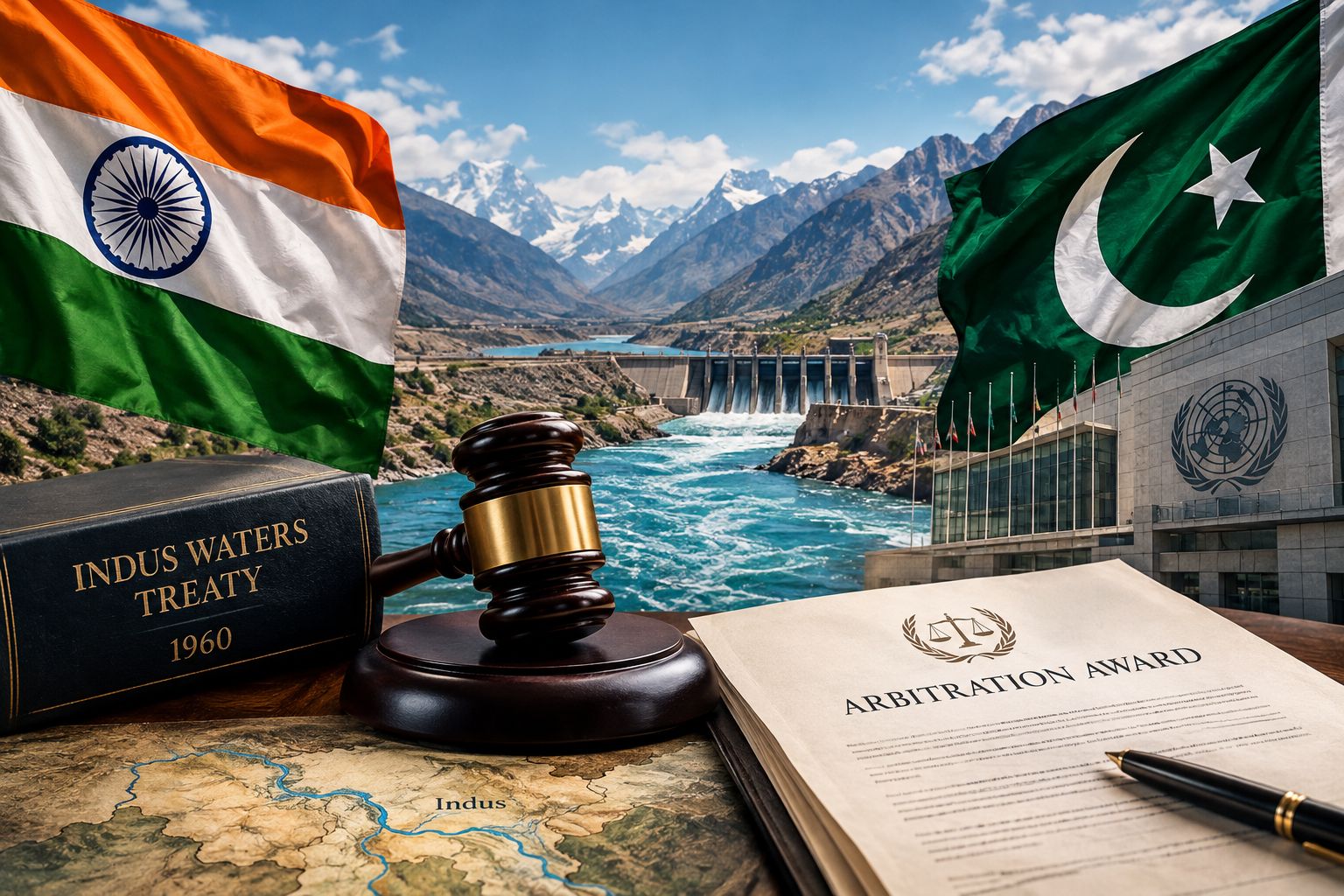
On 31 August 2026, the Court of Arbitration constituted under the Indus Waters Treaty 1960 (IWT) delivered its Award on the status of the Treaty, together with an Order on Interim Measures concerning India’s Ratle hydroelectric project. The Court unanimously held that India’s April 2025 decision to hold the Treaty “in abeyance” was not permissible under the Treaty or under international law and that the IWT “remains fully in force”. India’s response came the same day. The Ministry of External Affairs categorically rejected the “so-called award”, describing the Court as “illegally constituted”, “constituted by the World Bank in patent breach of the terms of the Treaty”, and without “jurisdiction whatsoever to pronounce on India’s sovereign decisions”.

At first glance, this may look like a fresh jurisdictional confrontation. It is not. India’s objection to the Court’s constitution and competence was raised, considered and rejected in 2023. What New Delhi presented as a response to the 2026 Award is, in legal substance, a restatement of an argument the Court has already adjudicated. That procedural history matters, both for assessing India’s position and for understanding what is now at stake.

The Dispute Did Not Begin With “Abeyance”

The controversy long predates India’s announcement, after the Pahalgam attack, that the Treaty would be held in abeyance. Pakistan had objected for years to design features of two run-of-river projects on the Western Rivers, the 330 MW Kishenganga and 850 MW Ratle plants, and on 19 August 2016 it requested a Court of Arbitration under Article IX and Annexure G of the Treaty. India, for its part, sought a Neutral Expert under Annexure F. After a prolonged pause, the World Bank activated both processes in 2022, appointing Michel Lino as Neutral Expert and completing the constitution of the Court under the chairmanship of Professor Sean Murphy.

India boycotted the Court and challenged its very existence. In its Award on Competence of 6 July 2023, the Court unanimously rejected all six of India’s objections. It held that paragraph 16 of Annexure G gave it the power to decide questions concerning its own competence; that the matters raised were disputes within the meaning of Article IX(2); that the proceedings had been initiated in accordance with Article IX(3) to (5); and, critically, that the Court “was properly constituted in accordance with Paragraphs 4 to 11 of Annexure G”. It also found that the parallel appointment of the Neutral Expert did not deprive it of competence, and that India’s absence did not prevent it from proceeding.

The Neutral Expert process, which India itself had requested, has continued in parallel. In January 2025 the Neutral Expert issued his own decision on competence, which New Delhi welcomed. India, in other words, accepts the Treaty’s dispute machinery when it is the claimant and disowns it when it is the respondent.

This point should not be lost in the political exchange. India may disagree with the 2023 determination and may continue to insist that the Court was improperly constituted. But that proposition has been tested before the body the Treaty itself designates to decide it, and it was rejected.

Then Came “Abeyance”

India’s announcement of 23 April 2025, communicated formally to Pakistan the following day, raised a different legal question: could a unilateral decision to hold the Treaty in abeyance deprive an already constituted Court of competence?

The Court answered that question in its Supplemental Award on Competence of 27 June 2025. Ruling unanimously, it held that India’s position, however it might be characterised in international law, “does not deprive the Court of Arbitration of competence”. The reasoning rested on a settled principle: a party’s unilateral conduct after proceedings have begun cannot undo the jurisdiction a tribunal already possesses. India rejected that award as well, calling it the “latest charade at Pakistan’s behest”.

The Court then turned to the substance. Its Award on Issues of General Interpretation of 8 August 2025 held that the exceptions permitting Indian hydropower on the Western Rivers must be read narrowly, that India must generally let those waters flow to Pakistan, and that design features such as spillways, intakes and pondage must remain within Treaty limits even where engineering practice might favour otherwise. When a further award on pondage followed in May 2026, the Ministry of External Affairs again declared that its abeyance decision “remains in force”.

The distinction between these questions is important. Challenging a tribunal’s original constitution is one argument; claiming that a later unilateral act has removed the treaty basis for its jurisdiction is another. India has consistently folded both into a single claim: that the Court has no authority to decide anything at all.

What the 2026 Award Actually Decided

The 31 August Award addressed the question the 2025 Supplemental Award had deliberately left open: is the Treaty still in force? Observing that “abeyance” is not a Treaty term and has no technical meaning in international law, the Court treated India’s position as a claim to suspend or terminate the IWT and examined each ground that might support it.

The Treaty itself offers none. Article XII(4) provides that it “shall continue in force until terminated by a duly ratified treaty” between the two governments. An appeal to sovereignty was no answer, since pacta sunt servanda binds states precisely in their capacity as sovereigns. The alleged material breaches, namely Pakistan’s refusal to renegotiate, its use of the Treaty’s own dispute procedures and cross-border terrorism, were each rejected. The Court stated that it took the terrorism allegation “extremely seriously” but found that the Treaty does not regulate the use of force and that India had in any case continued building its projects. Arguments based on a fundamental change of circumstances, from demographic pressure and clean-energy demand to climate change, failed because the changes were foreseeable, were not an essential basis of consent, or did not radically transform India’s obligations. Nor could the measure qualify as a lawful countermeasure, since it would disable the very dispute-settlement provisions that make the Treaty’s obligations enforceable.

Alongside the Award, the Court ordered interim measures prohibiting India from raising concrete on the Ratle dam wall and power intake above specified levels until 90 days after the Neutral Expert’s final decision, expected around July 2027, and requiring India to notify any change to the construction schedule. The significance of the ruling is therefore broader than a dispute over hydropower design. It concerns whether one state can unilaterally take a treaty-based dispute-settlement framework out of operation once proceedings are under way. For India, the answer remains that the Court was never validly constituted. For the Court, that question was answered three years earlier.

A Disagreement Is Not an Annulment

India’s latest response is consistent with its long-standing position. Yet rejecting an award is legally different from establishing that the tribunal lacked authority to make it. The IWT contains its own dispute-settlement architecture, which India negotiated, signed and ratified. Paragraph 16 of Annexure G expressly empowers the Court to decide questions of its competence, and its awards bind the Parties without appeal.

The charge that the Court was “constituted by the World Bank” does not alter this. The Bank did not create the Court; it performed the procedural role that Annexure G assigns to it in the selection of the umpires, and the Court confirmed in 2023 that its constitution complied with paragraphs 4 to 11 of that Annexure. The 2025 Supplemental Award then confirmed that India’s subsequent abeyance decision did not extinguish that competence.

The 2026 Award therefore did not come from a tribunal suddenly asserting jurisdiction over an unwilling state. It came from a tribunal whose competence had been determined twice, and whose proceedings continued with India notified at every stage and choosing not to take part. Non-participation is a choice open to any state. It does not suspend the process, and it does not convert a disagreement into an annulment.

The Larger Question

The Indus Waters Treaty has survived the wars of 1965 and 1971, the Kargil conflict and decades of hostility. Its durability has never depended on the absence of disagreement but on the existence of mechanisms through which disagreement can be channelled. India’s conduct now tests those mechanisms from two directions. First, can a state refuse to recognise a dispute-settlement body after it has been constituted and has ruled on its own jurisdiction? Second, can that same state then places the underlying treaty “in abeyance” and thereby remove the mechanism’s legal foundation?

The Court’s answers have been consistent. In 2023 it rejected India’s challenge to its constitution and competence. In 2025 it held that the abeyance decision could not deprive it of competence. In 2026 it rejected every ground advanced for suspending or terminating the Treaty.

The repetition is striking. India’s latest objection is a new political statement, but it is not a new legal argument. The central issue is no longer whether India agrees with the Award. It is whether a state may make a treaty’s operation and the machinery for resolving disputes under it contingent on its own unilateral acceptance. If that position were to prevail, the lesson for upstream states, and for every treaty with a compulsory dispute-settlement clause, would be that obligations bind only for as long as they remain convenient. That is the precedent the Indus dispute is now testing. On the question of the Court’s constitution, India is not confronting a new finding. It is regurgitating an objection the Tribunal rejected three years ago.


* Saamiya Siddiqui is a lawyer, legal researcher and published writer with a strong interest in journalism, public affairs and policy.

Picture of Guest

Guest