


Publications
Analysis Series
Analysis/0093/September/2026/London-Dialogue. 30 September 2026
By Tahir Azad
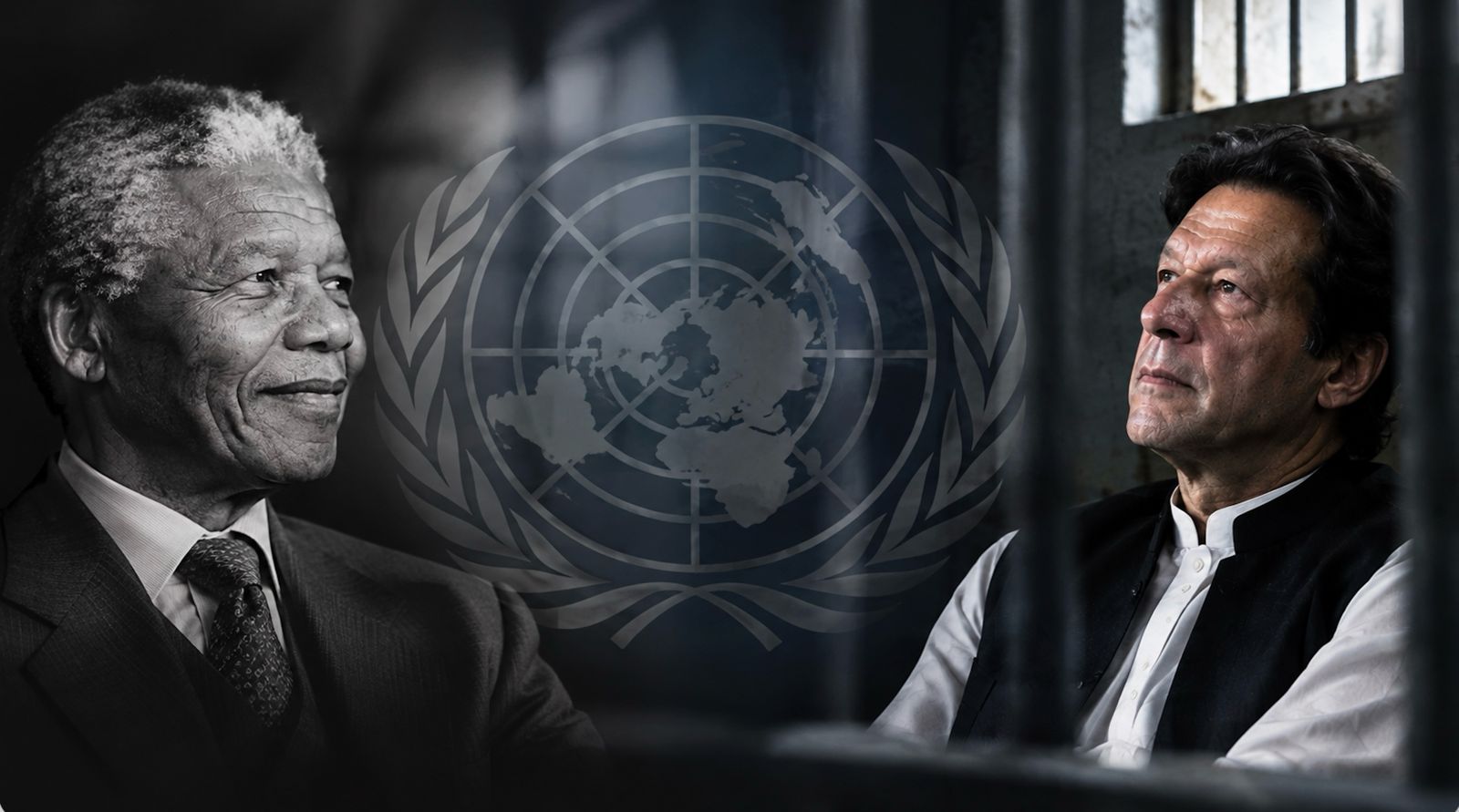
The United Nations (UN) guide to the prison standards that bear Nelson Mandela's name opens with his observation that a nation should be judged not by how it treats its highest citizens, but by how it treats its lowest ones. Pakistan is now failing a harder version of that test. It is failing it with a former prime minister, a 73-year-old man who led the country's only Cricket World Cup victory, who remains, by the reckoning of the country's leading pollster, its most popular political figure, and who has spent three years in Rawalpindi's Adiala Jail. The question this analysis addresses is not whether Imran Khan is guilty of any offence, which is a matter his appeals should settle, but whether the conditions in which the Pakistani state holds him meet the minimum standards that Pakistan itself has accepted. On the available evidence, they do not, and the consequences of that failure now extend well beyond one prison cell.
A Prisoner Without Visitors
The factual record is no longer confined to the claims of Khan’s party. In December 2025 the UN Special Rapporteur on Torture, Alice Jill Edwards, publicly called on Pakistan to end what she described as excessive periods of solitary confinement, with Khan reportedly confined to his cell for 23 hours a day, held in a small cell lacking natural light and adequate ventilation, and kept under constant camera surveillance. She reminded Islamabad that solitary confinement lasting longer than 15 days is regarded under international human rights law as a form of psychological torture.
Since then, the picture has darkened. Khan’s lawyers reported in February 2026 that he had lost around 85 per cent of the vision in his right eye. His sons, Sulaiman and Kasim, both British citizens, told Al Jazeera in August that they had last heard their father’s voice during a 20-minute call at Eid al-Fitr in March, that they had not seen him since November 2022, and that, apart from one brief visit by two of his sisters, he had been denied visitors for roughly ten months. Their mother, Jemima Goldsmith, says the sons have been refused visas and warned that they risk arrest if they travel to Pakistan.
The government’s position deserves to be stated fairly. Pakistan’s Ministry of Information has rejected claims of punitive isolation, insisted that Khan is a convicted prisoner rather than an executive detainee, cited records of roughly 198 interview sessions and more than 900 visitor entries across his imprisonment, and stated that he has undergone some 30 medical examinations. It has also argued that access to a prisoner cannot become a platform for political activity. However, cumulative visitor entries across three years say nothing about the quality or regularity of contact in the past ten months, and the government’s own medical process undercuts its case. Before the Supreme Court hearing of 18 August, a medical board and jail superintendent report recommended more frequent meetings with his immediate family to help manage his blood pressure and anxiety. When the state’s own doctors prescribe family contact as treatment, the withholding of that contact ceases to be an administrative detail.
What the Mandela Rules Require
The United Nations Standard Minimum Rules for the Treatment of Prisoners, adopted unanimously by the General Assembly in Resolution 70/175 in December 2015 and known as the Nelson Mandela Rules, are not an abstract aspiration. They are the universally recognised benchmark against which prison conditions are judged by UN mechanisms and national courts alike. Several of them speak directly to Khan’s case.
Rule 43 prohibits indefinite and prolonged solitary confinement outright. Rule 44 defines solitary confinement as confinement for 22 hours or more a day without meaningful human contact, and prolonged solitary confinement as anything exceeding 15 consecutive days. Rule 45 permits isolation only in exceptional cases, as a last resort and for as short a time as possible, and never by virtue of a prisoner’s sentence. Rule 43(3) states that restrictions or disciplinary sanctions shall not include a prohibition of family contact, while Rule 58 guarantees prisoners’ regular communication with family, both in writing and through visits. On health, Rule 24 requires care equivalent to that available in the community, and Rule 27 provides that clinical decisions may be taken only by the responsible health-care professionals and may not be overruled or ignored by non-medical staff.
Measured against this framework, the case is stark. A regime of 23 hours a day in a cell for extended periods breaches Rules 43 and 44 on its face. Months without contact with his children breach Rules 43(3) and 58. The decision to divert a court-ordered transfer to a private hospital on grounds of security, rather than medical judgement, sits uneasily with Rule 27. These rules also give practical content to obligations that bind Pakistan in law. Pakistan ratified both the International Covenant on Civil and Political Rights and the Convention against Torture in 2010, and Article 10 of the Covenant requires that all persons deprived of liberty be treated with humanity and respect for their inherent dignity. Article 14 of Pakistan’s own Constitution declares the dignity of man inviolable. The violation is therefore not merely of a UN guideline but of Pakistan’s treaty commitments and its constitutional order.
Courts Without Consequence
What makes this case exceptional is not that Pakistani courts have failed to act. It is that they have acted repeatedly and that their orders have not been carried out. On 18 August a three-judge bench of the Supreme Court ordered Khan transferred to Shifa International Hospital, directed that a medical board be formed with his personal physician and his sister, a doctor, associated with it, and required weekly family visits and twice-weekly calls with his sons. Instead, he was taken to the state-run PIMS hospital for a brief examination and returned to Adiala on 20 August. On 1 September the Islamabad High Court went further, directing the jail superintendent to ensure that neither Khan nor his wife, Bushra Bibi, is kept in solitary confinement, and ordering family meetings, telephone access to his sons, daily newspapers and books, and proper medical care.
The response of the state has been to route the matter elsewhere. On 15 September the newly created Federal Constitutional Court, established under the 27th Amendment, requisitioned the record of the case from the Supreme Court. At the hearing on 16 September, as JURIST reported, the proceedings ended without a determination on either the contempt petition or the jurisdictional dispute between the two courts. Meanwhile, the Supreme Court declined requests for an early hearing, with court sources noting that 94 contempt petitions were already pending before it. The pattern is familiar to students of hybrid regimes. Judicial orders are not openly defied so much as absorbed by delay, jurisdictional contest and procedural attrition, until the remedy arrives too late to matter.
This matters for the underlying convictions too. According to Al Jazeera, all but one of Khan’s convictions have been suspended or overturned, with appeals pending in the remaining Al-Qadir Trust matter. As early as March 2024, the UN Working Group on Arbitrary Detention concluded in Opinion No. 22/2024 that his detention had no legal basis, appeared intended to disqualify him from political office, and should be remedied by immediate release with compensation. Pakistan has neither complied with that opinion nor offered a substantive rebuttal to it.
Lower Than the Standard for Prisoners of War
A comparison with the laws of war is uncomfortable but instructive. Under Article 71 of the Third Geneva Convention of 1949, a prisoner of war, an enemy combatant captured in armed conflict, must be allowed to send and receive letters and cards, and any limitation may not fall below two letters and four cards a month. Such correspondence may not be delayed or withheld for disciplinary reasons. International humanitarian law thus guarantees an enemy soldier a regular line to his family. A former head of government, held by his own state, has been unable to speak to his sons for six months. When a state treats a domestic political prisoner below the floor, it would owe a captured adversary; the problem is no longer one of prison administration. It is a statement about how the state regards the political opposition it is holding.
A New Precedent in Pakistani History
Pakistan has imprisoned prime ministers before. Zulfikar Ali Bhutto was executed in 1979 after a trial the Supreme Court itself later acknowledged was unfair, and Nawaz Sharif was jailed and exiled under Pervez Musharraf. The present episode is distinctive in three respects. First, it is taking place under a constitutional framework that has been reshaped around the military leadership. The 27th Amendment of November 2025 created the post of Chief of Defence Forces for Field Marshal Asim Munir, granted lifetime immunity from criminal proceedings to the army chief and the president, and established the Federal Constitutional Court that has now drawn Khan’s medical case away from the Supreme Court. Second, it is being conducted against a leader whose electoral base remains intact. Despite losing its electoral symbol before the February 2024 election, PTI-backed candidates won more seats than any other party, a Commonwealth observer group later found that institutional decisions had consistently limited one party’s ability to contest, and Gallup Pakistan’s executive director told Al Jazeera this month that Khan remains the country’s most popular leader. Third, the pressure now reaches his family directly. All three of Khan’s sisters, each over 65, were detained in September under a 1960 public order law that permits preventive detention without charge.
This is a precedent with consequences beyond Pakistan. If the treatment of Imran Khan becomes normalised, with judicial orders deflected, family contact withheld and international findings ignored without cost, it will offer a template to other governments seeking to neutralise popular opponents without the political expense of an outright ban. Authoritarian practice travels through example, and the example being set in Rawalpindi is that a determined establishment can hold a former prime minister in conditions a UN expert calls potentially torturous and face nothing more than letters of concern.
The World Speaks; Washington Does Not
The international response has been broad and unusual in its composition. On 23 August, 21 former Test captains, among them Sunil Gavaskar, Kapil Dev, Clive Lloyd, Allan Border, Greg and Ian Chappell, David Gower and Michael Atherton, wrote to Prime Minister Shehbaz Sharif asking for an independent medical assessment and the restoration of weekly family visits. That three Indian captains signed it, at a time of acute India-Pakistan hostility, underlines that the appeal was humanitarian rather than partisan. On 18 September, former British Prime Minister Boris Johnson called the imprisonment a global scandal, argued that the Field Marshal had nothing to fear from an elderly prisoner in poor health, and proposed house arrest pending appeal as an obvious humane step.
The conspicuous silence belongs to the Trump administration. In the weeks after Trump’s election victory in November 2024, Richard Grenell, a close Trump ally who became a presidential envoy, publicly called for Khan’s release, and Trump allies had cultivated Pakistani American voters, many of them Khan supporters, on the expectation that his return would change Khan’s fortunes. Drop Site News later reported, citing two anonymous sources, that at his June 2025 White House lunch with Munir, Trump told the army chief to “resolve” the Khan issue. Whatever was said in private, the public record since has pointed the other way. Trump has described Munir in glowing terms, Washington has welcomed Pakistan’s alignment on regional crises, and, as analysts at the University of Melbourne’s Asialink have observed, the administration has embraced Khan’s jailers as part of a wider recalibration in South Asia. The executive branch has left the matter to Congress, where a bipartisan group of lawmakers wrote to Secretary of State Marco Rubio on 11 August, citing the Special Rapporteur’s findings and urging the State Department to raise Khan’s conditions directly with Islamabad.
The logic of the silence is transactional. Interests changed, and Pakistan’s military became useful to Washington on counterterrorism, on regional mediation and as a counterweight in a shifting South Asian balance. But silence is also a signal. A United States that routinely invokes the rights of detained political figures elsewhere yet says nothing about a former prime minister held in conditions condemned by a UN mandate holder is telling Pakistan’s establishment that strategic utility purchases immunity from scrutiny. That message will be read not only in Rawalpindi but in every capital holding an inconvenient opponent.
The Echo of 1971
Comparisons with 1971 must be made carefully, because the loss of East Pakistan involved a distinct ethnic and territorial dynamic and a humanitarian catastrophe on a scale that should not be invoked lightly. The structural warning, however, is real. In 1970 the Awami League won a clear electoral majority, the military leadership refused to transfer power, and in March 1971 the army launched Operation Searchlight to crush the political movement it could not defeat at the ballot box. The lesson of that year is that a state which treats the majority’s chosen leader as a security threat can win every tactical confrontation and still lose the country.
Several of those ingredients are visible today. A popular party is denied the power its vote share implies. The military sits at the apex of the constitutional order. The media space is constricted. And the political confrontation is acquiring a provincial dimension. The PTI governs Khyber Pakhtunkhwa, and ahead of the long march planned for 27 September, the authorities closed the motorway linking Islamabad and Peshawar, placed more than 2,000 containers across the capital and at Attock Bridge, the main crossing between Khyber Pakhtunkhwa and Punjab, and brought in some 19,000 police from Punjab and Sindh. When the federal state physically barricades itself against the elected government of a province, the imagery of 1971 is no longer rhetorical. Interior Minister Mohsin Naqvi’s promise of a permanent plan of action to settle matters once and for all, and the army chief’s earlier insistence that Pakistan must stop acting as a soft state, suggest an establishment that sees coercion as the solution rather than the problem. The PTI has since postponed the march to 4 October, which buys time but resolves nothing.
A Nuclear State Cannot Afford Anarchy
Pakistan is the world’s only Muslim-majority nuclear-weapon state, and its strategic stability rests not only on command-and-control arrangements but also on the cohesion and legitimacy of the state that operates them. That foundation is under strain from several directions at once. Militant violence in Khyber Pakhtunkhwa is intensifying, with an attack on a police compound in Kohat killing more than 20 people on 18 September. The economic shock from the Middle East war has pushed petrol to 393.75 rupees a litre, prompting Jamaat-e-Islami to launch, and then pause, its own march on the capital. As quoted by Al Jazeera, the government’s real fear is that anger over prices and anger over Khan’s imprisonment will merge and draw other groups onto the streets.
For a nuclear-armed state, the danger lies precisely in that convergence. An establishment that has concentrated constitutional, military and judicial authority in fewer hands has also concentrated the political risk. If public anger breaks out in a way that security forces cannot contain without mass casualties, the resulting crisis will unfold in a country bordering Afghanistan, India and Iran, with an active insurgency on its western frontier and a strategic arsenal at its core. International partners who today treat Khan’s detention as an internal matter would then confront it as a question of regional and nuclear security. Prevention is far cheaper than crisis management, and the cheapest preventive step available is also the most basic one: compliance with Pakistan’s own courts and its international obligations.
What Must Change
The immediate agenda is neither radical nor partisan. Pakistan should implement the Supreme Court’s order of 18 August and the Islamabad High Court’s order of 1 September in full, ending solitary confinement, restoring weekly family visits and regular calls with his sons, and allowing an independent medical board, including his own physicians, to assess and treat his eye condition. It should issue visas to Sulaiman and Kasim Khan and give credible assurances for their safe travel. His remaining appeal should be heard promptly by an independent bench, and the government should engage substantively with the findings of the UN Working Group and the Special Rapporteur rather than dismissing them.
The United Kingdom, whose citizens are being kept from their father, and the United States, whose leverage in Rawalpindi has rarely been greater, should raise these points publicly and at the highest level. Doing so would not be interference in Pakistan’s internal affairs. It would be a request that Pakistan honour the rules it helped adopt by consensus at the General Assembly in 2015. Field Marshal Munir now holds constitutional authority without precedent for a serving army chief. The measure of that power will not be whether it can keep one man in a cell, which it evidently can, but whether it can recognise that the legitimacy of the state it commands depends on restraint. Pakistan’s history offers a clear warning of what happens when that recognition comes too late.
Tahir Azad
Related posts
Rivers as Leverage: India’s Suspension of the Indus Waters Treaty and the Logic of Hydro-Coercion in South Asia
Iraq After Operation Inherent Resolve: Testing Security and State Control
The Electrostate Thesis: Geopolitics, Clean Energy Dominance, and China’s New Global Leverage
A Last Open Letter to President Mr D. J. Trump
Iran’s Reliance on “Self-Defence” in the Shadow of “Strategic Loneliness”
From Chokepoint Diversification to Coupling: Hormuz, Bab al-Mandab and the New Fragility of Gulf Energy Security
The South Atlantic Flashpoint: Argentina Tests Britain, Chile, and the US
Religious Rhetoric Around the Mecca Defence Agreement and Its Long-Term Impacts for Pakistan
Operationalising The Maritime Dimension Of The Makkah Joint Defence Agreement
The Arithmetic of Saturation: What the Iran War Taught About the Limits of Layered Air Defence
Beyond the Mecca Accord: Why Pakistan Must Choose Deterrence over Entanglement in Yemen
From Security Dependence to Strategic Autonomy: The Gulf Amid the 2026 Iran War
London Dialogue — Founding Statement
Publication Categories
- Analysis (102)
- Book Review (1)
- Commentary (6)
- Essay (9)
- Journal (0)
- Journal Article (0)
- Policy Brief (6)
- Policy Paper (1)
- Research Article (2)
- Research Report (5)
- Young Writers Corner (0)