Publications
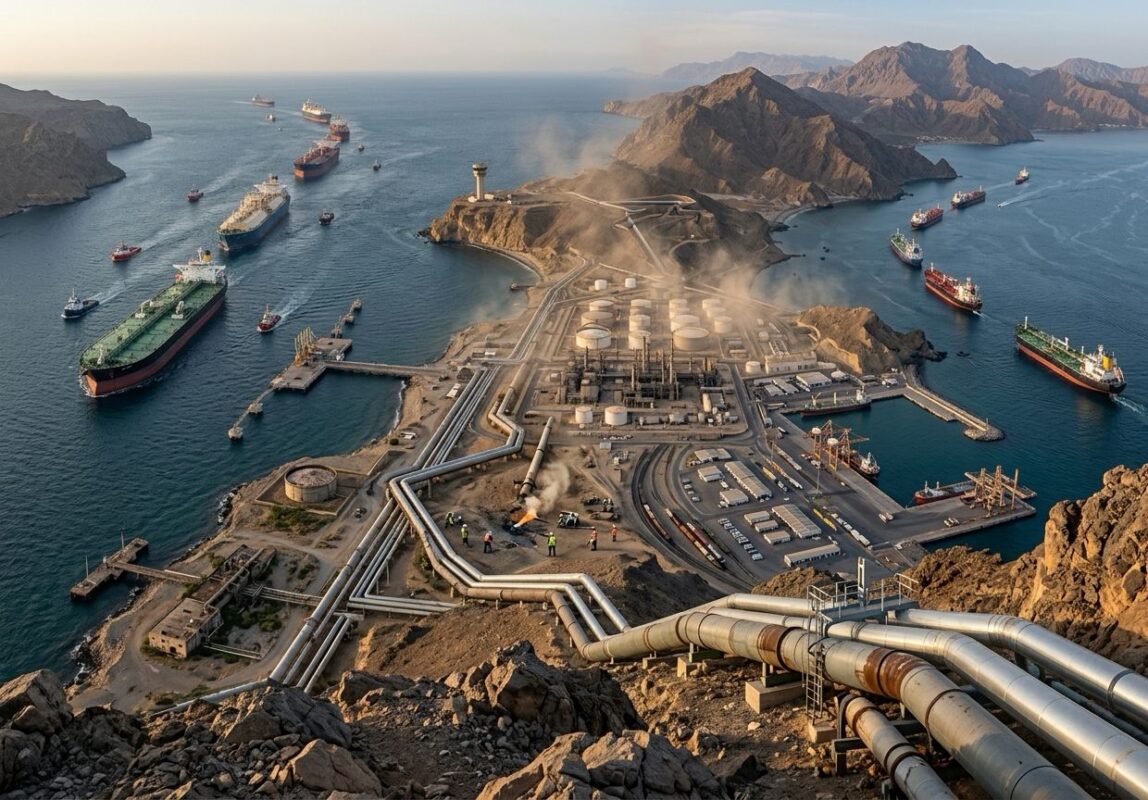
From Quiet Diplomacy to Attempted Maritime Security Governance: Oman’s Role and Limits in the 2026 Strait of Hormuz Crisis
Abdullah Hemmet Abdullah
Article
Article/02/September/2026/London-Dialogue. 04 September 2026
Authors: Prof. Dr. Abdullah Hemmet Abdullah
Affiliations: International Islamic University Malaysia, ISTAC-IIUM, Kuala Lumpur,
Malaysia; Islamic University of Gaza, Faculty of Economics and Administrative Sciences,
Gaza, Palestine; London Dialogue (LD), London, UK
EXECUTIVE SUMMARY | POLICY-FACING VERSION
From Quiet Diplomacy to Attempted Maritime Security Governance
Oman’s role and limits in the 2026 Strait of Hormuz crisis
WHAT HAPPENED
- Before the June opening, Oman had already used bilateral legal and diplomatic channels to place freedom of navigation and safe passage on the agenda.
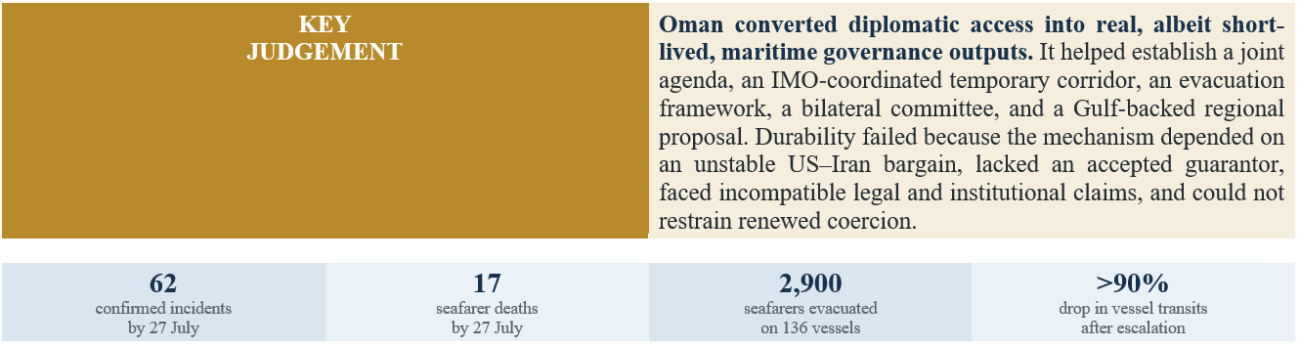
- After the mid-June US–Iran understanding, Muscat translated political principles into a joint working group, an IMO-coordinated no-fee corridor, evacuation procedures, and an Oman–Iran committee.
- The evacuation framework achieved partial implementation: 136 vessels carrying about 2,900 seafarers moved before the operation was paused following renewed violence.
- In July, attacks struck Omani territory, the ceasefire memorandum frayed, Iran rejected regional joint management, and the Persian Gulf Strait Authority advanced a rival permit-and-fee model.
- Resolution 2817 supplied condemnation, but the veto of the stronger April Security Council draft left no accepted operational guarantor.
WHY THE MECHANISM FAILED
Sponsorship dependency: The corridor and evacuation arrangements relied on a wider bargain that Oman did not control.
Missing guarantor: The IMO could coordinate procedures but not prevent attacks; Security Council deadlock left no accepted enforcement authority.
Leverage deficit: Oman could convene and translate, but not compel compliance or deter missiles, drones, mines, and coercive interference.
Incompatible governance objects: Oman organised shared navigation and services; Iran’s PGSA organised authorised passage under Iranian administration.
Role conflict: Oman was mediator, coastal state, GCC member, US defence partner, and directly affected sovereign territory at the same time.
PRIORITY RECOMMENDATIONS
- Create an Oman-hosted Hormuz Maritime Security Mechanism. Appoint an IMO technical co-chair and include Iran, GCC states, flag states, shipping associations, insurers, and designated guarantors through clearly separated civilian, technical, and security roles.
- Start with low-sovereignty functions. Prioritise a verified incident ledger, a 24-hour hotline, humanitarian windows, search and rescue, pollution response, navigational warnings, and common mine and GNSS information before negotiating route control.
- Put protection guarantees in writing. Use named guarantors, independent verification, pre-agreed suspension and restart criteria, and bounded civilian-protection mandates so that one attack does not produce indefinite institutional collapse
- Separate transit rights from service financing. Prohibit compulsory payment merely for passage; permit transparent cost-based charges only for optional services directly rendered; finance shared public goods through voluntary, audited, project-specific contributions.
- Adopt a phased, without-prejudice settlement. Allow cooperation without requiring parties to abandon positions on UNCLOS or custom; exchange safety data with PGSA liaison points without recognising unilateral transit authorisation, and defer route allocation until compliance is demonstrated.
Policy bottom line: Quiet diplomacy becomes governance only when institutions survive renewed coercion. The immediate objective should therefore be a narrow, phased, technically credible mechanism—not a comprehensive settlement of sovereignty and regional security competition.
PHASE 1 | STABILISE
Joint incident ledger; 24-hour hotline; protected humanitarian windows; common navigational warnings; written pause and restart rules.
PHASE 2 | INSTITUTIONALISE
Search-and-rescue coordination; pollution response; exercises; voluntary audited service fund; independent verification.
PHASE 3 | NEGOTIATE
Address route allocation or a revised traffic-separation scheme only after verified compliance and sustained de-escalation.
Abdullah Hemmet Abdullah
Related posts
Rivers as Leverage: India’s Suspension of the Indus Waters Treaty and the Logic of Hydro-Coercion in South Asia
Iraq After Operation Inherent Resolve: Testing Security and State Control
The Electrostate Thesis: Geopolitics, Clean Energy Dominance, and China’s New Global Leverage
A Last Open Letter to President Mr D. J. Trump
Iran’s Reliance on “Self-Defence” in the Shadow of “Strategic Loneliness”
From Chokepoint Diversification to Coupling: Hormuz, Bab al-Mandab and the New Fragility of Gulf Energy Security
Imran Khan’s Solitary Confinement and the Mandela Rules
The South Atlantic Flashpoint: Argentina Tests Britain, Chile, and the US
Religious Rhetoric Around the Mecca Defence Agreement and Its Long-Term Impacts for Pakistan
Operationalising The Maritime Dimension Of The Makkah Joint Defence Agreement
The Arithmetic of Saturation: What the Iran War Taught About the Limits of Layered Air Defence
Beyond the Mecca Accord: Why Pakistan Must Choose Deterrence over Entanglement in Yemen
London Dialogue — Founding Statement
Publication Categories
- Analysis (102)
- Book Review (1)
- Commentary (6)
- Essay (9)
- Journal (0)
- Journal Article (0)
- Policy Brief (6)
- Policy Paper (1)
- Research Article (2)
- Research Report (5)
- Young Writers Corner (0)