


Publications

From Chokepoint Diversification to Coupling: Hormuz, Bab al-Mandab and the New Fragility of Gulf Energy Security

Picture of Abdullah Hemmet Abdullah

Abdullah Hemmet Abdullah

Analysis Series

Analysis/0094/October/2026/London-Dialogue. 01 October 2026

By Prof. Dr. Abdullah Hemmet Abdullah

Abstract

Gulf energy security has long treated pipelines, alternative terminals, and redundant shipping routes as the answer to the Strait of Hormuz’s vulnerability. The disruptions of 2026 reveal a harder problem: bypass systems can be physically separate yet operationally coupled through terminals, onwards chokepoints, insurance, transfer capacity, and deliberate attack, so nominal redundancy can collapse under correlated stress. This analysis develops the concept of chokepoint coupling and proposes “independent deliverable capacity” as a more useful resilience test: not how much infrastructure exists on paper, but how much energy can still reach a destination when several parts of the network are under pressure at once.

When The Bypass Becomes Part of The Crisis

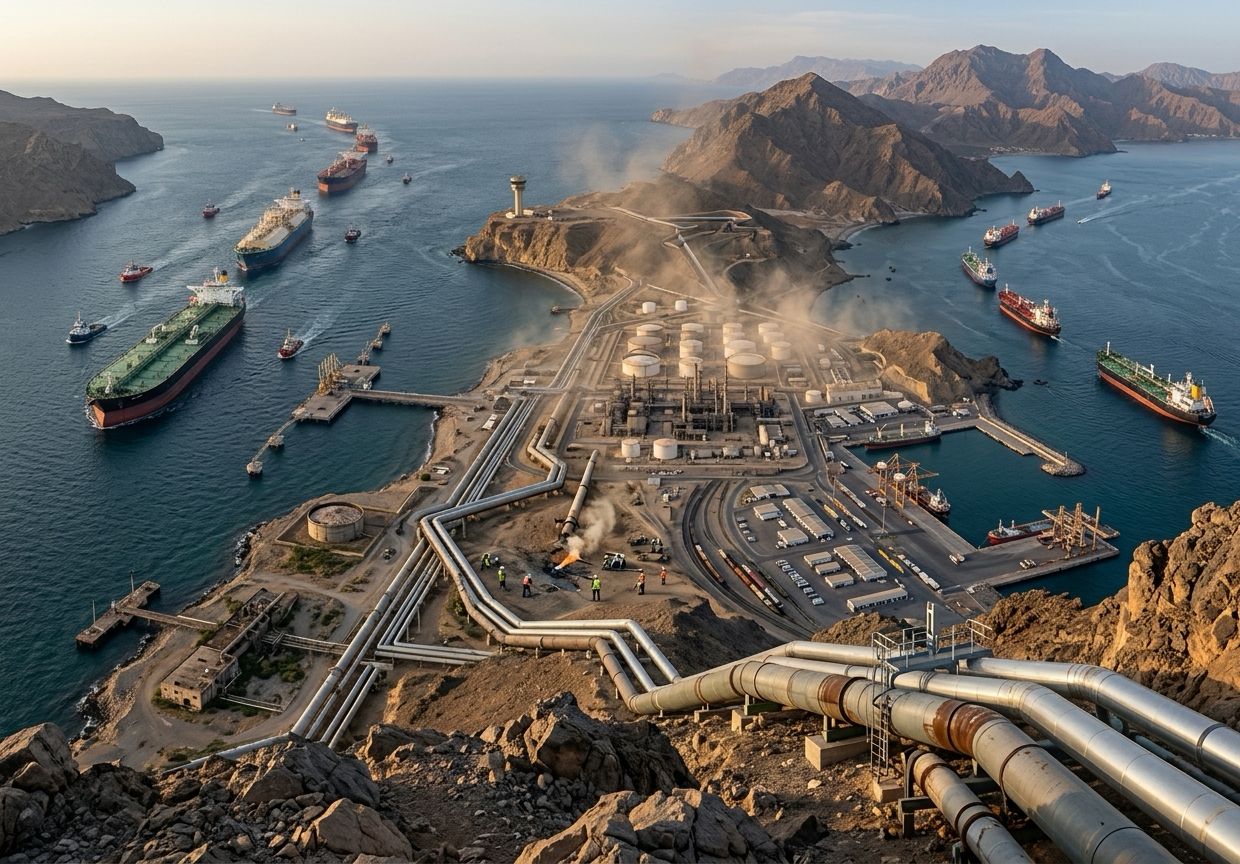
Saudi Arabia entered 2026 with what looked like one of the strongest physical answers to Hormuz risk in the Gulf. In the first quarter, Aramco raised the East-West Pipeline to its maximum 7.0 million barrels per day (mb/d) capacity and described the system as a critical supply artery for maintaining west-coast exports when shipping through Hormuz was constrained. The regional war that began with U.S.-Israeli strikes on Iran on 28 February 2026 turned that contingency architecture from an insurance policy into core operating infrastructure.

The September attack on the East-West system exposed the weakness hidden inside that success. Kpler reports that multiple pumping stations were disabled on 10 September and that no crude had loaded from Yanbu since 11 September. Kpler estimated that terminal inventories covered only about three to five days of normal loadings, or roughly nine days of refinery runs if no additional crude reached the west-coast system. Attribution remains contested. Saudi Arabia said the drones originated from Iraq, and Iraq’s prime minister’s office subsequently confirmed that the drones had been launched from Iraqi territory and dismissed the military commander responsible for the relevant province. Iran-backed Iraqi armed groups denied carrying out the strike, while Kpler and parts of the trade press described the incident as a Houthi attack. No group formally claimed responsibility. That uncertainty is analytically important rather than inconvenient: the bypass faced threats from more than one theatre and direction of attack.

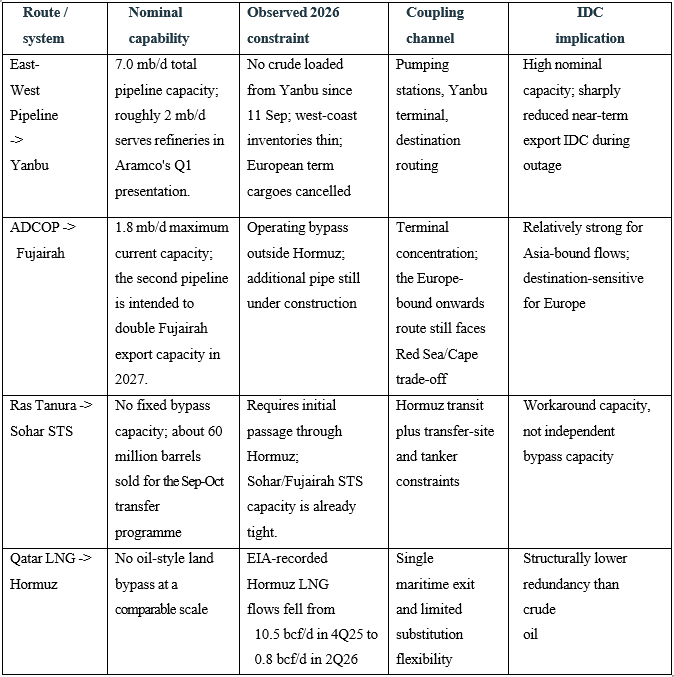
The commercial consequences provide the clearest evidence of route coupling in the entire episode. After Yanbu loadings ceased, Aramco cancelled late-September cargoes and allocated no October crude to its European term customers. European refiners were therefore forced to seek substitute grades outside the Saudi system; Poland’s Orlen, for example, moved rapidly to secure additional alternative cargoes. At the same time, Aramco sold about 60 million barrels from Ras Tanura for September and October loading via ship-to-ship transfer at Sohar. The contrast is the article’s core empirical point. Europe-bound barrels depended on the Red Sea-facing corridor because it bypassed Hormuz; once that corridor failed, contracted European flows could not simply be rerouted within the same Saudi network. Asia-bound barrels had more room to move, but only by returning to Ras Tanura, crossing Hormuz and relying on already-constrained transfer capacity near Oman. The bypass did not fail uniformly: it failed by destination.

From A Geography Problem to A Network Problem

The established diversification doctrine was geographical. If Hormuz became unreliable, Saudi crude could move west to Yanbu; Emirati crude could move east to Fujairah; inventories and spare tanker capacity could bridge short disruptions. The logic was sound, and without those investments the 2026 shock would have been much worse. What it underestimated was dependence between the alternatives themselves.

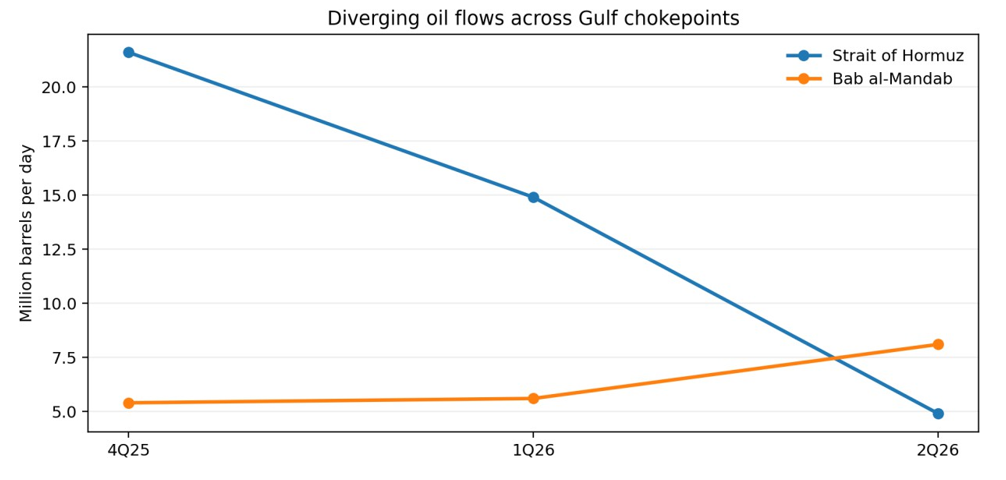
The shift is visible in the U.S. Energy Information Administration’s chokepoint data. Oil and petroleum liquids moving through Hormuz fell from 21.6 mb/d in the fourth quarter of 2025 to 4.9 mb/d in the second quarter of 2026. Over the same interval, Bab al-Mandab flows rose from 5.4 to 8.1 mb/d. The EIA series is unusually important because it shows the redistribution of traffic across the network, not merely a reduction at one strait. It also requires caution: the agency notes that Automatic Identification System (AIS) signals around Hormuz have become especially unreliable since the end of February and that 2026 estimates are being revised frequently.

Figure 1. Diverging oil flows through Hormuz and Bab al-Mandab, 4Q25-2Q26.

Source: U.S. Energy Information Administration, Global Energy Security Data. Hormuz 2026 volumes are subject to frequent revision because AIS data are unusually unreliable.

Recent commentary has already identified the strategic compression. Ctech argued that Hormuz, Bab al-Mandab, and the Saudi pipeline are becoming one energy crisis, while the Middle East Council on Global Affairs described the Gulf as caught between Hormuz and Bab al-Mandab. Those diagnoses are persuasive, but they remain primarily geographical: simultaneous pressure on several routes. The next analytical step is to ask how much of a nominal bypass remains truly usable once you discount common failure channels.

Chokepoint Coupling: Structural and Adversarial

Chokepoint coupling occurs when an alternative route is physically separate from the chokepoint it is meant to bypass, but its effective availability remains dependent on another vulnerable corridor, shared infrastructure, constrained logistics, or the same conflict environment. Four structural forms are especially visible in 2026.

Route coupling appears when a bypass simply transfers exposure downstream. A barrel loaded at Yanbu avoids Hormuz, but its onward route depends on the destination: Europe-bound trade typically moves north through Suez, while southbound Red Sea access brings Bab al-Mandab into the risk map. Infrastructure coupling arises when a pipeline remains intact on paper but pumping stations, storage, power, or loading terminals fail. Logistical coupling emerges when tanker availability, ship-to-ship transfer sites, escorts and port handling become the binding constraint rather than the pipe itself. Risk-pricing coupling appears when insurers and charterers price a region-wide threat rather than a single waterway, raising the cost of supposedly independent alternatives.

A fifth mode is more strategic: adversarial coupling. This occurs when an opponent, proxy or aligned armed group deliberately targets the route that has absorbed traffic from a disrupted chokepoint. The September attack cannot serve as proof of a centrally directed campaign because attribution remains contested. It does, however, show that the bypass itself can become a target once its strategic value rises. Resilience planning must therefore test not only correlated failure but also an adversary’s intelligent adaptation.

Independent Deliverable Capacity

This is where the usual language of capacity becomes misleading. A 7 mb/d pipeline is not equivalent to 7 mb/d of energy security if its pumping stations are disabled, its terminal is offline, its ships cannot obtain cover, or the receiving market can be reached only through another contested corridor. A more useful concept is independent deliverable capacity (IDC): the quantity of energy that can still be delivered to a specified market after discounting the route’s failure modes.

This is a heuristic, not an engineering standard or forecast. Each multiplier can be expressed as a value between zero and one for scenario analysis. The point is methodological: a route with large nameplate capacity can have low strategic value when one critical multiplier collapses. 

Table 1. Stress-testing independent deliverable capacity. Sources: Aramco, EIA, ADNOC, Kpler and Reuters; current through 21 September 2026.

Europe and Asia Do Not Face the Same Network

The value of IDC becomes clearest when the destination is specified. The Yanbu disruption did not create one uniform Saudi export problem. It separated customers by the route their supply depended on. Europe-facing term flows were cut, and refiners had to substitute North Sea and other Atlantic Basin grades. Asia, by contrast, could receive more Saudi barrels from Ras Tanura after those barrels traversed Hormuz and were transferred near Sohar. Physical production had not vanished; the network had changed which destinations it could serve reliably.

This is route coupling in operational form. The East-West Pipeline had created genuine resilience for Europe because it moved Saudi crude towards the Mediterranean without requiring Hormuz. When Yanbu went offline, that independence disappeared. The available workaround served Asian demand more readily, but only by reintroducing the very chokepoint risk the pipeline had been built to avoid. A single national export-capacity number therefore conceals the geography that matters to customers: what counts is not how many barrels the system can move in aggregate, but how many it can still deliver to a specified market after the relevant route fails.

Oman and Fujairah: Shock Absorbers with Ceilings

Oman and the United Arab Emirates remain central to Gulf resilience because they provide logistics outside the Persian Gulf. Sohar has become a transfer node for Saudi barrels exiting through Hormuz, while Fujairah gives the UAE a pipeline-fed export point outside the strait. Yet the September shock demonstrates that these nodes are not an unlimited reserve of flexibility. Kpler reports that Fujairah and Sohar handle most Gulf ship-to-ship transfers and are believed to be operating at or close to capacity. The shock absorber can therefore become its own bottleneck.

The UAE response points in the right direction but also illustrates the time lag between recognising a vulnerability and removing it. The current Abu Dhabi Crude Oil Pipeline can move up to 1.8 mb/d to Fujairah. ADNOC says its second west-east pipeline was about 50% complete in May 2026 and is being accelerated towards operation in 2027, which would double export capacity through Fujairah. The strategic gain will depend not only on pipe capacity but on storage, terminal redundancy, power, cyber resilience and the ability of onwards shipping to avoid the same conflict system.

LNG Shows Where Diversification Reaches Its Limit

Crude oil can be stored, blended, redirected, loaded from different terminals and transferred between tankers. Liquefied natural gas has far less room for improvisation. EIA data show LNG flows through Hormuz falling from 10.5 billion cubic feet per day in the fourth quarter of 2025 to 0.8 billion cubic feet per day in the second quarter of 2026. That collapse matters because no East-West-style land corridor can substitute for Qatari LNG exports at a comparable scale.

For Gulf energy strategy, oil and LNG should therefore no longer be placed under one generic heading of “chokepoint resilience”. Oil resilience is increasingly a problem of decoupling routes and logistics. LNG resilience is more fundamentally a problem of storage, destination-side inventory, shipping availability and supply diversification outside the Gulf.

What A Resilience Doctrine Built Around IDC Would Change

A shift from nominal capacity to independent deliverable capacity would change planning in five practical ways. First, governments and national oil companies would stress-test routes by destination rather than report one aggregate bypass figure. Europe, East Asia and South Asia do not inherit the same risks from the same infrastructure.

Second, infrastructure hardening would focus on nodes rather than pipelines alone. Pumping stations, tank farms, single-point moorings, power supply, communications and repair stocks become part of the same resilience calculation. The September Yanbu episode showed that disabling a small number of critical nodes can neutralise very large nameplate capacity without destroying the pipeline itself.

Third, logistics would be treated as infrastructure. Ship-to-ship transfer locations, tugs, pilots, escorts, tanker pools, insurance and emergency port slots should be measured as finite capacity. Kpler’s warning that Sohar and Fujairah are already near operational limits is precisely the kind of information a conventional pipeline-capacity metric ignores.

Fourth, scenarios would distinguish incidental coupling from adversarial coupling. The former asks whether correlated regional risk can disable several routes. The latter asks how quickly an opponent can identify and attack whichever route becomes strategically important after the first disruption. That is a harder test because the network itself changes the adversary’s incentives.

Finally, consumer states would incorporate these considerations into resilience design. Producer-side redundancy cannot carry the entire burden. Strategic stocks, alternative crude slates, LNG portfolio diversity, and storage closer to demand reduce the amount of flexibility that must be improvised inside a conflict zone. Resilience is strongest when the producer network and the consumer network do not fail in the same direction.

The Gulf After Redundancy

The central lesson of 2026 is not that chokepoint diversification failed. The East-West Pipeline, Fujairah, Omani transfer infrastructure and inventories prevented a much larger shock. The lesson is narrower and more consequential: diversification does not create resilience unless the alternatives have sufficiently independent failure modes.

That is why the emerging debate over “one energy crisis” across Hormuz, Bab al-Mandab and Yanbu should move from description to measurement. Independent deliverable capacity offers a way to do so. It asks what can actually reach a customer after terminal outages, maritime restrictions, insurance constraints, logistics saturation, and destination geography are applied to the number printed on a pipeline map.

For decades, Gulf energy strategy asked how to build routes around Hormuz. The next phase will be harder: building routes that do not merely bypass the same chokepoint but remain operationally independent when the whole network is being tested.

Data Note. The EIA September 2026 Short-Term Energy Outlook was completed on 3 September, before the 10 September attack on the East-West Pipeline. This article therefore uses the EIA material for historical chokepoint-flow data and methodology, not for post-attack forecasts. All September operational claims are sourced to later Aramco, ADNOC, Kpler or Reuters reporting.

Picture of Abdullah Hemmet Abdullah

Abdullah Hemmet Abdullah