Publications
Demography as Grand Strategy: Population Change and National Power in the Twenty-First Century
Emilie Buxton
Analysis Series
Analysis/0099/October/2026/London-Dialogue. 14 October 2026
By Emilie Buxton
Introduction
For a long time, traditional understandings of national power have centred on territorial sovereignty, military capability, defence and state security. As a result, strategic and security policy has remained predominantly military-, industrial- and technology-centric, with governments prioritising investment in military strength, industrial capacity and technological development. That emphasis is not misplaced, but the strategic landscape of the twenty-first century is changing. Power is increasingly shaped not only by what states possess but also by the characteristics and trajectories of the populations that sustain those capabilities.
This paper does not reject conventional measures of national power but seeks to broaden how the foundations of state capacity are understood. Just as industry, economic productivity, energy security and technological innovation are recognised as forms of strategic capital, demography should be considered an equally fundamental strategic resource. The central argument is that population structure underpins the capacity of states to generate economic growth, military capability, technological innovation and political resilience. Demography is therefore not simply a social or economic variable but a strategic asset that warrants comparable political and strategic attention.
Historically, the principal sources of national power have evolved alongside transformations in the international system. Nineteenth-century strategic competition was shaped by industrialisation, territorial expansion and access to raw materials, while the twentieth century increasingly centred on oil, manufacturing capacity, nuclear deterrence and technological superiority. Each period was therefore characterised not only by changes in the distribution of power, but by changes in the resources through which power was generated. The twenty-first century represents another such transition. Technology, industry and military capability remain indispensable, but states are increasingly competing over the people who sustain them: workers, scientists, innovators, entrepreneurs, skilled migrants and military-age populations. Grand strategy is consequently entering a demographic age in which population dynamics increasingly shape the ability of states to generate other forms of national power.
The relationship between states and their populations is reciprocal: governments shape demographic outcomes through policy, while inherited demographic structures constrain the choices available to governments. Population size alone, however, does not determine national power. Its age structure, skills, health, labour-force participation, mobility and distribution determine how effectively human capital can be converted into economic and strategic capability. Without sufficient human capital, the effectiveness of other strategic resources is ultimately constrained. Twenty-first-century demographic strategy must therefore extend beyond responses to declining fertility and population ageing to encompass migration, labour-force composition, education and human-capital development.
Demographic change is particularly significant because it unfolds over decades. Unlike economic cycles, military expenditure or technological breakthroughs, demographic transformations cannot be rapidly reversed: states cannot immediately expand their working-age populations, overcome population ageing or replace generations lost through sustained fertility decline. Demographic momentum therefore creates long-term strategic constraints as well as opportunities, shaping the conditions within which governments must operate.
Despite this, demography has historically been treated largely as a background variable in international politics: a means of describing populations according to their size, structure and distribution rather than a determinant of geopolitical capability. This perspective underestimates the extent to which demographic processes shape the material foundations of state power. Demography has consequently re-emerged as a central strategic concern, with implications for military power, economic competitiveness, technological innovation, political legitimacy and long-term geopolitical influence.
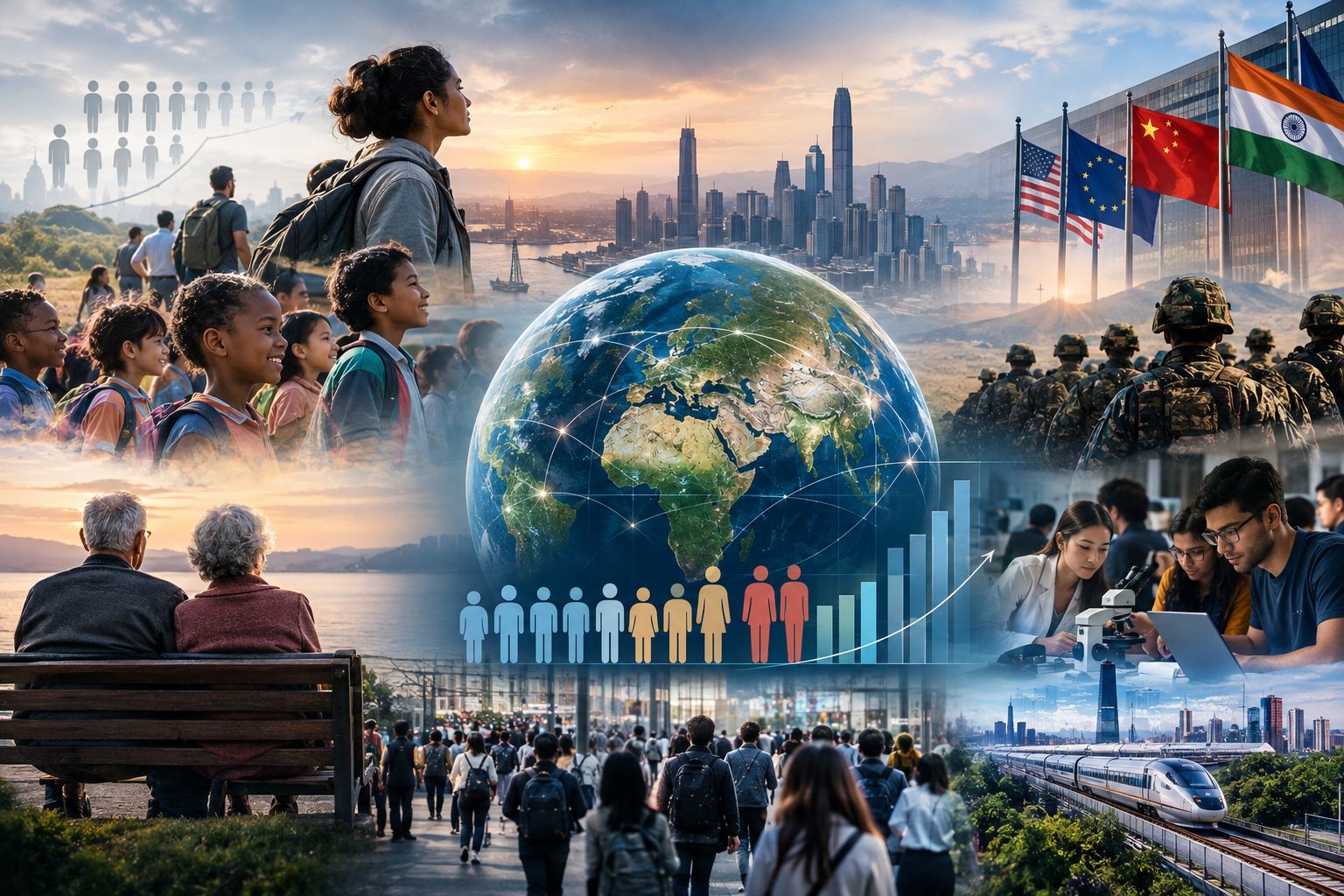
These implications differ significantly across states. East Asian powers face acute challenges from ageing and declining populations, while Europe and North America confront similar pressures as shrinking working-age populations place increasing demands on productivity and welfare systems. By contrast, countries such as India and Nigeria possess rapidly growing populations that could generate larger labour forces, expanding domestic markets and greater geopolitical influence, provided that population growth is converted into human capital and productive employment. Demographic change therefore creates neither automatic decline nor automatic power. Its strategic consequences depend on the ability of states to translate population dynamics into national capability.
The central question is consequently whether demography is becoming a decisive long-term determinant of national power and whether states can overcome demographic decline once it becomes structurally embedded. This paper argues that demographic change is increasingly fundamental to grand strategy, but that structural decline cannot be readily reversed through short-term intervention. States must instead adopt sustained and adaptive policies that anticipate demographic change and seek to maximise the economic, technological, military and political capabilities of the populations they possess.
In an international system increasingly characterised by demographic divergence, the ability to understand, anticipate and manage population change may prove as consequential to national power as military strength, technological superiority or economic wealth. States that recognise demography as a strategic resource—and integrate demographic considerations into grand strategy accordingly—will possess significant advantages over those that continue to treat population change as a secondary social concern.
Why Demography Matters Strategically
Demography is often understood through indicators such as fertility, age structure, population size and distribution. These measures, however, should not be treated simply as descriptive statistics. They are strategic variables that shape the long-term trajectory of national power. Migration, urbanisation, labour-force participation, education and health further determine how effectively populations can be converted into economic productivity, technological innovation, military capability, national resilience and geopolitical influence. Demographic change is therefore not merely a social phenomenon but a process through which states acquire, sustain or lose the foundations of power.
Fertility is strategically significant because it determines the future supply of human capital. Changes in fertility affect the size of future labour forces, economic growth potential and military recruitment pools, while also shaping the tax base available to sustain welfare systems, defence expenditure and technological investment. The effects are necessarily long-term: governments cannot immediately compensate for generations of low fertility once smaller cohorts reach working age. Persistent fertility decline can therefore constrain national capacity decades before its full economic and strategic consequences become apparent.
Age structure is closely connected to this problem. The dependency ratio captures the balance between economically active populations and those more reliant on state support, making population ageing an important constraint on fiscal and strategic flexibility. As the proportion of older people increases, governments face competing demands for pensions, healthcare and social care alongside defence, education, infrastructure and investment. Ageing does not inevitably weaken national power—older populations may possess greater experience, wealth and accumulated human capital—but it changes the allocation of resources available to the state. The strategic question is therefore not simply whether a population is ageing, but whether its institutions and economy can sustain a changing age structure without sacrificing other sources of national capability.
Migration provides a different demographic mechanism by redistributing population and human capital across borders. Its strategic significance lies not only in the number of people moving but also in who moves and what capabilities they bring. Skilled migration can expand labour supply, address workforce shortages and strengthen innovation in receiving states, while persistent emigration can deprive origin countries of valuable expertise. The competition for highly skilled migrants has consequently become an increasingly important dimension of international competition. Countries such as Canada and Australia have used immigration systems to attract skilled workers, while the United States has benefited from its ability to attract scientists, engineers, entrepreneurs and other highly educated migrants. Migration policy can therefore function as an instrument for accumulating human capital and, by extension, national power.
Education determines how effectively populations can generate that power. It transforms demographic quantity into human capital by increasing productivity, innovation and institutional capacity. This makes universities more than educational institutions: they can function as strategic demographic infrastructure by attracting international students and researchers, generating knowledge and retaining skilled graduates. Students who enter a country temporarily may subsequently become workers, innovators and entrepreneurs, meaning that higher education can contribute to long-term population and talent strategies. States therefore compete not only for educated populations but increasingly for the institutions capable of producing and attracting them.
Health represents another essential component of demographic capability. Population health affects workforce participation, productivity and resilience during periods of economic or national crisis. Poor health can reduce the effective size of the labour force while increasing demands on healthcare and social protection systems; healthier populations, by contrast, allow individuals to remain economically and socially productive for longer. This is particularly significant in ageing societies, where extending healthy working lives can partially offset the fiscal pressures created by longer life expectancy and smaller working-age populations. Health is consequently not merely a welfare concern but part of the productive capacity on which national resilience depends.
Urbanisation similarly alters how demographic resources are converted into economic and strategic power. Cities concentrate workers, capital, infrastructure, universities and research institutions, generating agglomeration effects that can increase productivity and accelerate innovation. Cities such as Shenzhen, Dubai, Delhi and Jakarta demonstrate the potential for population concentration to generate industrial, technological and geopolitical influence. Yet urbanisation can also create strategic vulnerabilities. Housing shortages, infrastructure pressures, inequality and inadequate public services can turn demographic concentration into political instability. Urbanisation therefore represents both a mechanism for generating national power and a test of state capacity to manage population growth effectively.
The distribution of population across a state’s territory has wider implications for territorial cohesion and national security. Persistent demographic concentration can deepen regional inequalities, weaken economic opportunities outside major urban centres and contribute to political fragmentation. Where regional identities become increasingly disconnected from national institutions, demographic disparities can compound existing political tensions and create vulnerabilities that external actors may exploit. Population distribution is therefore not simply a matter of economic geography; it can affect the cohesion and resilience of the state itself.
The United Kingdom provides an illustrative case. London concentrates a substantial share of the country’s employment (17% according to Centre for Cities), financial activity (50% according to House of Commons Library), educational institutions (29% according to Universities UK) and highly skilled workforce (77% of workforce vs 69% nationwide, according to London Datastore), generating significant economic advantages while also contributing to regional disparities. Efforts to strengthen other cities through devolution and regional investment reflect a broader recognition that the geographical distribution of economic and human capital affects national resilience. The strategic question is not whether population should be concentrated—agglomeration can generate considerable economic benefits—but whether states can capture those benefits without allowing demographic and economic disparities to undermine territorial cohesion.
Taken together, these mechanisms demonstrate why demography should be treated as a component of grand strategy rather than as a collection of separate social policy issues. Fertility determines future population cohorts; age structure shapes fiscal and political constraints; migration redistributes human capital; education and health determine its quality; and urbanisation and population distribution influence how effectively it can be mobilised. Because these processes unfold over generations, their strategic consequences frequently extend beyond the electoral cycle. Demographic strategy therefore requires governments to anticipate population change and align today’s policies with the economic, technological, military, and political capabilities they will need decades into the future.
Population As a Source of National Power
Population is not simply a measure of national size but a fundamental source of national power. Economic output, military capability, technological innovation and political resilience all depend upon the people who sustain them. A large population alone, however, does not guarantee strategic advantage. National power depends on states’ ability to convert population into productive human capital through employment, education, health, and effective institutions. The strategic question is therefore not simply how many people a state possesses, but how effectively it can mobilise their capabilities.
The demographic dividend illustrates this principle. When fertility declines to sustainable levels while the working-age population expands relative to dependants, states can benefit from increased labour supply, productivity, savings and fiscal capacity. East Asia’s economic transformation during the latter half of the twentieth century was supported not only by industrial policy but also by favourable demographic conditions, with countries such as South Korea and Singapore benefiting from large and increasingly educated workforces (71% 25–34-year-old South Koreans and around 60% of Singapore‘s labour force have a tertiary completion rate, according to OECD and Ministry of Manpower).The converse is visible in ageing societies, where rising dependency ratios place greater pressure on governments to finance pensions, healthcare and social care while supporting smaller working-age populations. These pressures can reduce strategic flexibility by diverting resources from defence, infrastructure and technological investment.
The composition of the workforce is therefore as important as its size. Female labour-force participation is particularly significant because it can substantially expand the effective working population without requiring population growth. This complicates the conventional focus on fertility as the primary measure of demographic strength. Pronatalist policies that encourage larger families without adequate childcare, parental leave and flexible employment can increase fertility while simultaneously reducing women’s participation in the labour market. Conversely, the Nordic experience suggests that policies supporting both family formation and female employment can generate higher levels of participation while sustaining comparatively favourable fertility rates. The strategic objective is consequently not simply to produce more people but to maximise the productive contribution of the population that already exists.
The importance of population mobilisation is particularly evident during periods of national crisis. During the Second World War, the large-scale integration of women into industrial production expanded the productive capacity of the Allied economies while millions of men served in the armed forces. The lesson extends beyond wartime mobilisation: states derive greater strategic capacity when they are able to utilise the skills and productive potential of their entire populations. Labour-force participation should therefore be understood as a component of national power rather than merely an economic or social indicator.
Population ultimately provides the human infrastructure of national resilience. States require not only soldiers but also doctors, engineers, scientists, teachers and care workers to sustain the institutions, infrastructure and economic activity on which national power depends. Military capability cannot be separated entirely from the wider population that supplies its personnel, industrial base, tax revenues and supporting services. Grand strategy must therefore recognise that maintaining national power is inseparable from developing and effectively mobilising human capital. Population is not merely an input into state power; it is the human foundation from which its other instruments are generated.
The Four Demographic Challenges Reshaping Geopolitics
If demography is a source of national power, then demographic change must be understood not simply as a domestic policy concern but as a geopolitical force. Four interconnected transformations are particularly significant: population ageing, youth bulges, migration and the global competition for human capital. Each affects the distribution of economic, military and political capability, while their effects unfold over decades and can persist across generations.
The first challenge is population ageing. Across Europe and East Asia, as seen in China and Germany, ageing populations are reducing the proportion of working-age and military-age citizens while increasing demand for pensions, healthcare and social care. Ageing can also alter political incentives, as older electorates may place greater emphasis on welfare provision and political stability than on increased defence expenditure. These effects can gradually reshape states’ priorities and strategic choices.
Ageing should not, however, be understood simply as demographic decline. Older populations retain substantial economic value through accumulated experience, institutional knowledge, financial assets and, in some cases, higher savings. The strategic challenge is therefore how effectively states adapt institutions and labour markets to longer lives, as seen in Japan with their management of demographic decline through investing in technology to reduce reliance on manpower. Retirement age also becomes a strategic decision in this context, with implications for workforce size, pension sustainability, productivity and fiscal capacity.
Nevertheless, ageing creates structural constraints when working populations contract faster than economies can adapt. Rising dependency ratios can increase fiscal pressure and force governments to balance pensions and healthcare against defence, infrastructure, research and technological investment. Labour shortages can also extend into the military sphere, as some European armed forces struggle to meet recruitment targets. The resulting question is whether ageing states can maintain economic and military capacity while sustaining the welfare systems upon which their populations depend. For advanced economies, demographic ageing may therefore become one of the defining long-term constraints on strategic autonomy.
The second challenge exists at the opposite end of the demographic spectrum. States with disproportionately large youth populations possess substantial demographic potential, but that potential is conditional. Where education systems, labour markets and political institutions cannot absorb expanding generations, unemployment, underemployment and political frustration can increase. Under such conditions, extremist organisations, criminal networks and insurgent movements may find recruitment easier among economically marginalised young people, as illustrated by the increasing political instability and social tension in India and Nigeria over frustration with levels of unemployment, inflation and poverty.
The relationship is not deterministic: young populations do not inherently produce instability. Where governments create employment, expand education and build effective institutions, youth populations can instead generate economic growth and a substantial demographic dividend. Where these opportunities are absent, however, demographic pressure can compound existing political and economic grievances. Sustained outward migration can also transmit these pressures across borders, contributing to political tensions and debates over immigration and social cohesion in receiving states. Youth bulges therefore represent strategic potential whose consequences depend heavily on state capacity.
Migration constitutes a third demographic challenge because it redistributes populations across borders and can be incorporated into statecraft. Traditionally treated primarily as a humanitarian or economic issue, migration has increasingly acquired a geopolitical dimension. As Kelly Greenhill argues, states can manipulate population movements as a form of strategic coercion, seeking political, economic or diplomatic concessions from other governments.
Belarus’s facilitation of migrant movements towards the Polish border in 2021, Turkey’s negotiations with the European Union over refugees, and Russia’s displacement of Ukrainians following the 2022 invasion demonstrate how population movements can become entangled with geopolitical competition. The strategic manipulation in such cases lies with governments and other political actors rather than migrants themselves, who are frequently responding to conflict, persecution or economic hardship. Migration should therefore be understood simultaneously as a humanitarian phenomenon and a potential instrument of statecraft.
Migration can also serve less coercive strategic purposes. Governments increasingly use immigration policy to address labour shortages, attract skilled workers and offset demographic decline, while population movements can alter the demographic balance of strategically contested territories. Climate change, conflict and economic inequality are likely to increase migration pressures during the twenty-first century, potentially expanding both the opportunities for migration diplomacy and the political challenges associated with population movement.
The fourth challenge is the growing competition for human capital. Population change is shaped not only by births and deaths but also by who leaves and who arrives. Brain drain can therefore have consequences extending far beyond population loss, particularly when countries lose scientists, engineers, entrepreneurs, medical professionals and other highly skilled workers. Ukraine and Russia, for example, have experienced significant displacement of skilled populations following the 2022 invasion, while Romania, Bulgaria and several Baltic states have experienced substantial outward migration since joining the European Union. Despite high levels of remittances in states like India and Pakistan, similar concerns exist widely across parts of sub-Saharan Africa, the Middle East and Venezuela.
The strategic consequence is a shift from competition over population size towards competition over population quality. Whereas twentieth-century geopolitical rivalry centred heavily on coal, oil, industrial production, nuclear capability and technological superiority, twenty-first-century competition increasingly concerns the workers and human capital required to generate these capabilities. Canada and Australia use skilled immigration systems to attract workers; Germany has expanded pathways for skilled migration to address labour shortages; Japan has gradually opened routes for specialist workers; Gulf states rely extensively on foreign labour to sustain economic development; and the United States’ H-1B system and the European Union’s Blue Card seek to attract highly skilled workers. States are therefore increasingly competing not simply for resources but for the people capable of producing and advancing them.
This emerging competition raises broader questions about the future geography of national power. Which states will retain the largest productive workforces as ageing accelerates elsewhere? Which will possess sufficient military-age populations to sustain armed forces and reserves? To what extent can artificial intelligence and automation compensate for shrinking labour forces, and where will they instead increase demand for highly skilled workers? Most importantly, which states are accumulating demographic influence? India, Nigeria, Indonesia, Pakistan and Ethiopia are among the countries expected to account for substantial population growth during the twenty-first century, while China, Japan, Italy, Germany and Russia face ageing and declining populations.
The strategic significance of these divergences is considerable. Demographic competition increasingly resembles earlier forms of competition over industrial capacity and energy: states seek to secure the underlying resources required to generate power. Yet the resource in this case is human capital itself. As governments compete for workers, scientists, engineers, entrepreneurs and skilled migrants, population is becoming an increasingly important arena of geopolitical competition. The twenty-first century may therefore be defined not only by competition over territory, resources and technology, but by competition over the people capable of sustaining them.

Strategic Implications: Can Governments Shape Demography?
If demographic change increasingly shapes the foundations of national power, governments require demographic strategies alongside military, economic and foreign policy strategies. Demographic trends cannot be engineered with the precision of defence procurement or fiscal policy: they unfold over generations and are shaped by social, cultural and economic forces that governments only partially control. Nevertheless, states retain significant capacity to influence demographic outcomes through family policy, immigration, housing, healthcare, education, urban planning and labour-market reform. The objective of demographic strategy is therefore not to control population change but to shape its consequences and build institutions capable of adapting to it.
A strategic demographic approach must extend beyond attempts to increase birth rates. Pronatalist policies may help reverse long-term population decline, but their effectiveness depends on the broader conditions in which people decide about family formation. Affordable housing, accessible childcare, secure employment and flexible parental leave can create conditions more supportive of both fertility and female labour-force participation than financial incentives alone. Immigration can address immediate labour shortages, while education and healthcare increase the quality and productivity of available human capital. Governments must therefore consider demographic policy as a portfolio of interventions rather than a single attempt to increase population size.
Technology offers another way to adapt to demographic constraints. Automation, artificial intelligence and robotics can compensate for some reductions in labour supply by increasing productivity, particularly in economies facing persistent workforce shortages. Yet technology should not be seen as a simple substitute for people. AI is more likely to complement skilled labour than eliminate it entirely: while automation may reduce demand for routine tasks, it can increase demand for workers capable of developing, operating and regulating increasingly complex technologies. The strategic value of human capital may therefore increase alongside technological advancement. States that combine technological investment with education and skills development are likely to be better positioned than those that treat automation as a substitute for investment in their populations.
These dynamics reveal several strategic paradoxes. Larger populations do not automatically produce greater national power: Nigeria has substantial demographic potential, but converting that potential into economic and geopolitical influence depends on institutional capacity, employment, and human-capital development. Conversely, some of the world’s wealthiest societies, including South Korea, experience persistently low fertility despite high levels of economic development. Immigration can strengthen labour markets and innovation while simultaneously generating political tensions, while ageing societies may accumulate substantial wealth and expertise even as rising welfare and healthcare costs constrain fiscal flexibility. Similarly, youthful populations offer strategic potential without guaranteeing economic or political success.
The central implication is that governments cannot determine demographic outcomes outright, but neither are they passive observers of demographic change. They can influence fertility, shape migration, extend working lives, develop human capital, raise productivity and determine how effectively population growth or decline is absorbed by economic and political institutions. Demographic strategy is therefore fundamentally an exercise in managing long-term constraints and opportunities. States that align population policy with economic, technological, and strategic objectives will be better positioned to convert demographic change into national power rather than letting it become a source of strategic vulnerability.
Demography and Grand Strategy
Recognising demography as a source of national power changes how grand strategy is understood. Military capability, industrial capacity, economic policy and diplomacy have traditionally occupied the centre of strategic thinking, while migration, family policy, education and healthcare have largely been treated as matters of domestic governance. Yet policies that shape a population’s size, health, skills, and composition also shape the long-term foundations of national security. Demographic policy should therefore be understood not as separate from grand strategy, but as an essential component.
The implications extend well beyond military recruitment. Ageing populations reduce the pool of military-age citizens while affecting reserve forces and the future composition of the officer corps. Modern armed forces also depend upon civilian populations capable of sustaining defence industries, advanced manufacturing, logistics, cyber capabilities and technological innovation. A shrinking or ageing workforce can therefore weaken both military manpower and the industrial base that sustains military power. Longer life expectancy may also increase demands for veterans’ healthcare and welfare provision, creating additional fiscal pressures alongside defence requirements.
Demographic structure can further influence the political willingness to use force. Older electorates may, although not universally, place greater emphasis on domestic stability, welfare provision and the avoidance of high-casualty conflicts. Demography can therefore shape not only a state’s capacity to wage war but also its political willingness to sustain it.
These dynamics have direct implications for deterrence. Credible deterrence depends not only on immediate military capability but also on an adversary’s assessment of whether a state can sustain prolonged conflict. Strategic endurance requires sufficient personnel, industrial capacity, fiscal resources and public support to absorb losses and maintain production over time. The war in Ukraine illustrates the importance of these factors, with sustained conflict placing demands on personnel replacement, defence production and societal resilience. Taiwan similarly places significant emphasis on reserve mobilisation and societal resilience, reflecting the recognition that deterrence depends not only on military technology but on the capacity to withstand sustained pressure.
Grand strategy can no longer be understood solely as managing external threats. It must also encompass the long-term stewardship of the population that sustains economic, military and technological capability. In the twenty-first century, demographic resilience is increasingly a component of strategic resilience.
Concluding Thoughts
Demography changes slowly, but it shapes national power for generations. Defence budgets fluctuate annually, governments change through elections and alliances respond to immediate geopolitical pressures; populations, by contrast, develop over decades. Today’s birth rates shape the labour force of the 2040s, the military-age population of the 2050s and the taxpayers who will sustain states well into the second half of the century. Once demographic decline becomes structurally embedded, its momentum further limits policy flexibility: even successful reforms cannot rapidly reverse shrinking workforces or ageing populations. Grand strategy therefore requires a longer horizon than contemporary policymaking often permits.
The implications for policymakers are clear. Demographic considerations should be integrated into national strategy alongside defence, economic and foreign policy. Migration, education, healthcare, family policy, urbanisation and infrastructure are not merely domestic concerns but investments in future national capability. As climate change reshapes migration and urban resilience, and artificial intelligence transforms rather than simply replaces the value of human capital, these demographic considerations will become increasingly important to geopolitical competition.
Viewed historically, this represents an evolution rather than a departure from traditional conceptions of grand strategy. Previous eras were shaped by competition over territory, industrial capacity, energy and technology. The twenty-first century increasingly adds competition over the human capital required to sustain them. States therefore compete not only to develop weapons and technologies but also to attract skilled migrants, retain graduates, sustain productive workforces, and build populations capable of adapting to technological and environmental change. The strategic resource has not shifted away from military or economic power; rather, greater attention must be given to the population that makes those forms of power possible.

The strategic question for the twenty-first century is consequently not simply which states will possess the largest populations but which will cultivate the most productive, resilient, and sustainable ones.
Emilie Buxton
Related posts
Can Britain Bring Iran Back to the Table?
Yemen’s Forgotten Human Rights Crisis: Geopolitical Rivalries, Maritime Security and the Cost of War
The Democratic ‘Tsunami’: What It Means for Trump’s War on Iran?
What the Democratic Sweep in the US Midterm Elections Means for Trump’s Iran Policy and Gulf Security
Breaking the Taboo: The Strategic Folly of a US Nuclear Strike on Iran
Blurred Lines: Federalism and Provincial Autonomy in Pakistan
Paper Shields: The Makkah Pact and the Hard Test of Collective Defence
Iran’s Axis of Resistance Now: Less Than an Axis, More Than Resistance?
Leading through Uncertainty: Building Resilient Interdependence in a Multipolar World
Why Does the Game of Chicken Between Iran and the United States Keep Going?
Trojan APCs: Ukraine’s Kamikaze BTR-60s in Operation Vivaldi
The Emissions We Do Not Count: Militaries and the Missing Climate Ledger
London Dialogue — Founding Statement
Publication Categories
- Analysis (117)
- Book Review (1)
- Commentary (8)
- Essay (17)
- Journal (0)
- Journal Article (0)
- Policy Brief (7)
- Policy Paper (1)
- Research Article (3)
- Research Report (6)
- Young Writers Corner (0)