
Publications

Britain’s Strategic Choices in the Iran War

Picture of Tahir Azad

Tahir Azad

Analysis Series

Analysis/0102/October/2026/London-Dialogue. 21 October 2026

By Dr Tahir Azad

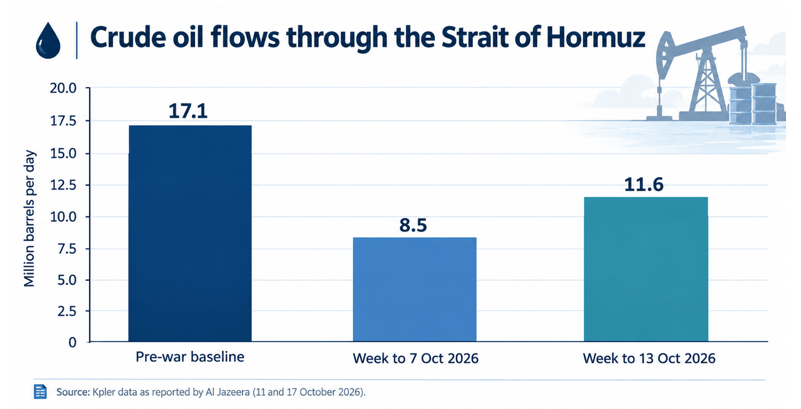
Nearly eight months after the United States and Israel launched strikes on Iran on 28 February 2026, the war has settled into a pattern that is costly for everyone and decisive for no one. The Strait of Hormuz, which carried roughly a fifth of global oil and gas before the war, remains contested water. In the week to 13 October, crude flows through the strait stood at 11.6 million barrels per day, about 68% of the pre-war baseline, and October has recorded more attacks on merchant shipping than any month since the conflict began.

The United Kingdom is not a belligerent in the formal sense. It took no part in the opening strikes, has refused to join the American naval blockade of Iranian ports, and insists that its military activity in the region is defensive. Yet Britain is far from a bystander. American bombers have flown from British bases, British households are paying more for fuel and energy, around 300,000 British nationals live in a region within range of Iranian missiles and Houthi drones, and an alleged Iranian plot against RAF Fairford has brought the war onto British soil. The question for London is no longer whether the war affects British interests, but whether Britain can shape its outcome or will simply absorb its consequences.

This analysis examines the channels through which the war reaches the UK, the strategic uncertainty created by the Trump administration's shifting decisions, including its easing of sanctions on Russian energy, and the diplomatic and strategic options open to the government of Prime Minister Andy Burnham. It argues that Britain cannot be the principal broker of a US–Iran settlement, but that it can play a significant secondary role as convenor, maritime guarantor and diplomatic bridge, provided it acts before the American midterm elections reshape Washington's calculations.

A War Britain Did Not Choose but Cannot Escape

Britain’s posture has been one of qualified distance. In April, Keir Starmer stated plainly that the UK was not supporting the American blockade and would not be dragged into the war. At the same time, London permitted the United States to use British bases for operations it described as the collective self-defence of the Gulf, including strikes on Iranian missile sites that were targeting shipping. When Burnham succeeded Starmer in July, he continued that policy, allowing American aircraft to operate from Diego Garcia and RAF Fairford as US operations resumed after the collapse of the Islamabad memorandum.

The defensive commitments have grown steadily. A Joint Typhoon Squadron supported Qatar’s air defence earlier in the conflict, and on 20 October the Defence Secretary, Wes Streeting, approved the deployment of RAF Typhoon jets to fly defensive counter-air missions over Saudi Arabia after Houthi attacks on Riyadh’s King Khalid International Airport. These deployments protect allies and British residents, but they also reinforce Tehran’s view that the UK is a party to the conflict. Iranian officials have repeatedly accused London of enabling aggression, while the British government has attributed a suspected plot against RAF Fairford to the Islamic Revolutionary Guard Corps, sanctioning two Iranians and summoning Iran’s ambassador.

The result is an uncomfortable middle position. Britain carries many of the risks of participation, including retaliation, hybrid threats at home and the exposure of its forces, without the influence that comes from a seat at the negotiating table. Mediation between Washington and Tehran has run through Pakistan, Qatar, Oman and others, and not through London.

Hormuz and the Home Front

The most immediate channel of exposure is economic. Brent crude touched $110 a barrel on 17 October for the first time since May, and renewed attacks on tankers have reversed the recovery in Gulf exports seen in September. Analysts at Lloyd’s List have warned that the shuttle system now used to move Gulf oil through Hormuz, often with transponders switched off and cargoes transferred at sea, is not sustainable as a new normal.

Figure 1: Crude oil flows through the Strait of Hormuz against the pre-war baseline (million barrels per day).

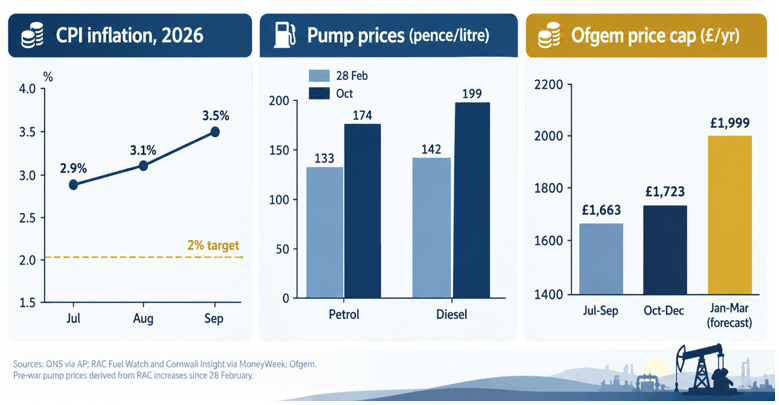
In Britain, the pass-through is visible at the forecourt and in household bills. Consumer price inflation rose to 3.5% in the year to September, its highest level in almost a year, with motor fuel prices up 30% on a year earlier. RAC data show petrol averaging 174p per litre and diesel 199p, increases of roughly 41p and 57p since the war began. The Ofgem price cap rose to £1,723 in October, and Cornwall Insight expects a further rise to around £1,999 in early 2027. Markets now anticipate that the Bank of England will raise the Bank Rate from 3.75% on 5 November, reversing a downward path that was underway before the war.

Figure 2: The cost of the war at home. UK CPI inflation, pump prices and the Ofgem price cap, 2026.

The war has also exposed a structural vulnerability. With North Sea gas in long-term decline, the UK remains dependent on international gas markets, and the Energy and Climate Intelligence Unit has warned that slowing the energy transition would leave Britain more exposed both to Hormuz and to an American trading partner that has proved less reliable. Energy security has become national security in the most direct sense.

Commercially, the Gulf matters more to Britain than ever. Total UK–GCC trade was worth around £53 billion in 2025, and the free trade agreement concluded in May is estimated to add £3.7 billion a year to the UK economy in the long run. The agreement still awaits signature, and the government has kept its options on Iran-related secondary sanctions under active consideration. The value of that partnership depends on the security of the region it binds Britain to.

Britons in the Line of Fire

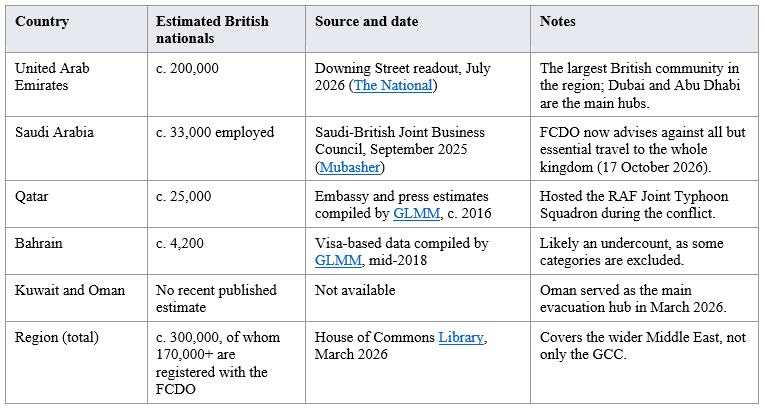
The human dimension of British exposure is often understated. The House of Commons Library estimated in March that around 300,000 Britons were in the region, of whom more than 170,000 had registered their presence with the Foreign, Commonwealth and Development Office (FCDO). The UAE alone hosts an estimated 200,000 British citizens, a figure cited by Downing Street when Burnham thanked Abu Dhabi for its support of the British community. Table 1 brings together the best available estimates, although official country-level figures are not published for every Gulf state.

Table 1: Estimated British nationals in the Gulf

Note: Country figures come from different sources, dates and methods and should not be summed.

Risk has shifted geographically as the war has evolved. In March, government-chartered flights brought Britons home from Oman as Iranian missiles struck Gulf states. In October, the threat moved towards Saudi Arabia, where a Houthi strike on King Khalid International Airport killed at least 12 people, and on 17 October, the FCDO extended its advice against all but essential travel to the entire kingdom. A further escalation, particularly one targeting energy infrastructure, desalination plants or aviation hubs, would place tens of thousands of British workers and their families in direct danger and could require a non-combatant evacuation larger than any the UK has attempted in recent decades.

Consular preparedness is therefore a strategic task rather than an administrative one. It requires pre-agreed landing rights, overland routes through Oman and Saudi Arabia, clear insurance guidance for those working against FCDO advice, and close coordination with Gulf governments, which carry the primary responsibility for the security of residents.

Washington's Erratic Compass

Britain’s dilemma is sharpened by the unpredictability of American policy. Since February, the Trump administration has gone to war without congressional authorisation, imposed a naval blockade, signed and then abandoned the Islamabad memorandum, and alternated between demands for zero enrichment and signals, voiced by Vice President JD Vance, that a meaningful reduction in Iran’s enrichment capacity might suffice. The president has said that the war will end one way or another immediately after the midterms, while the US military has reportedly been told to prepare for heavier strikes after the vote on 3 November.

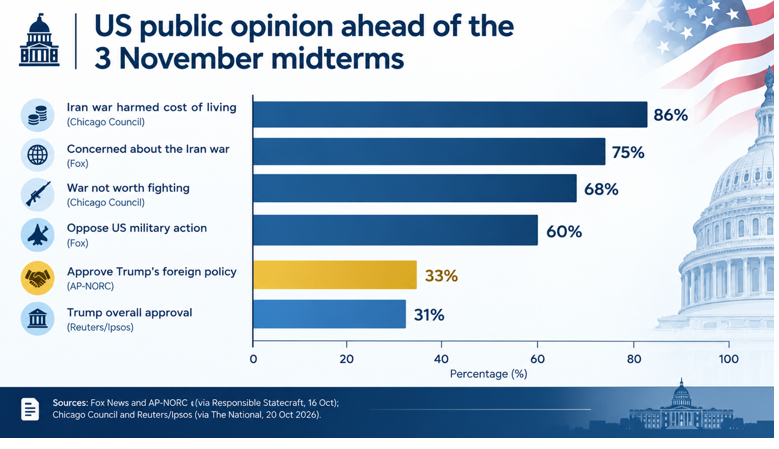
The midterm elections are now a central variable in the war. Polling by Fox News and AP-NORC places the Iran war among voters’ top concerns, ahead of immigration and crime. Three in four voters say they are concerned about the war, six in ten oppose US military action, and approval of Trump’s foreign policy has fallen to 33% in AP-NORC polling. A Reuters/Ipsos poll published on 19 October put the president’s overall approval at 31%.

Figure 3: Selected US public opinion indicators on the Iran war and the president, October 2026.

Two broad scenarios follow. If the Democrats win the House, as current forecasts suggest is likely, congressional pressure for a negotiated exit will grow through hearings, funding scrutiny and war powers votes, although the president will retain wide latitude. If the administration instead seeks to restore credibility through escalation, the weeks after 3 November could become the most dangerous phase of the war. British policy should be designed for both outcomes rather than wait for one.

The Russian Dividend and European Fatigue

The war has also distorted Western policy towards Russia. To contain fuel prices, Washington issued temporary waivers from March allowing the purchase of Russian oil stranded at sea, and in October it went further. The Treasury authorised the sale and import of Russian diesel until April 2027, and on 16 October the president waived the sanctions and tariffs mandated by new legislation targeting the largest buyers of Russian oil, arguing that he wished to keep Moscow engaged in Ukraine peace talks.

For Britain and Europe, this is a strategic contradiction. Europe has spent more than four years trying to reduce Moscow’s energy revenues in order to constrain its war against Ukraine, while absorbing the economic costs of that effort. The Iran war raises those costs further through higher energy prices, even as Washington relaxes pressure on Russia to manage the consequences of a war it chose. The outcome is a squeeze on European budgets at a moment when defence spending must rise, and a weakening of the sanctions coalition that the UK has championed. Russia’s gains from higher oil prices and sanctions relief are among the clearest strategic dividends of the conflict.

Bystander or Broker? Britain's Strategic Options

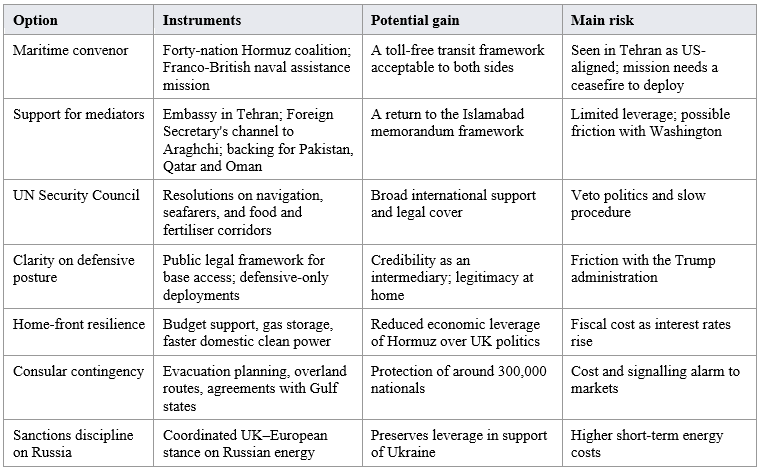
Britain cannot impose a settlement, and it lacks the leverage enjoyed by the parties’ chosen mediators. It does, however, possess a combination of assets that few others share: permanent membership of the UN Security Council, an embassy in Tehran, deep defence relationships across the Gulf, a leading position in maritime insurance and shipping intelligence through Lloyd’s and the UK Maritime Trade Operations centre, and an established record of coalition-building on Hormuz. Table 2 sets out the principal options.

Table 2: The UK’s strategic options in the Iran war

Source: London Dialogue assessment.

Lead the maritime track. In April, the then Foreign Secretary, Yvette Cooper, convened more than 40 countries to coordinate diplomatic and economic tools for reopening Hormuz, and a Franco-British naval assistance mission has since been agreed in principle to provide demining and reassurance once a durable ceasefire holds. London should turn that coalition from a post-war plan into a present-day diplomatic instrument by developing a toll-free, coordinated transit framework that could be offered to both Washington and Tehran. Iran’s demand that the United States back an Iran–Oman arrangement on coordinated entry and exit routes suggests that transit modalities, rather than sovereignty claims, may be negotiable.

Reinforce existing mediators rather than compete with them. Pakistan, Qatar and Oman have carried messages between the parties since the spring. Britain’s comparative advantage lies in supporting these channels with technical expertise on maritime arrangements, verification and the sequencing of sanctions relief, and in using its relationship with Washington to encourage a return to the framework of the Islamabad memorandum. Foreign Secretary Ed Miliband met Abbas Araghchi at the UN General Assembly in September, which shows that a direct line exists. It should be used for substance and not only for warnings.

Use the Security Council. As a permanent member, the UK can table or shape resolutions on freedom of navigation, the protection of seafarers and humanitarian corridors for food and fertiliser. These issues command support well beyond the Western camp, and none of them requires either party to concede on its core demands.

Separate defence from offence, visibly. Britain’s defensive deployments in Qatar and Saudi Arabia protect allies and British nationals, but continued permission for American strikes from British bases erodes London’s credibility as an intermediary. A clearer and publicly stated legal framework for base access, tied explicitly to the protection of shipping and allied territory, would reduce ambiguity both at home and in Tehran.

Harden the home front. Energy resilience, through gas storage, accelerated domestic generation and targeted support for vulnerable households, reduces the leverage that Hormuz exerts over British politics. The Budget on 28 October is the first real test of whether the government treats energy security as a strategic priority.

Prepare for the worst in the Gulf. Contingency planning for the evacuation of British nationals, including overland routes and standing agreements with Oman and Saudi Arabia, should proceed now rather than after a post-midterm escalation has already begun.

Hold the line on Russia. The UK should coordinate with European partners to maintain its own sanctions on Russian energy and resist the normalisation of waivers, while acknowledging the supply pressures that vulnerable importers face.

Can Britain Play a Significant Role?

Realism is required. Washington and Tehran will decide when this war ends, and neither currently regards London as an indispensable channel. Iran views Britain through the lens of base access and a long regional history, while the Trump administration has shown little patience with allies who decline to fight. British influence is therefore indirect and depends heavily on timing.

Within those limits, Britain can still matter. The window between the midterm elections and any post-election escalation is likely to be short. If London, working with France and the Gulf states, can present a ready-made package on maritime transit, verification and humanitarian corridors before that window closes, it would offer both sides a face-saving pathway that does not depend on either conceding first. That is the role of a broker in the modern sense: not the author of a peace, but the architect of the conditions that make one possible.

Other major powers also have a part to play. China, as the largest buyer of Gulf energy, and the European Union, as a major economic stakeholder, share Britain’s interest in an open strait. A British strategy that draws them into a common framework on navigation would dilute the perception that Hormuz is solely an American–Iranian contest and would increase pressure on both sides to settle.

Conclusion

Britain’s choice is not between war and neutrality. It has already moved beyond neutrality, and it should not move towards war. The real choice lies between passive exposure and active shaping. A bystander absorbs higher energy bills, faces hybrid threats at home and waits for Washington to decide. A broker uses its convening power, maritime expertise and diplomatic channels to help shorten the war and protect the 300,000 Britons in the region. The coming fortnight, framed by the Budget on 28 October 2026, the American vote on 3 November and the Bank of England decision on 5 November, will reveal which role London intends to play.

Picture of Tahir Azad

Tahir Azad