

Publications
Breaking the Taboo: The Strategic Folly of a US Nuclear Strike on Iran
Tahir Azad
Analysis Series
Analysis/0109/November/2026/London-Dialogue. 04 November 2026
By Dr Tahir Azad
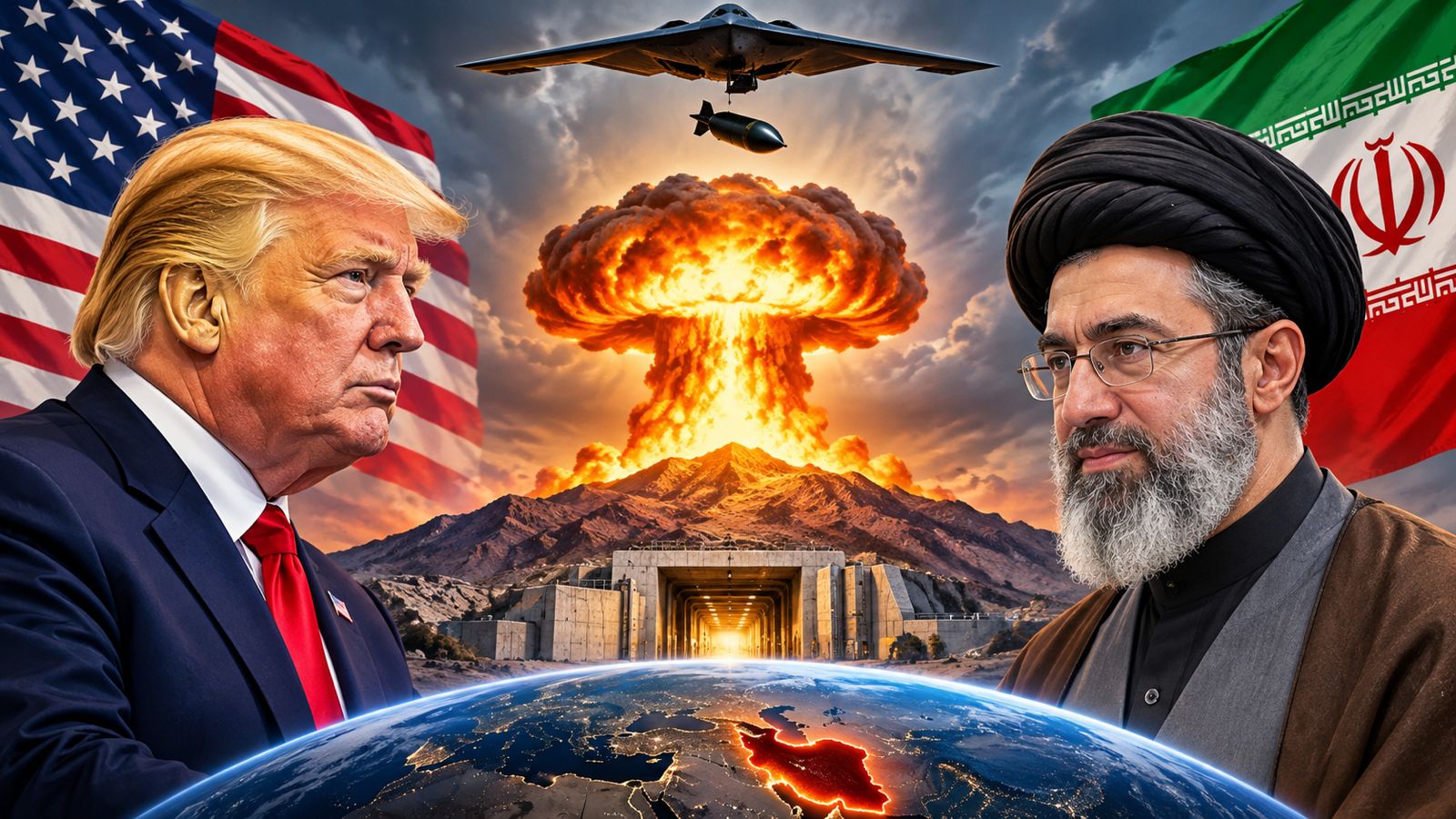
For 81 years, no state has detonated a nuclear weapon in war. That record became an open subject of debate this week, after the American commentator Tucker Carlson claimed that President Donald Trump may be days away from a nuclear strike on Iran’s Pickaxe Mountain complex, under pressure from Prime Minister Benjamin Netanyahu. The claim is unverified, and the White House has dismissed it. It has nevertheless exposed a question that analysts cannot leave aside, because Trump continues to threaten the site while experts doubt that conventional bombs can reach its deepest halls.
This analysis argues that a US nuclear strike on Iran would be a strategic folly on its own terms. It might disable a mountain complex, yet it would not remove Iran’s enriched uranium, its expertise or its motive to build a bomb. It would strengthen that motive, divide Washington from its allies, endanger neighbouring states and deepen an energy crisis. Its most lasting cost would lie beyond the Middle East, in the weakening of the restraint that nuclear-armed states have so far shown over Ukraine, Korea and Taiwan. Because some popular versions of this case overreach, the analysis tests them as well as the argument for nuclear use.
What is Known and What is Alleged
Trump’s public record points away from nuclear use. In April he said that a nuclear weapon “should never be allowed to be used by anybody”, and in October he told Newsmax, “I wouldn’t use nuclear. We don’t have to.” However, his signals on force remain mixed. He warned on 1 November of a “crushing blow” and said that remaining sites could be handled “in 10 minutes”, while answering “no” a day later when asked whether he was considering an attack after the midterm elections. The White House replied to Carlson by citing “a wide range of options” and by denying that he had any insight into military planning.
Netanyahu’s reported role needs equal care. Axios reporting, relayed by The New Arab, suggests that he wants renewed strikes straight after the midterms, while Trump prefers to give the Qatar-mediated talks more time. That concern strikes in general. The specific claim that he is pressing for a nuclear strike rest on Carlson and one unnamed “informed observer”, and it should be treated as an allegation until better evidence appears.
Why, then, examine an unlikely event? Hans Kristensen of the Federation of American Scientists calls it “highly unlikely”. Daryl Kimball of the Arms Control Association answers, “Is it likely? No,” yet adds that it remains possible under a president with sole launch authority. US declaratory policy offers no firm barrier either. The US negative security assurance covers only non-nuclear NPT parties “in compliance” with their obligations, and the IAEA Board reported Iran to the UN Security Council for non-compliance in September. The Pentagon’s policy chief has said that no new posture review is planned and called the first Trump term’s declaratory policy “very good”. Restraint therefore rests on political choice, which is why the costs of that choice deserve scrutiny.
The Military Case and Its Limits
The strongest argument for nuclear use is technical. The Institute for Science and International Security estimates that the complex lies at least 100 metres under the mountain, with the ridge rising 78 to 145 metres above its entrances. Experts have long doubted that the 30,000-pound GBU-57 can reach the main caverns. A 2005 US National Research Council study concluded that many important deep targets can be held at risk only by nuclear weapons. Advocates of the nuclear option can fairly cite that finding.
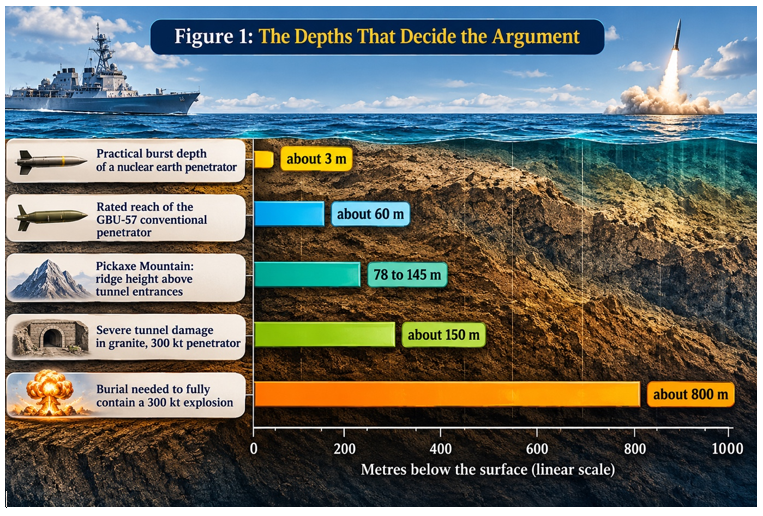
The same study, however, demolishes the idea of a clean strike. As Figure 1 shows, an earth penetrator can burst only a few metres down, whereas a 300-kiloton explosion would need burial at about 800 metres for full containment. The committee concluded that such weapons cannot penetrate deeply enough to contain their effects. The only specialised air-delivered US penetrator, the B61-11, has a reported yield of 340 to 400 kilotons at maximum, more than twenty times the Hiroshima bomb. Kristensen judges that one could “probably do the job” of rendering the site unusable, even if some very deep structures survived. At that yield, the word “tactical” would be a euphemism.
Sources: National Research Council (2005); Institute for Science and International Security (2026); GBU-57 figure as publicly attributed to the US Air Force. Values are indicative, vary with geology and are not a measure of the depth of any specific hall.
The deeper flaw concerns the target itself. The Institute assesses that the site is not operational, and no schematics are public. Israeli and American officials believe that Iran moved thousands of centrifuges there last autumn, yet US intelligence believes no enrichment has occurred since the 12-day war, and IAEA chief Rafael Grossi said on 28 October that Iran does not appear to be enriching. David Albright wrote in July that he had been told the site was spared because nothing of sufficient value lay inside. Above all, Grossi believes that much of Iran’s 440.9 kilograms of 60 per cent uranium remains at Isfahan, with some at Natanz, although some experts fear that part of it reached Pickaxe. A nuclear strike could thus destroy a suspect facility and leave the most relevant material and all of the knowledge intact. Non-nuclear alternatives exist, including conventional strikes on entrances, repeated strikes on recovery work and sabotage. These only delay Iran, but so would a nuclear strike, at an incomparably higher price.
The Proliferation Paradox
Trump’s most consistent war aim is that Iran must never obtain a bomb. A nuclear strike is the act most likely to defeat that aim. Tehran’s debate is already moving: Supreme Leader Mojtaba Khamenei has neither endorsed nor abandoned his late father’s fatwa, a small group of lawmakers has presented a bill to leave the NPT, and an unnamed senior official told the Financial Times that policy “has not changed yet”. President Masoud Pezeshkian still insists that Iran is not seeking nuclear weapons. An American nuclear attack would probably settle that argument in favour of the hardliners, since any surviving leadership would conclude that only a deterrent could prevent a repetition. By the IAEA’s yardstick, the stockpile held before June 2025 could yield enough explosive for about ten weapons if further enriched.
The lesson would travel. North Korea’s Kim Jong Un already cites the Iran war as proof of the “legitimacy” of keeping his arsenal. An April 2025 Asan poll found that 76 per cent of South Koreans favoured an indigenous capability, though experts urge caution about that figure, and Japan’s prime minister has left open a revision of its non-nuclear commitments. A US strike on an NPT party would tell every hesitant government that treaty membership offers no protection when it matters. Stephen Schwartz of the Bulletin of the Atomic Scientists expects “a new wave of nuclear proliferation” that would be extremely difficult to stop.
Law, Allies and Political Isolation
The International Court of Justice held in 1996 that the threat or use of nuclear weapons would “generally be contrary” to humanitarian law. It left unresolved only an “extreme circumstance of self-defence, in which the very survival of a State would be at stake”. Whatever weight that narrowly decided passage carries, a preventive strike by a superpower on a state without the bomb lies far outside it. Fallout would add a further problem. Schwartz lists a downwind zone that, depending on the winds, runs from Iraq and the Gulf states to Turkey, Russia, Afghanistan and Pakistan. The Court confirmed that the principle of neutrality applies whatever weapons are used, so contamination of non-belligerents would be a legal issue in its own right.
The claim that no ally except Israel would accept such a strike is a forecast rather than a fact, since allies have not been publicly tested on it, and this analysis found no allied government endorsing the idea. The evidence for the forecast is nonetheless strong. Schwartz anticipates global condemnation “apart from Israel”. Britain, France and Germany stayed out of even the conventional strikes in February, with European leaders wary of action that could breach international law. In 2023, G7 leaders underscored the record of non-use and called any Russian use of nuclear weapons “inadmissible”. Members of the Stockholm Initiative, including Germany, Japan, South Korea and Canada, deplore any breach of security assurances, although Washington would argue that Iran falls outside them. Kristensen warns that the United States would become “the nuclear pariah”, and alliances that rest on American nuclear guarantees would struggle to survive that label intact.
The Human, Environmental and Economic Bill
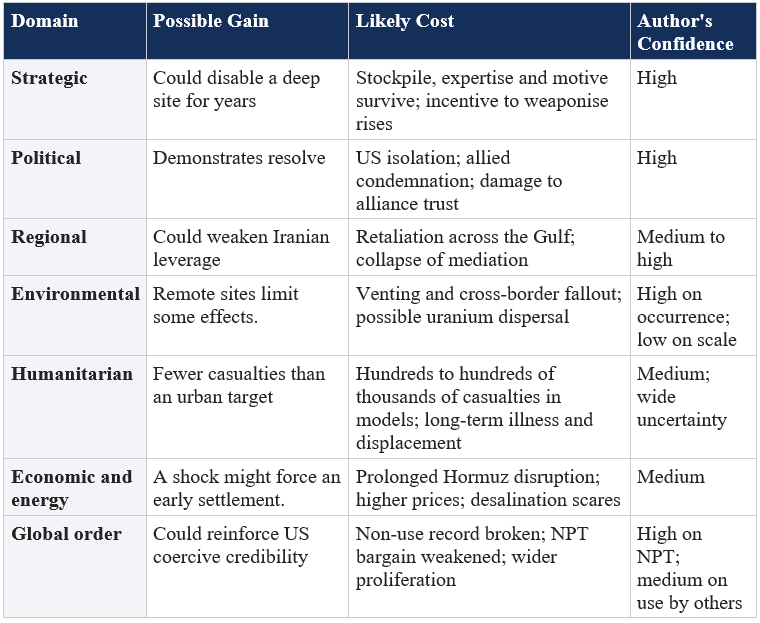
The National Research Council estimated that attacks on remote deep targets could cause anywhere from hundreds of casualties at low yields to hundreds of thousands at high yields with unfavourable winds, with an uncertainty of a factor of 10 to 100. Kristensen’s simulation shows debris spreading nearly 300 kilometres downwind, perhaps further, and any uranium in the tunnels might be entombed or lofted. By this author’s rough measurement, that radius from the site takes in Kashan, Isfahan and Qom.
One widely shared claim goes too far, as stated. Carlson asserts that fallout would poison the water of 100 million people, yet the site is more than 400 kilometres from the Gulf coast by the same rough measure, and the IAEA’s warnings about desalination concerned the Bushehr reactor on the shore. The more defensible point is that fear alone could be disruptive. Desalination supplies 99 per cent of Qatar’s drinking water and more than 90 per cent of Bahrain’s and Kuwait’s, so even a limited scare could interrupt supply until testing confirmed safety.
The energy shock would come on top of an existing crisis. In its October outlook, the US Energy Information Administration forecast Brent at $105 per barrel for the fourth quarter, with Middle East flows still constrained. Khamenei has ordered a response without geographical limits to any renewed attack, and Tehran has already threatened Gulf desalination plants. A nuclear strike would also probably end the talks in which Iran claims it could reopen Hormuz within two days, on conditions Washington has not accepted. Table 1 sets out this balance sheet.
Table 1: The Balance Sheet of a US Nuclear Strike on Iran
Source: Author’s assessment, drawing on the sources cited in this analysis.
The Precedent: Ukraine, Korea and Taiwan
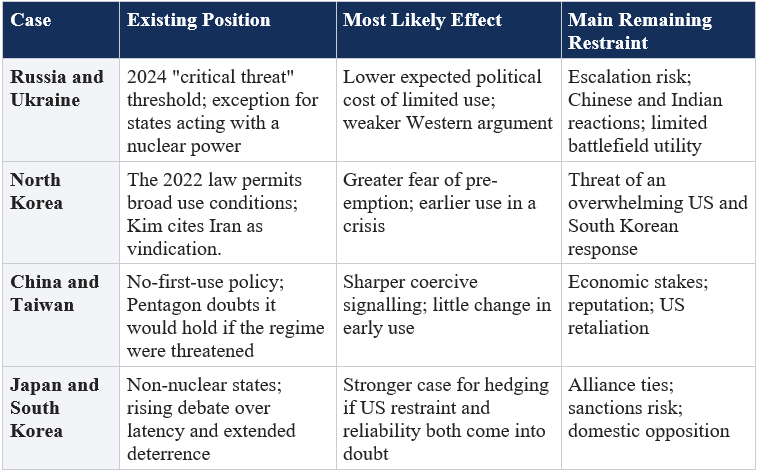
The most serious global danger is often put too simply. A US strike would not make nuclear use by others legitimate. It would make it cheaper, by removing the country best placed to organise punishment and by supplying a ready rhetorical defence. This analysis’s sharper claim is therefore one of lowered costs rather than automatic imitation, and the effect would differ in each case, as Table 2 shows.
Russia is the clearest case. Its 2024 doctrine lowered the threshold from a threat to the state’s existence to a “critical threat” to sovereignty or territorial integrity. An earlier analysis by this author found that restraint over Ukraine now rests chiefly on strategic calculation rather than doctrine or norm. A US strike would alter that calculation, since Moscow could cite a preventive American strike on a non-nuclear state, and G7 language about “inadmissible” use would ring hollow. Carlson’s claim that Russia has already told two governments it would feel free to follow is unverified. Kristensen’s judgement is more measured: other nuclear-armed states “would feel less inhibited”, Putin included. Moscow would still weigh battlefield utility, escalation, and the reaction of China and India.
North Korea needs little licence. Its 2022 law is ambiguous enough to allow first use against a non-nuclear state, and it provides for an automatic strike if the leader’s command and control is endangered. The greater risk is fear. A Washington prepared to use nuclear weapons against a buried facility would look more dangerous to a regime whose survival depends on buried facilities. In a crisis with South Korea or Japan, this author infers Pyongyang would have stronger reasons to use its weapons early.
China presents the most nuanced case. Beijing maintains a no-first-use policy and an unconditional pledge to non-nuclear states, although the Pentagon assesses that it would probably consider first use if defeat over Taiwan gravely threatened the regime, a view Beijing rejects. Early detonation is improbable. The likelier effect is bolder nuclear blackmail aimed at deterring American intervention, made harder to rebut by Washington’s own example. China might equally gain more by keeping its pledge and presenting itself as the responsible nuclear power, so the precedent could help Beijing diplomatically without changing its doctrine.
Table 2: How a US Precedent Could Travel
Source: Author’s assessment, drawing on the sources cited in this analysis.
Testing the Counterarguments
Three objections deserve an answer. The first holds that a demonstration would restore American credibility and frighten adversaries. It might, but frightened adversaries do not necessarily disarm. Pyongyang’s response to the Iran war has been to harden its position, and a nuclear strike would give that logic greater force. It would also frighten the allies whose confidence and credibility are meant to serve.
The second holds that the taboo is sturdier than critics suggest and that universal condemnation of a single strike could even reinforce it. There is evidence for its resilience. A 24-country survey found that 73 per cent endorsed the taboo, and the authors regard the norm as robust. Yet condemnation matters only if it carries a price, and the state hardest to punish would be the one that had broken the norm. The same survey’s 47 per cent approval also concerned retaliation for a nuclear attack on an ally, which is far removed from a preventive strike.
The third is the most serious: a nuclear-armed Iran would be worse. Trump argues that Iran would use such a weapon “instantaneously”, and the stockpile problem is real. But ECFR finds no evidence that Iran is working to mount a warhead on a missile, and its assessed scenario is one in which Iran neither rebuilds nor negotiates. That leaves time, although ECFR warns that without monitoring Iran could enrich rapidly, which argues for restoring inspections. A strike chosen to foreclose a hypothetical bomb would make an actual decision to build one more likely.
A Better Course
Four steps follow:
- First, Trump’s October statement should become formal policy, conveyed to allies and to Congress, because a remark in an interview is too thin a safeguard for a decision of this weight.
- Second, allied governments should say now what they would say afterwards. Kimball rightly urges international leaders to speak out, and private reassurance has little deterrent value.
- Third, Pickaxe Mountain belongs inside the Doha negotiations, tied to IAEA access and to the pathway for diluting highly enriched uranium in the lapsed June Joseph Cirincione’s blunt judgement that diplomacy offers the only realistic way to disable the site may overstate the case, but Iran did once remove the core of its Arak reactor under the 2015 agreement.
- Fourth, the conditional assurances that leave this door open should give way to the legally binding instrument that the Stockholm Initiative wants explored.
Conclusion
A nuclear strike on Pickaxe Mountain remains improbable, and it should be discussed without alarmism. Its logic, however, fails at every level examined here. It could not guarantee the end of Iran’s programme, it would enlarge the motive for a bomb, and it would hand others a precedent that no later statement could withdraw. The strongest reason for restraint is one a strategist should recognise: the record of non-use protects the United States more than any single target in Iran threatens it.
Tahir Azad
Related posts
Can Britain Bring Iran Back to the Table?
Yemen’s Forgotten Human Rights Crisis: Geopolitical Rivalries, Maritime Security and the Cost of War
The Democratic ‘Tsunami’: What It Means for Trump’s War on Iran?
What the Democratic Sweep in the US Midterm Elections Means for Trump’s Iran Policy and Gulf Security
Blurred Lines: Federalism and Provincial Autonomy in Pakistan
Paper Shields: The Makkah Pact and the Hard Test of Collective Defence
Iran’s Axis of Resistance Now: Less Than an Axis, More Than Resistance?
Leading through Uncertainty: Building Resilient Interdependence in a Multipolar World
Why Does the Game of Chicken Between Iran and the United States Keep Going?

Trojan APCs: Ukraine’s Kamikaze BTR-60s in Operation Vivaldi
The Emissions We Do Not Count: Militaries and the Missing Climate Ledger
Another Iran War? Diplomatic Evacuations and the Politics of Escalation
London Dialogue — Founding Statement
Publication Categories
- Analysis (117)
- Book Review (1)
- Commentary (8)
- Essay (17)
- Journal (0)
- Journal Article (0)
- Policy Brief (7)
- Policy Paper (1)
- Research Article (3)
- Research Report (6)
- Young Writers Corner (0)