
Publications

Blurred Lines: Federalism and Provincial Autonomy in Pakistan

Picture of Dr Tauseef Javed

Dr Tauseef Javed

Analysis Series

Analysis/0108/November/2026/London-Dialogue. 02 November 2026

By Dr Tauseef Javed

Introduction

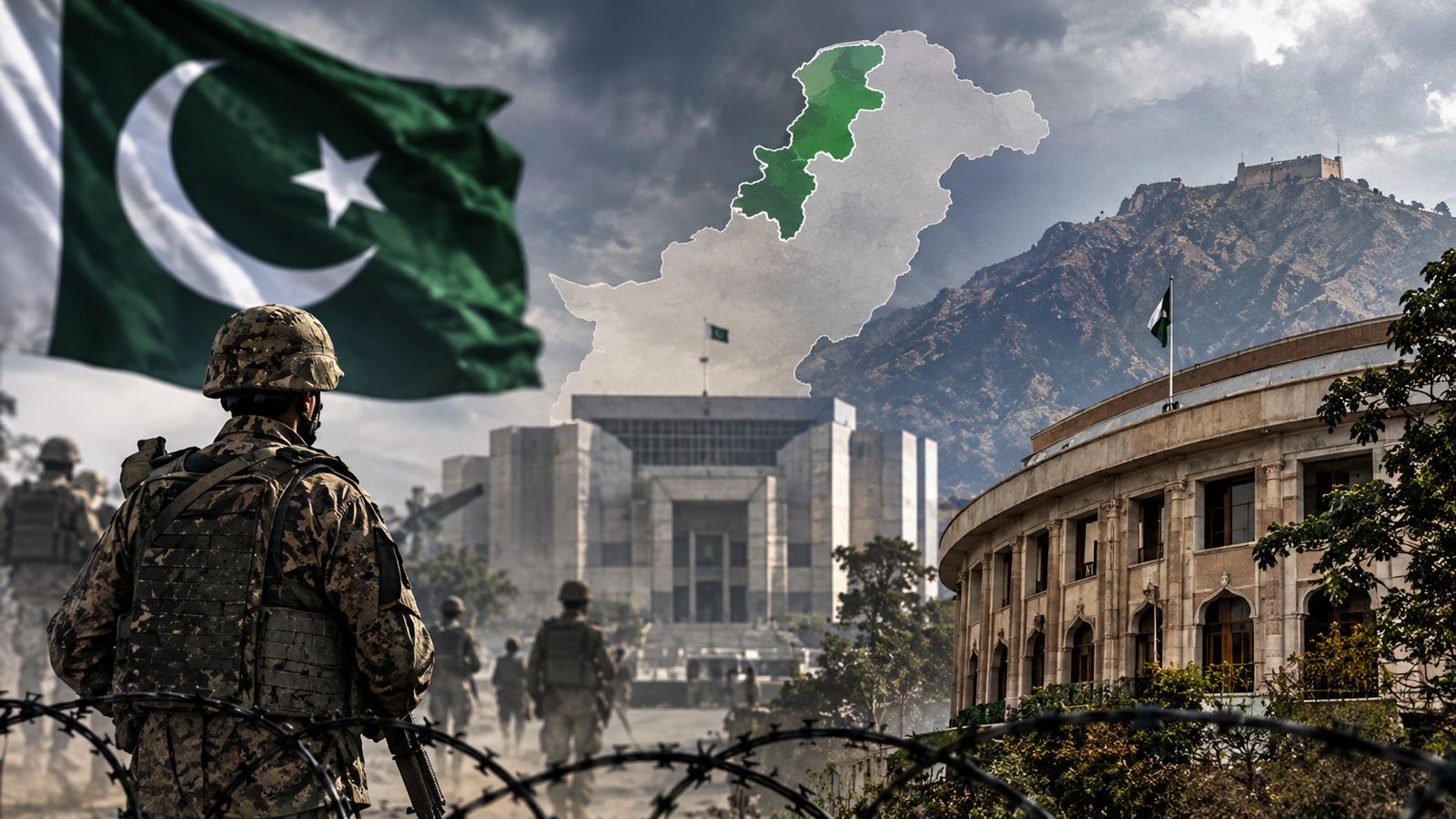
The imposition of a state of emergency and Governor’s Rule in Khyber Pakhtunkhwa (KPK) in October 2026 has raised fundamental questions about the uneasy relationship between national security, constitutional authority, and democratic federalism. KPK faces a persistent security crisis, driven by the resurgence of militancy and by cross-border challenges involving Afghanistan. Yet the federal government’s decision to assume control of provincial executive functions has generated considerable political and constitutional controversy. The central question is not whether Pakistan should respond decisively to terrorism, which it plainly must, but whether extraordinary constitutional intervention is an appropriate response to disagreements between federal and provincial governments over security policy.

This analysis argues that the KPK intervention blurs three distinctions on which Pakistan’s federal settlement depends: between security failure and political disagreement, between allegation and established evidence, and between targeted emergency powers and the wholesale suspension of an elected government. Drawing on securitisation theory and the logic of cooperative federalism, it suggests that the precedent now being set may prove more consequential than the immediate crisis itself.

The Security Context

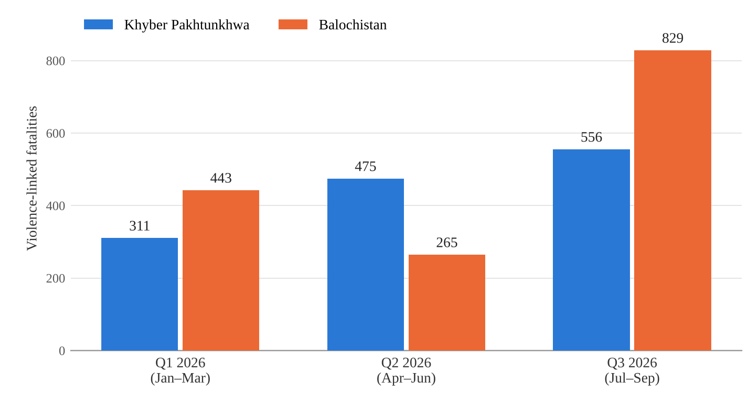
Khyber Pakhtunkhwa has long remained at the forefront of Pakistan’s struggle against militancy. The resurgence of the Tehreek-e-Taliban Pakistan (TTP), mounting attacks against security personnel and civilians, and instability along the Afghanistan–Pakistan border have created an increasingly complex security environment. During the second quarter of 2026, the Center for Research and Security Studies (CRSS) recorded 475 violence-linked fatalities in KP, more than 61 per cent of the national total and a rise of roughly 53 per cent on the previous quarter. The province also accounted for 57 per cent of all violent incidents nationwide. These developments demand coordinated action by federal and provincial authorities, supported by effective intelligence sharing and law enforcement cooperation.

The picture, however, is more complicated than a simple story of provincial collapse. CRSS data for the third quarter show that national fatalities rose by 83 per cent to at least 1,415, but that Baluchistan, rather than KPK, drove most of this increase. Baluchistan’s fatalities more than tripled to 829, while KP recorded 556 (Figure 1). These figures confirm that KP’s security situation is grave. They also complicate the claim that KPK was uniquely ungovernable, a point opposition politicians raised quickly when they asked why Baluchistan had not faced comparable measures.

Figure 1: Violence-Linked Fatalities in Khyber Pakhtunkhwa and Baluchistan, 2026

Source: Center for Research and Security Studies (CRSS), quarterly security reports for Q1 to Q3 2026.

From Allegation to Proclamation

The security situation has become increasingly intertwined with political confrontation between Islamabad and the Pakistan Tehreek-e-Insaf (PTI)-led provincial administration. Federal ministers, including Defence Minister Khawaja Asif and Information Minister Attaullah Tarar, publicly questioned the provincial government’s commitment to counterterrorism and alleged that the PTI leadership was facilitating militancy and maintaining connections with elements operating from Afghanistan. Interior Minister Mohsin Naqvi claimed that the government held dozens of pieces of evidence, none of which has been made public. Such accusations are serious and warrant transparent investigation. Nevertheless, allegations of political or administrative complicity in terrorism must be distinguished from independently established evidence, particularly when they become the stated basis for displacing an elected government.

On 11 October 2026, President Asif Ali Zardari promulgated the emergency under Article 232 and Governor’s Rule under Article 234 of the Constitution, acting on the federal cabinet’s recommendation. The cabinet cited the provincial government’s ‘deliberate disengagement from the fight against terrorism’. Chief Minister Sohail Afridi and senior PTI figures were detained, Governor Faisal Karim Kundi assumed control with an eleven-member advisory council, and the army was authorised to deploy in aid of civil power. A joint sitting of Parliament approved both proclamations on 15 October amid opposition protests.

The timing matters. The intervention followed weeks of political tension, collapsed negotiations, and the PTI’s planned long march towards Islamabad to demand the release of its imprisoned founder, Imran Khan. Days after the takeover, Tarar suggested that a formal ban on the PTI might no longer be necessary because the party had already lost its provincial government. This convergence raises legitimate questions about how far security considerations were separated from partisan political calculation.

The Constitutional Architecture

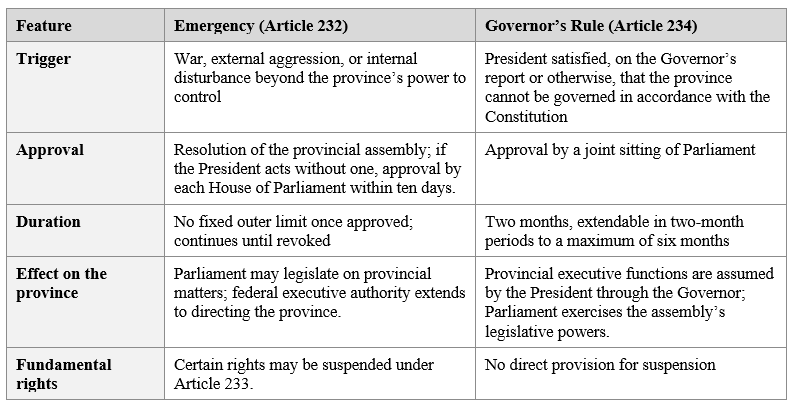
Pakistan’s Constitution provides two distinct instruments, designed for different problems (Table 1). Article 232 addresses war, external aggression, or an internal disturbance beyond the power of a provincial government to control. Article 234 addresses a more fundamental situation, in which the government of a province cannot be carried on in accordance with the Constitution. The Eighteenth Amendment of 2010 deliberately raised the threshold for internal emergencies, reflecting a hard-won consensus that provincial autonomy should not be suspended at federal discretion.

Table 1: Emergency and Governor’s Rule Compared

Source: Constitution of the Islamic Republic of Pakistan, Articles 232 to 234, as amended by the Eighteenth Amendment (2010).

Judicial precedent reinforces this distinction. In the Sabir Shah litigation of 1994, arising from an earlier federal intervention in the same province, the Supreme Court indicated that Article 234 could not be used simply to dismiss a chief minister and cabinet. In 1998, the Court upheld an emergency premised on an external threat but struck down the suspension of fundamental rights, finding that domestic lawlessness did not by itself justify such measures. Governor’s Rule has now been imposed in KPK for the fourth time, after 1975, 1994, and 1999, and each earlier episode is remembered less for its security outcomes than for the political realignment that followed.

The current intervention combines both instruments simultaneously, compounding their effects. The emergency is confined to twelve districts, largely the former tribal areas and the southern districts of Bannu, Dera Ismail Khan, Tank, and Lakki Marwat, while the Hazara and Mardan divisions are exempt. Governor’s Rule, by contrast, displaces the elected government across the entire province. If the threat is geographically concentrated, the case for suspending representative government province-wide requires far more justification than has so far been offered. Therefore, current measures in KPK by narrowest and broadest definition could not fulfil the constitutional obligations to impose upheld the provincial government. The petition filed in Peshawar High Court (PHC) to challenge the federal actions in the province as unconstitutional and such measures are open federal intervention.

Securitisation and the Politics of Exception

Securitisation theory, developed by Barry Buzan, Ole Wæver, and Jaap de Wilde, offers a useful lens for understanding these developments. It holds that political actors can frame an issue as an existential threat and thereby justify measures that fall outside the bounds of normal politics. The theory does not assume that threats are fabricated, and terrorism in KPK is both real and lethal. Its insight lies in showing how the act of securitisation can move a political dispute into a domain where emergency logic supersedes deliberation, accountability, and consent.

In Pakistan’s current environment, the framing of the KPK administration as an obstacle to national counterterrorism efforts has become part of a wider partisan contest. This does not necessarily mean that the federal government’s security concerns are unfounded. Rather, it highlights the importance of examining how security threats are presented, substantiated, and translated into constitutional action. Since the federal government’s formation in 2024, confrontation between Islamabad and Peshawar has remained intense. In such a polarised and uncertain environment, the risk that federal action serves political motives as much as security needs cannot be dismissed.

Securitisation also depends on an audience accepting the claim. Parliamentary ratification supplied formal acceptance, yet the vote divided largely along party lines, and the province whose government was suspended had no meaningful voice in the process. The Eighteenth Amendment’s requirement of provincial consent for internal emergencies was designed precisely to prevent such one-sided securitisation. Bypassing it may satisfy the letter of the Constitution while straining its spirit.

The Costs of Blurred Lines

The danger emerges when counterterrorism becomes inseparable from partisan political competition. If allegations of administrative failure or political disagreement are treated as sufficient grounds for extraordinary intervention, the distinction between national security requirements and political control becomes increasingly blurred. Three costs follow from this.

First, institutional trust erodes. Effective counterterrorism in KPK depends on intelligence sharing, police cooperation, and community engagement, all of which require a functioning relationship between federal and provincial authorities. Second, the legitimacy of counterterrorism itself suffers. When security operations are perceived as instruments of political control, communities in conflict-affected districts may become less willing to cooperate with the state, which is precisely the outcome that militant groups seek. Internet disruptions and school closures across parts of the province have already imposed visible costs on ordinary citizens. Third, a precedent is established. Any future federal government facing a hostile provincial administration may cite the KPK case as a ready template for intervention.

Over the longer term, such a template would leave Pakistan constitutionally weaker and institutionally more dysfunctional. It would serve political rivalries rather than ordinary citizens, whose security depends on cooperation between levels of government rather than the dominance of one over the other. Petitions challenging the proclamations are now before the PHC, and the judiciary’s response will shape whether the KPK case becomes an exception or a norm.

Way Forward

Pakistan needs a counterterrorism strategy grounded in institutional cooperation, constitutional restraint, and political consensus. Dialogue must dilute political rivalries rather than deepen them. The federal government should place the evidence underpinning its allegations before a parliamentary committee or judicial forum so that claims of complicity can be tested rather than merely asserted. Governor’s Rule should remain strictly time-bound and should not be extended without a demonstrated breakdown of constitutional machinery, as distinct from political disagreement. The emergency in the affected districts should be paired with a joint federal–provincial security mechanism, and elected provincial representatives should be restored to their roles at the earliest opportunity. Existing forums, including the Council of Common Interests (CCI) and the National Action Plan (NAP) framework, offer channels through which disputes over security policy can be resolved without suspending representative government.

The imposition of Governor’s Rule in KPK presents Pakistan with a challenge that extends well beyond the immediate confrontation between the federal government and the PTI. The country must confront militancy with determination by bringing all stakeholders on board, while preserving the constitutional principles that sustain its federal and democratic institutions. The solution primarily be political not military in KPK. Treating security challenges as grounds for political intervention risks setting a precedent which leaves provincial autonomy permanently vulnerable to partisan considerations.

Picture of Dr Tauseef Javed

Dr Tauseef Javed