

Publications
Beyond the Patriot: Europe’s Anti-Ballistic Missile Coalition Takes Shape
Viktor Trumbetas
Analysis Series
Analysis/0087/September/2026/London-Dialogue. 25 September 2026
By Viktor Trumbetas
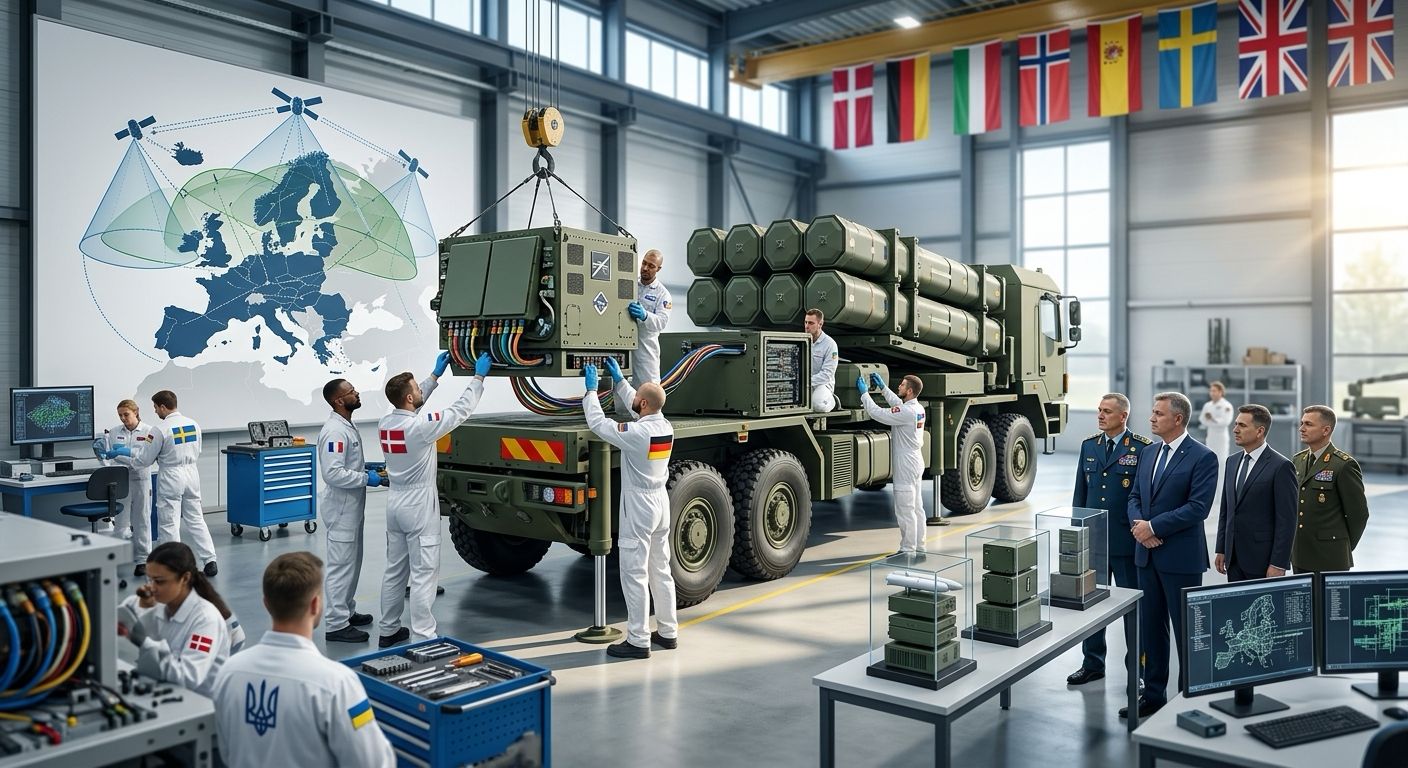
Ukraine and 10 European partners have recently, in July, launched a joint programme to build a cheaper alternative to the U.S. Patriot system, aimed at the Russian ballistic missiles that Kyiv is least able to stop. According to Reuters, leaders gathered in Paris for a summit where 10 countries and about a dozen defence firms agreed to press ahead with what they call the Integrated Anti-Ballistic Missile Coalition. The founding members, named in a joint declaration published on the British government’s official webpage, are Denmark, France, Germany, Italy, the Netherlands, Norway, Spain, Sweden, Ukraine and the United Kingdom.
The coalition’s efforts will centre on Freyja, Ukraine’s attempt to build a European-backed, lower-cost alternative to the Patriot. President Volodymyr Zelenskiy framed the project in strategic terms: “The more means Ukraine has to shoot down Russian ballistic missiles, the greater the chance that Putin will come to the negotiating table, as his last argument in this war will no longer work.” He was careful, however, to present Freyja as an addition rather than a replacement. “Our work on a joint system – Freyja – is not intended to replace existing systems. It is a way to supplement our defence, create a strong shield over the entirety of Europe, and do all of this faster and at a lower cost,” he said. He later described the system as something like a Lego set, drawing on expertise from different European firms, that could be operational within 12 months and would allow all stakeholders to produce the weapon. The industrial line-up reflects that ambition. Companies at the summit included Eurosam, the maker of the SAMP-T, as well as Leonardo, Thales, Saab and Ukraine’s own Fire Point. German Chancellor Friedrich Merz said: “It will also help our defence industries in Europe work even more closely together and learn from one another.” Writing on X, French President Emmanuel Macron added, “Faced with the ballistic threat, we are making a clear choice: protect Ukraine, strengthen our collective security, and build the Europe of defence.”
The Threat: Russia's Ballistic Arsenal
The coalition is a sharp countermeasure to a threat that has grown quickly. Russian ballistic missile use rose by more than 50% in 2025. Drones have taken a larger share of Russian strikes this year, and the ballistic share of the overall mix has eased since, but the missiles remain a significant danger to Ukraine’s military and civilian infrastructure. That danger is sharper because Ukraine’s air defence interceptors are depleted and in short supply. The most widely used tactical ballistic missile system in Russia’s inventory is the 9K720 Iskander, its primary operational-tactical workhorse for conventional strikes. It has a range of roughly 400 to 500 km, carries warheads of up to 700 kg (conventional or nuclear-capable), and flies at Mach 6 to 7, or about 7,500 to 9,000 km/h. Alongside it operates the Kh-47 Kinzhal (“Dagger”), an air-launched missile that Russian state media has described as a “uniquely capable” next-generation hypersonic weapon. Its reported range is around 1,500 kilometres (930 miles). Moscow’s claims go further: that it can penetrate any enemy air defence system and that it could hit London in nine minutes. These are Russian boasts and should be read as such. Joining these missiles in the threat picture is the North Korean KN-23 (Hwasong-11A), a short-range ballistic missile that resembles the Iskander. What they share is speed. At several times the speed of sound, they leave defenders little time and few options, which is why the quality of the interceptor matters as much as the quantity.
Ukraine's Patriot Problem
Against missiles of this kind, Ukraine relies heavily on U.S.-made Patriot air defence systems, the only weapon in its arsenal that can reliably intercept Russian ballistic missiles. Deliveries of the Patriot have been disrupted by political volatility, low stockpiles and long production lead times, so Kyiv cannot simply order more when the threat rises. The consequences are visible. This month Russia has intensified its ballistic missile attacks on Kyiv and the southern port city of Odesa, firing dozens of missiles. Ukraine could not shoot down most of them because it lacked interceptors. This is the gap the coalition is designed to close. A single supplier, a single production line and a single political relationship are a fragile foundation for the defence of a country under sustained missile attack. A second source of anti-ballistic interceptors, built in Europe and in Ukraine, would reduce that exposure even if it never fully replaces the Patriot.
Freyja: The Flagship Project
Freyja is the coalition’s flagship, and its design explains both its promise and its dependencies. According to Ukrainian sources, the missile itself is of Ukrainian production, but a working system also needs radars, control systems, and many other elements that Ukraine does not yet manufacture. European partners with existing production capacity for those components could speed the process considerably. That is the logic behind the “Lego” description Zelenskiy used. The missile recycles a Soviet S-300 interceptor and depends on a German infrared seeker, while Ukrainian and German industry develop the wider system around it. The appeal is cost. If operational, Freyja would cost roughly $700,000 per round, less than a fifth of the $3.8 million Patriot missile it is meant to supplement. Against salvoes of ballistic missiles, that difference decides how many interceptors can be fired and how long a defence can be sustained. Davyd Aloian, deputy secretary of Ukraine’s National Security and Defence Council overseeing the Freya project, estimates that Fire Point, the Kyiv munitions firm developing Freyja, aims to produce the first prototype of the missile by the first half of 2027.
What The Declaration Commits To
The joint declaration is a statement of intent, not a funding pledge. The ten leaders announce “the initiation of the establishment” of a purely defensive coalition and express support for its flagship project to work at pace to develop an anti-ballistic capability. Their stated premise is that “the protection of Europe requires a global solution of integrated missile defence architecture to deter and defeat future missile threats”, to be developed through collective effort, technological openness and trusted industrial cooperation. The text is explicit that the coalition will complement, not displace, what already exists: existing ballistic missile defence systems, including sovereign European solutions already acquired, or to be acquired, by participating countries. By pooling their defence industrial base, research and operational experience, the signatories aim to build a shared anti-ballistic missile capacity for Europe. They also stress that the effort is defensive in character: “We do this not against any people, but in defence of our own.” The declaration acknowledges the unique experience Ukraine has gained in defending against Russia’s war of aggression. The practical machinery is still to be built. The signatories aim to establish common operational requirements, joint technical working groups, clear governance mechanisms and a roadmap towards the coalition’s first operational capabilities, in line with their constitutional arrangements and international obligations. They will also seek to support joint research and development under the flagship project, including by exploring appropriate funding opportunities, and to promote enhanced data and information exchange. The coalition remains open to other nations that share its principles and objectives, and in this regard, on the 18th of September, it was announced that Poland has joined the Anti-Ballistic Missile Coalition too, as its 11th member.
Assessment Of the Coalition: Promise, European Shield and Open Questions
The coalition matters first as a political signal. Eleven European governments, including Germany, France, the United Kingdom and Italy, have committed to a shared anti-ballistic project, and the founding list does not include the United States. It also gives Europe’s missile makers a common programme at a moment when the ballistic threat is no longer a distant scenario. The framing needs care, though. Reuters describes Freyja as an alternative to the Patriot, while Zelenskiy and the declaration both insist it will supplement existing systems. The second reading is the more realistic one. Cheaper interceptors are most valuable if they take on the bulk of incoming threats, leaving scarce Patriot missiles for the targets that need them most. The timelines are the main open question. Zelenskiy says the system could be operational within 12 months. Fire Point, per Euromaidan Press, targets a first ballistic intercept by the end of 2027 and had aimed to start serial production as early as August 2026. The declaration itself sets no date, promising only a roadmap towards first operational capabilities. Whether serial production has begun is unclear from the available sources, and “operational” and “first intercept” are not the same milestone. There are also dependencies to manage. Freyja relies on a German seeker and on radars and control systems that Ukraine does not yet make, and the declaration only promises to explore funding. If a design built around recycled Soviet-era interceptors is to scale, the partners will need reliable supply lines for every part of the system. Meanwhile, Russian ballistic strikes continue, and Freyja cannot help defend Kyiv and Odesa today. The Patriot will remain the bridge for now, which makes the coalition’s success as much a matter of speed as of design.
Viktor Trumbetas
Related posts
Rivers as Leverage: India’s Suspension of the Indus Waters Treaty and the Logic of Hydro-Coercion in South Asia
Iraq After Operation Inherent Resolve: Testing Security and State Control
The Electrostate Thesis: Geopolitics, Clean Energy Dominance, and China’s New Global Leverage
A Last Open Letter to President Mr D. J. Trump
Iran’s Reliance on “Self-Defence” in the Shadow of “Strategic Loneliness”
From Chokepoint Diversification to Coupling: Hormuz, Bab al-Mandab and the New Fragility of Gulf Energy Security
Imran Khan’s Solitary Confinement and the Mandela Rules
The South Atlantic Flashpoint: Argentina Tests Britain, Chile, and the US
Religious Rhetoric Around the Mecca Defence Agreement and Its Long-Term Impacts for Pakistan
Operationalising The Maritime Dimension Of The Makkah Joint Defence Agreement
The Arithmetic of Saturation: What the Iran War Taught About the Limits of Layered Air Defence
Beyond the Mecca Accord: Why Pakistan Must Choose Deterrence over Entanglement in Yemen
London Dialogue — Founding Statement
Publication Categories
- Analysis (102)
- Book Review (1)
- Commentary (6)
- Essay (9)
- Journal (0)
- Journal Article (0)
- Policy Brief (6)
- Policy Paper (1)
- Research Article (2)
- Research Report (5)
- Young Writers Corner (0)