

Publications
Between Two Straits: The US–Iran War’s Dangerous Pre-Election Equilibrium
Dr Hichem Karoui
Analysis Series
Analysis/0098/October/2026/London-Dialogue. 13 October 2026
By Dr Hichem Karoui
With negotiations stalled and the United States approaching its midterm elections, Hormuz and Bab el-Mandeb have become interconnected fronts in a contest of military leverage, economic endurance and political timing.
The confrontation between the United States and Iran has entered its most dangerous phase since the war began—not because either side has chosen unlimited escalation, but because both are strengthening their positions while diplomacy struggles to narrow their differences. Between now and the US midterm elections on 3 November, the most likely outcome is an armed stalemate: intermittent attacks, contested maritime access and indirect negotiations through Qatar. Yet the widening war in Yemen and the concentration of US naval power have reduced the margin for miscalculation.
At the centre of this confrontation are two maritime choke points. The Strait of Hormuz is Tehran’s principal instrument of coercion against Washington and the global economy. Bab el-Mandeb has become the arena in which Iran’s Houthi allies and Saudi-backed Yemeni forces contest access to the southern Red Sea. These are not identical fronts, nor are the Houthis simply an operational extension of Iran. Nevertheless, simultaneous instability in both straits allows pressure generated in one theatre to reinforce the other.
Diplomacy without convergence
Qatar confirmed on 6 October that mediation and message exchanges between Washington and Tehran were continuing “without interruption”. Doha’s role remains essential because it provides a channel through which proposals, warnings and clarifications can pass even when direct diplomacy is politically impossible. But continued communication should not be confused with substantive convergence.
Iran has linked reopening Hormuz to seven conditions derived from the June interim framework. Although the complete list has not been officially detailed, Tehran’s broader proposal includes an end to US military action and the naval blockade, relief for Iranian oil exports, access to frozen assets and a ceasefire encompassing Lebanon. Iranian officials say that, if Washington accepts the package, Hormuz could reopen within seven days.
Washington’s position runs in the opposite sequence. The Trump administration wants Iranian maritime and nuclear concessions before granting significant economic relief. Vice President JD Vance has said that ending the war requires a meaningful reduction in Iran’s enrichment capability—not merely a promise of future restraint.
This sequencing dispute is the core obstacle. Iran will not surrender its principal leverage before receiving reciprocal guarantees; Washington will not reward Tehran while Hormuz remains coercively restricted. A comprehensive settlement before 3 November is therefore unlikely. A narrower arrangement—covering protected shipping, humanitarian cargoes, a temporary no-strike period or continued negotiations after the election—remains possible.
Hormuz: control versus disruption
Neither side exercises uncontested control of Hormuz. Iran cannot prevent all transits, particularly those supported by the United States or conducted with tracking systems disabled. The United States, however, cannot guarantee safe passage to every commercial vessel without assuming substantially greater military and financial risk.
The latest shipping figures illustrate this ambiguity. According to data reported by Reuters, only seven commodity vessels crossed the strait on 6 October—the lowest daily total since 23 July. Crude flows fell to at least 10.1 million barrels per day, approximately 74% of the pre-war level. Traffic rose slightly the following day but remained far below the roughly 125 large commercial vessels that used the passage daily before the conflict. These numbers exclude ships operating with their Automatic Identification System switched off.
Yet reduced traffic through the strait has not translated directly into an equivalent collapse in regional exports. Shipments from the Gulf of Oman and Red Sea have risen sharply as producers use bypass pipelines, alternative terminals and ship-to-ship transfers. Middle Eastern exporters briefly exceeded pre-war aggregate levels despite the continuing insecurity in Hormuz.
This situation creates a paradox. Iran retains enough capability to impose danger, delay and higher insurance costs, but not enough to seal the waterway completely. Washington can preserve strategic energy flows but not normalise commercial confidence. Hormuz is therefore functioning as a zone of selective denial: open enough to prevent total economic rupture, dangerous enough to preserve Iranian bargaining power.
That distinction matters because Hormuz normally carries about one-fifth of global petroleum-liquid consumption and around one-fifth of global liquefied natural gas trade, most of the latter originating in Qatar. Even intermittent disruption therefore transmits costs well beyond the Gulf through freight rates, energy prices, inflation expectations and strategic stockpiling.
Washington’s electoral calculus
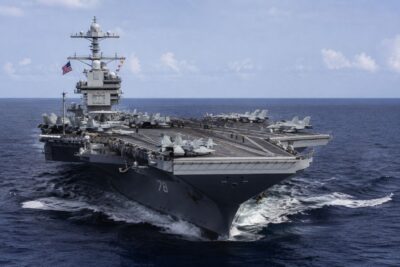
The US military buildup suggests preparation for both deterrence and escalation. Washington is dispatching roughly 9,000 additional sailors and Marines, including another carrier strike group and an amphibious force. If existing deployments remain in place, three US carriers could operate in or near the region by late October.
This concentration gives President Donald Trump a wider range of options: maritime escort, air and missile defence, suppression of Iranian coastal systems, strikes against missile launchers and command nodes, personnel recovery and possible evacuation operations. It also sends Tehran a message that the United States could shift rapidly from blockade enforcement and limited retaliation to a broader campaign.
Electoral timing nevertheless encourages caution. A major operation before 3 November could produce US casualties, another energy-price shock and an open-ended commitment immediately before voters go to the polls. Iran may calculate that Washington’s political threshold for escalation is temporarily higher and use calibrated pressure to improve its negotiating position.
But this restraint has limits. The death of US personnel, severe damage to a carrier or destroyer, the sinking of a protected tanker or a major strike on Gulf energy infrastructure would make non-response politically and militarily difficult. More deployed forces also mean more valuable targets and more opportunities for accidental or unauthorised encounters.
Bab el-Mandeb: the war widens
The more dynamic battlefield is now western Yemen. After Ansar Allah (Houthis) forces advanced down the Red Sea coast in September, Saudi-backed Yemeni government forces launched a major counter-offensive around Dhubab, Mokha and the approaches to Bab el-Mandeb. Saudi air power has provided extensive cover, while government forces claim to have recovered key coastal positions.
These claims require caution. Reuters verified that fighting was taking place and that government-aligned forces had advanced but could not independently establish the full extent or durability of their territorial gains. The Houthis have disputed the government’s account, and reports on 7 October indicated continued fighting around Dhubab and conflicting claims of control.
The coastal offensive exploits a genuine Houthi vulnerability. On open ground, Saudi air superiority and government armour can impose heavy costs. But possession of the shoreline does not eliminate the maritime threat. Houthi missiles and drones can be launched from inland and elevated terrain, while fighting around Taiz threatens roads connecting the coast with Aden and other government-held areas.
The Houthi response has been to widen pressure against Saudi strategic depth. Ansar Allah group has claimed missile and drone attacks against airports, military facilities and energy infrastructure, including sites around Riyadh, Abha, Khamis Mushait, Rabigh, Najran and Jizan. Saudi authorities confirmed casualties at airports on 7 October, although not every Houthi claim has been independently verified.
Bab el-Mandeb is particularly important because Saudi Arabia has used its East–West pipeline and Red Sea terminals to reduce dependence on Hormuz. If both chokepoints become simultaneously hazardous, the value of this strategic redundancy declines. Saudi Arabia is therefore fighting not merely for Yemeni territory but for the credibility of its principal maritime alternative.
Israel and the Gulf
The Gulf monarchies find themselves in a precarious position, balancing their reliance on US protection with the risk of dependence on US protection and exposure to Iranian retaliation. Qatar is the clearest example: it is Washington’s indispensable mediator, host to major US forces and the Gulf’s dominant LNG exporter. Doha must maintain its connection to Tehran while safeguarding its territory and infrastructure from exploitation without repercussions.
Saudi Arabia has moved further toward open belligerency through its Yemen campaign. The kingdom’s immediate objective is unlikely to be the rapid conquest of Houthi-held northern Yemen. More plausibly, Riyadh seeks to push Houthi launch systems away from Bab el-Mandeb, protect Red Sea ports and pipelines, and re-establish deterrence against attacks on Saudi cities and infrastructure.
Israel remains a potential accelerator. Because Tehran links a settlement to hostilities in Lebanon, renewed large-scale Israeli operations against Hezbollah could obstruct even a limited US–Iran arrangement. Israel is unlikely to initiate another major campaign inside Iran before the US elections without a direct provocation or time-sensitive intelligence. It will, however, preserve the option to strike if Iran attacks Israeli territory or appears to exploit negotiations to rebuild strategic capabilities.
The Road to 3rd November
Three outcomes define the period ahead. The most likely, at roughly 50%, is armed bargaining: diplomacy continues, Hormuz remains selectively restricted, the United States protects priority shipping and retaliates proportionately, while fighting persists around Bab el-Mandeb. A pre-election escalation—triggered by a mass-casualty or high-value maritime attack—carries an estimated 25% probability. A limited interim understanding covering shipping or a temporary cessation of attacks accounts for the remaining 25%.
The decisive variable is not whether either side prefers total war; neither currently appears to do so. It is whether increasingly dispersed forces can remain below each other’s red lines while political leaders use military pressure to improve negotiating terms. Qatar’s channel reduces the risk of misinterpretation, but it cannot neutralise the danger created by missiles in flight, ships under attack and rival forces operating at close range.
Until Election Day, Washington is likely to accumulate military options without immediately employing them at maximum scale. Iran will probably seek to demonstrate that it can still disrupt Hormuz while avoiding an incident that gives the United States an uncontestable justification for a larger campaign. In Yemen, however, escalation is already under way. The danger is that the struggle for Bab el-Mandeb produces precisely the kind of high-casualty event that collapses restraint in Hormuz—and transforms two connected maritime crises into a single regional war.
Dr Hichem Karoui
Related posts
Can Britain Bring Iran Back to the Table?
Yemen’s Forgotten Human Rights Crisis: Geopolitical Rivalries, Maritime Security and the Cost of War
The Democratic ‘Tsunami’: What It Means for Trump’s War on Iran?
What the Democratic Sweep in the US Midterm Elections Means for Trump’s Iran Policy and Gulf Security
Breaking the Taboo: The Strategic Folly of a US Nuclear Strike on Iran
Blurred Lines: Federalism and Provincial Autonomy in Pakistan
Paper Shields: The Makkah Pact and the Hard Test of Collective Defence
Iran’s Axis of Resistance Now: Less Than an Axis, More Than Resistance?
Leading through Uncertainty: Building Resilient Interdependence in a Multipolar World
Why Does the Game of Chicken Between Iran and the United States Keep Going?

Trojan APCs: Ukraine’s Kamikaze BTR-60s in Operation Vivaldi
The Emissions We Do Not Count: Militaries and the Missing Climate Ledger
London Dialogue — Founding Statement
Publication Categories
- Analysis (117)
- Book Review (1)
- Commentary (8)
- Essay (17)
- Journal (0)
- Journal Article (0)
- Policy Brief (7)
- Policy Paper (1)
- Research Article (3)
- Research Report (6)
- Young Writers Corner (0)